

This case seems like it would pair well with J.N.A. Realty, which seems to still be a casebook staple. I’ve always paired J.N.A. Realty with Oppenheimer v. Oppenheim, but every year I have to exert some mental effort to remember which party is Oppenheimer and which is Oppenheim. But this new case might not be much better: one party is Ashland; the other is SuperAsh.
After it renewed for five years, Ashland’s second renewal was due on September 3, 2020. It neglected to provide written notice of its intention to renew until November 20, 2020, but SuperAsh nonetheless accepted the renewal. The September 2021 renewal was timely signed but for some reason was never sent to SuperAsh, and in November, SuperAsh provided notice that the leases would terminate the at the end of the year. The parties negotiated tolling agreements that extended the leases until April 15, 2022 but negotiations for new lease terms failed. Ashland filed for declaratory relief that it effectively exercised its renewal option. SuperAsh counterclaimed for breach.
The trial court, like the court in J.N.A. Realty, ruled in favor of the lessee, finding that its inadvertent negligence could be excused in equity, especially as terminating the lease would result in a forfeiture. An intermediate appellate court affirmed. It did so in reliance on its own precedent, which was in tension with that of another Ohio intermediate appellate court. The Ohio Supreme Court agreed to resolve the tension accepting SuperAsh’s appeal on the following proposition: “A court may not equitably renew a written lease in contradiction to the express, unambiguous renewal conditions of the lease.”
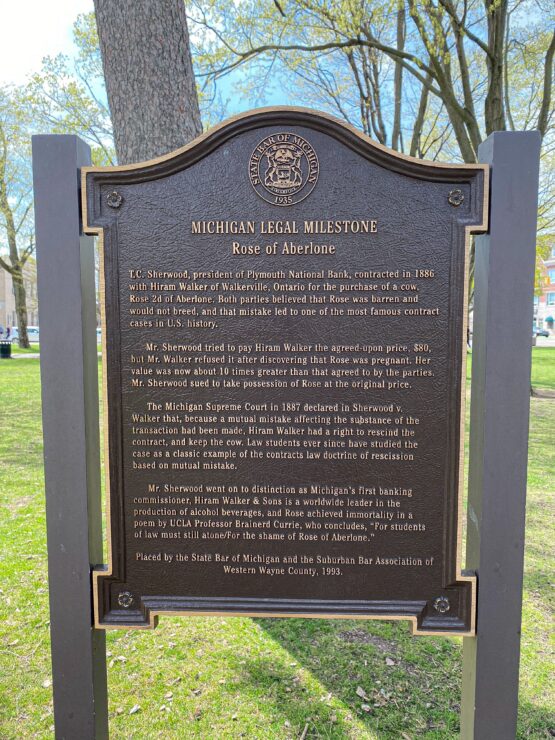
In Ashland Global Holdings, Inc. v. SuperAsh Remainderman Ltd. Partnership, the Ohio Supreme Court first held that equity may not excuse failure to timely exercise an option unless that tardiness is caused by mistake, or misconduct by the counterparty. The negligent party may not seek relief in equity. In the Court’s rendering, the lower courts mistook the term of art “mistake” for its broader, ordinary meaning. In order for contracts doctrine of mistake to apply, there must be a mistake relating to a fact that is a basic assumption between the parties as to the subject matter of the contract, such as occurred in Sherwood v. Walker, commemorated in the image above. A mistake that is simply the product of the mistaken party’s negligence is a different matter altogether. So far, so good.
Unlike the New York court in J.N.A. Realty, the Ohio Supreme Court does not recognize an equitable exception to the strict enforcement of express conditions, even in case of forfeiture. “This court has historically refrained from using equity in such circumstances even when one party would suffer a hardship.” This overstates matters a bit. Equity still has a role, as the Court acknowledges elsewhere in the opinion, if the case involves mistake or misconduct by the counterparty. Still, Ohio law clearly constrains equity’s intrusions on the law more energetically than does New York.
A few random thoughts. At most, Ashland had a right to renew its lease through December 2021. Because of the tolling agreements, it effectively retained the lease until April of that year. The case was finally resolved in 2025. Seems like a long battle over leases that only had less than eight months to run in any case. Perhaps the case is really about the $10 million in improvements that Ashland (really Speedway) wanted to recover, and the tolling agreements might have prohibited it from doing so. If so, that gave SuperAsh a lot of bargaining power as the parties tried to negotiate new leases.

In addition to teaching J.N.A. Realty, I also teach Market Street Associates. In that case, Judge Posner (above) remanded for the trial court to determine whether Market Street Associates had breached the duty of good faith and fair dealing by not reminding the lessor of the consequences of the lessor’s refusal to provide funding for improvements to the property. That refusal triggered a buy-back provision on terms that favored Market Street Associates. The Court in J.N.A. Realty, noted that the lessor in that case provided notice of many things to its tenant, but it never reminded the tenant of the approaching deadline to extend the lease. That fact seemed like it could provide an alternative ground for avoiding the forfeiture. Here too, I wonder if a court might consider whether the lessor, which had excused late notice in the past and was well aware of the impending deadline, had an obligation, consistent with the duty of good faith and fair dealing, to remind Ashland of the need to provide written notice.
The Court reversed the judgment granting equitable relief. There was also an equitable estoppel ruling that the intermediate appellate court never reached and now will need to address on remand. That might be a context in which arguments similar to the ones I have raised about the duty of good faith and fair dealing could be considered. Based on this ruling, it seems like Ohio law has a rather formalist bent, and if I had to guess, I would think it unlikely that the court would follow Judge Posner’s reasoning, even though it sounds not in equity but in the sound principle that transactions costs would rise if contractual partners were allowed take advantage of their counterparties through sharp practices.