

On August 20, 2026, the U.S. Small Business Administration (“SBA”) issued a proposed rule that would reset small-business size standards across the economy and a companion white paper proposing a new methodology for calculating them. The proposed rule—Small Business Size Standards, 91 Fed. Reg. 53,741—would establish new size standards for 338 industry groups and industries. The accompanying white paper—Revised Size Standards Methodology, 91 Fed. Reg. 54,096—supplies the analytical framework SBA used to derive the standards in the proposed rule. Notably, SBA calculated the proposed standards using a methodology that is itself out for notice-and-comment, with both comment periods closing the same day, September 21, 2026.
For government contractors, the practical significance may be considerable. SBA estimates that the proposal would produce a net increase of approximately 114,541 firms newly eligible for small-business status, while fewer than 200 firms would lose eligibility. In short, the proposal would open the small-business contracting universe to tens of thousands of additional firms—roughly 37,002 of which already hold Fiscal Year (“FY”) 2025 federal contracts—while removing almost none.
Link to Background on the Methodology Change Background on the Methodology Change
Under its earlier, 2024 methodology, SBA set each industry’s standard by scoring seven separate factors—various measures of firm size, assets, market concentration, and, for heavily contracted industries, two federal-contracting-disparity ratios—then averaging them within minimum and maximum caps. SBA now argues that the prior approach distorted outcomes, pointing, for example, to farm size standards that failed to reflect the national scope of agricultural markets.
The 2026 proposal would replace the 2024 methodology with what SBA considers a simplified, market-based model. It measures an industry’s “average market size” using three inputs—national industry size, the number of distinct geographic markets, and a net-import adjustment—and converts that figure into a single standard. The proposal would also default many receipts-based industries to employee-based size standards (on the theory that employment is less volatile year to year). The proposal also consolidates standards. The current table of 978 six-digit NAICS standards would collapse into 338. SBA indicates this will reduce confusion over which of several similar codes applies to a given firm.
Link to Operative Changes: Current and Proposed Standards Operative Changes: Current and Proposed Standards
While the proposal would affect hundreds of industries, the changes in the following sectors are especially noteworthy based on the magnitude of the proposed increases, the amount of federal procurement spending, and the extent to which those industries align with observed federal procurement priorities.
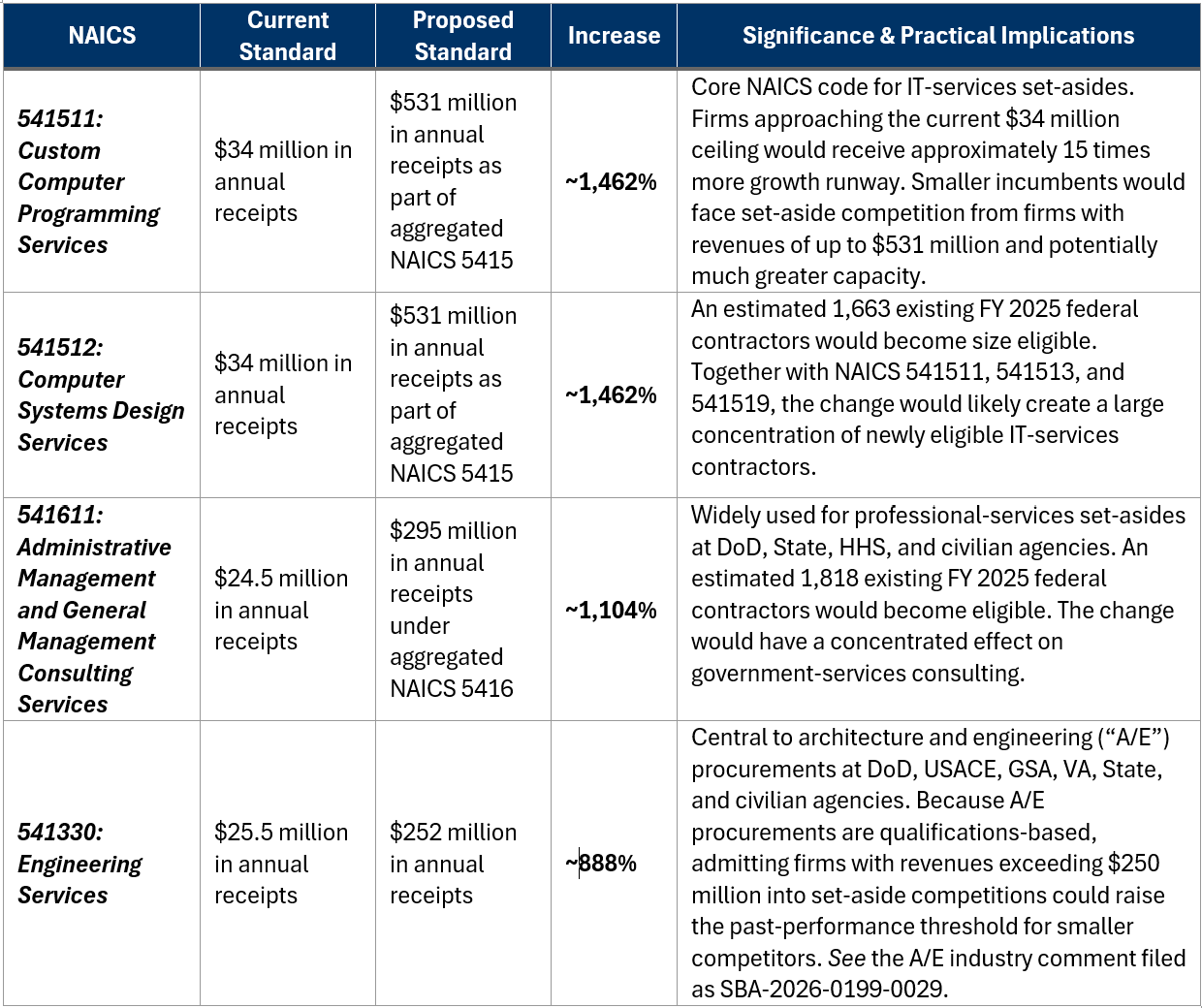
Beyond the individual code changes, two structural features of the proposal warrant particular attention. First, the proposal would eliminate the maximum size-standard cap. Under the current framework, size standards generally cannot exceed $47 million in receipts and 1,500 employees. Under the proposed methodology, SBA would retain a minimum standard but remove any explicit maximum. Because average market size can grow without a ceiling, several employee-based manufacturing and extractive industries would exceed the historical 1,500-employee cap. For example, the size standard for Ship Building and Repairing (NAICS 336611) would increase from 1,300 to 2,300 employees, and Drilling Oil and Gas Wells (NAICS 213111) would increase from 1,000 to 2,650 employees.
Second, SBA’s proposed methodology generated lower standards in 45 industries, yet the agency proposes not to reduce any of them. Instead, SBA would retain the existing standard or, where the measure of size would change, effectively maintain or increase the existing standard. SBA explains that reductions would cost experienced and capable firms their small-business status and their eligibility for federal assistance and contracting programs. SBA cites the difficult business conditions of 2021 through 2024, including high inflation and increased regulatory burdens, in concluding that reductions would stifle ongoing economic growth. The result is that no firm in these industries would be forced out of small-business status, even where SBA’s analysis indicates the market could be served by smaller entities. For instance, Gypsum Product Manufacturing (NAICS 32742) would retain a 1,500-employee standard even though SBA’s proposed methodology would produce a 700-employee standard.
Link to Other Takeaways for Government Contractors Other Takeaways for Government Contractors
The proposal, if adopted, would reshape the competitive landscape for small-business contracting, presenting both opportunities and challenges for federal contractors. With respect to set-aside procurements, a larger pool of firms would qualify as small, not only expanding the field of eligible competitors but also exposing smaller incumbents to competition from substantially larger newly eligible firms.[1] Prime contractors subject to small-business subcontracting requirements would likewise have a broader universe of qualifying small-business subcontractors from which to choose.
The shift toward employee-based standards could also influence strategic growth planning. Because those standards are not tied to revenue, firms may pursue technology and productivity investments that increase output and operational capacity without proportionate headcount growth, extending their eligibility and pushing out the “benefit cliff” that has historically discouraged growth near a threshold.
The proposal carries significant implications for M&A activity as well. Higher thresholds increase the viability of small-to-small combinations by reducing the risk that affiliation immediately eliminates the combined entity’s small-business status. In valuation terms, savvy buyers have historically discounted small-business set-aside revenue in valuation exercise because the SBA’s affiliation rules may disqualify an acquired company from set-asides as a result of the transaction. In particular, the increased thresholds and the focus on headcount-based standards may facilitate greater private equity investment in qualified small businesses, as private equity firms themselves tend to have modest headcounts.
Link to What Comes Next What Comes Next
Both comment periods close September 21, 2026. As of the date of this post, the docket for the proposed rule reflected 231 comments and the methodology docket reflected 27, including filings from individuals and small firms and at least one detailed submission from an existing contractor. Those figures are likely to grow significantly before the deadline. Given the breadth of the proposed changes and the unusual posture of size standards derived from a methodology that is still under review, contractors and investors should evaluate how the revised thresholds would affect their eligibility, competitive positioning, and transaction planning—and consider submitting comments before the deadline. We will continue to monitor developments as the rulemaking proceeds.
[1] Notably, the expansion would not reach every program uniformly. SBIR and STTR programs retain a separate 500-employee eligibility cap (13 C.F.R. § 121.702) that this rulemaking would not change. A firm could qualify as small under the new standards yet still exceed the ceiling for SBIR/STTR, rendering those programs comparatively less generous than they have been relative to other small-business opportunities.