

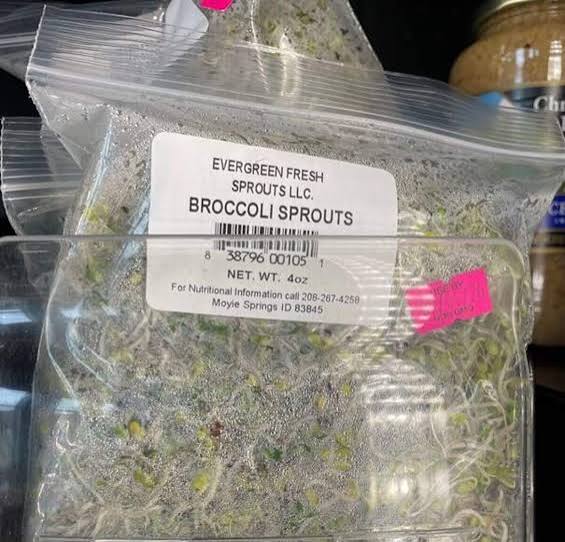
On September 2 the Washington State Department of Health posted an outbreak notice linking thirteen Salmonella Bovismorbificans illnesses in seven Washington counties to broccoli sprouts produced by Evergreen Fresh Sprouts, LLC of Moyie Springs, Idaho. Two more people are sick in Montana and one in Idaho, sixteen in all. Illnesses began between July 7 and August 18. Two Washington patients have been hospitalized, no one has died, and no recall has been issued.
The company name should be familiar. Evergreen Fresh Sprouts was the grower behind a 2011 SalmonellaEnteritidis outbreak that sickened 25 people in five states and a 2014 E. coli O121 outbreak that sickened 19 in six. Over three outbreaks and fifteen years, sixty people have been made sick, and the company has recalled product once, in 2011, after first refusing to and after FDA took the unusual step of warning the public directly.
Sixteen sick in three states, and Montana expects its count to grow
Washington interviewed twelve of its thirteen patients. Eight reported eating sprouts from Evergreen Fresh Sprouts; seven ate broccoli sprouts, and the eighth could not say which variety. The sprouts were sold in clamshells and plastic bags at grocery stores and food co-ops and served in restaurants. Samples from Evergreen and from other suppliers are being tested at the Washington State Public Health Laboratory. The state says this outbreak appears unrelated to the multistate Everything Sprouts alfalfa sprout outbreak I have been writing about since August.
Montana’s health department said on September 3 that its two patients bought the sprouts at Montana grocery stores, that local sanitarians are contacting the stores known to have sold them, and that it expects its case count to rise once additional laboratory testing is complete. Idaho, where the company is based, had not posted a notice of its own as of Thursday evening; its single case appears only in the Washington and Montana counts. In Whatcom County, which has three of Washington’s cases, health officials told the Cascadia Daily News they do not have a confirmed list of every place the sprouts were sold or served.
Washington cases by county of residence, as of September 2, 2026 (4 + 3 + 2 + 1 + 1 + 1 + 1 = 13). Source: Washington DOH.
| County | Cases |
| King | 4 |
| Whatcom | 3 |
| Spokane | 2 |
| Skagit | 1 |
| Snohomish | 1 |
| Walla Walla | 1 |
| Yakima | 1 |
| Total | 13 |
2011: Salmonella Enteritidis, twenty-five sick, a refusal, an FDA warning, and then a recall
Between April 12 and July 5, 2011, 25 people in five states were infected with the outbreak strain of SalmonellaEnteritidis: ten in Montana, ten in Washington, three in Idaho, and one each in New Jersey and North Dakota. CDC linked the illnesses to alfalfa sprouts and spicy sprouts sold under the Evergreen Produce label.
On June 27, 2011, FDA warned consumers directly not to eat the sprouts, a step the agency generally takes only when a company will not recall. The company’s co-owner told the Associated Press it had stopped producing the sprouts but would not pull them from shelves, and told The Produce News she had refused FDA’s request because a recall would be “admitting guilt.” On July 1 the company recalled alfalfa and spicy sprouts with expiration dates from June 22 through July 14, distributed in Washington and Idaho to four distributors and three retail stores. That same morning I asked whether FDA would use the mandatory recall authority Congress had given it six months earlier. It did not have to; the company relented.
On October 19, 2011, FDA sent the company a warning letter. Product and environmental samples had not turned up Salmonella, but inspectors documented pipes dripping onto uncovered sprouts and employees who did not put on clean gloves or aprons before handling them, and the agency concluded the sprouts were adulterated under federal law.
2014: E. coli O121, nineteen sick in six states, no recall, and the seed lot stayed in use into July
CDC’s final update on August 1, 2014, counted 19 people infected with Shiga toxin-producing E. coli O121 in six states: eleven in Washington, three in Idaho, two in Montana, and one each in California, Michigan and Utah. Illnesses began between May 1 and May 20. Seven of the sixteen with information, 44 percent, were hospitalized; no one developed hemolytic uremic syndrome and no one died. Thirteen of sixteen people interviewed had eaten raw clover sprouts, against a background rate of no more than eight percent, most of them in sandwiches at Jimmy John’s, Pita Pit and Daanen’s Deli locations in Washington and Idaho. FDA’s traceback found that Evergreen had supplied sprouts to seven restaurants where nine of the sick people ate.
FDA inspected the Moyie Springs facility on May 22 and 23, May 27 through 30, and June 6, 2014. The Form 483 is posted in FDA’s electronic reading room. Investigators observed condensate and irrigation water dripping from rusty valves, a corroded watering system in the mung bean room, tennis rackets with scratches, chips and frayed plastic being used to scoop sprouts, a corroded pitchfork used to move them, and a squeegee of corroded metal and untreated wood used to agitate sprouts in a soak vat.
There was no recall. CDC’s page carries the line “Recall: No.” CDC’s June 27 update reported that the company had continued to produce and distribute clover sprouts from the same seed lot linked to the outbreak, and that sprouts from that lot might still be in the marketplace. The outbreak had been announced May 22. FDA and CDC met with the owner on June 26 to encourage the company to stop using the lot; the owner agreed, and FDA confirmed on July 1 that the lot was gone and a new one had arrived. Marler Clark filed four lawsuits on behalf of people sickened in that outbreak, and I wrote about the company’s history at the time.
Three outbreaks, sixty sick, one recall
Outbreaks linked to Evergreen Fresh Sprouts, LLC, 2011 to 2026 (25 + 19 + 16 = 60). Sources: CDC final updates for 2011 and 2014; Washington DOH and Montana DPHHS for 2026. The 2026 row will change.
| Year | Pathogen | Product | Sick / states | Recall | FDA action |
| 2011 | SalmonellaEnteritidis | Alfalfa and spicy sprouts | 25 in 5 | July 1, after refusing | Consumer warning June 27; warning letter Oct. 19 |
| 2014 | E. coli O121 | Raw clover sprouts | 19 in 6 | None; seed lot dropped July 1 | Form 483, June 6 |
| 2026 | SalmonellaBovismorbificans | Broccoli sprouts | 16 in 3 | None as of Sept. 3 | None posted |
Two things show in that table. The first is that in 2011 and 2014 epidemiology and traceback identified the grower while product samples came back negative for the outbreak strain. That is the normal shape of a sprout outbreak: the contaminated lot is eaten before anyone tests it, and contamination clusters in a batch rather than spreading evenly through it. Washington’s samples are pending now. Nobody should wait for them.
The second is what a recall is for. A recall produces lot codes, a distribution list, notification down the chain to every distributor, restaurant and grocer, and an entry in FDA’s enforcement reports. Without one, Washington has no confirmed list of where these sprouts went, Montana’s sanitarians are calling stores one at a time, and the only identifier a consumer has is the company name on the bag. FDA has been able to order a recall since January 2011, six months before the first Evergreen outbreak. I asked whether it would use that power on this company fifteen years ago, and I asked the same question about Everything Sprouts three weeks ago. Same commodity, same company, same question.
What to do if you bought or ate these sprouts
- Do not eat broccoli sprouts from Evergreen Fresh Sprouts. Throw them away or return them to the store, and wash anything they touched with hot soapy water or in a dishwasher.
- See a doctor for diarrhea with a fever above 102°F, diarrhea lasting more than three days, bloody diarrhea, vomiting that keeps you from holding down liquids, or signs of dehydration.
- If you were sick, report it. Washington uses an online Foodborne Illness Notification form; Whatcom County Health and Community Services is at 360-778-6000. Montana and Idaho residents should call their local health department.
- Keep the package or receipt, or a photo of either, and ask the lab or health department to preserve your isolate. Whole genome sequencing is what ties an illness to this outbreak, and isolates are routinely discarded.
Sixteen is the number today. Montana has already said it will not be the number next week.