

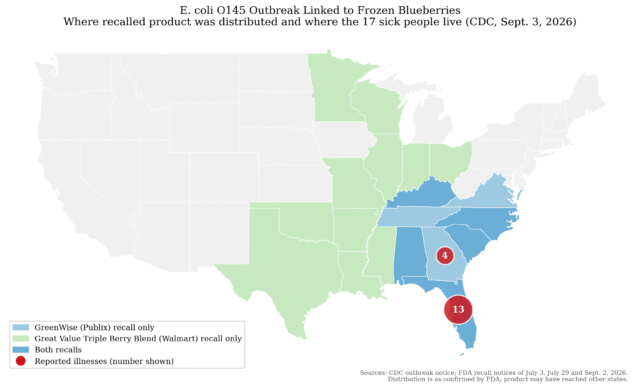
Quick answer: As of September 3, 2026, CDC counts 17 people infected with E. coli O145 after eating frozen organic blueberries from Frutas y Hortalizas del Sur S.A. of San Carlos, Chile. Thirteen live in Florida and four in Georgia; six have been hospitalized and none have died. Recalled products are GreenWise frozen blueberries and whole mixed berries sold at Publix in eight states and one lot of Great Value Organic Triple Berry Blend sold at Walmart in 16 states. FDA has placed the supplier on import alert. If any of these berries are in your freezer, throw them out or return them.
The CDC update adds five illnesses and two hospitalizations since the last count. Illnesses began between May 11 and August 2, 2026. Epidemiologic and traceback data point to frozen organic blueberries from a single Chilean supplier. What the update does not say is where the contamination came from, how many of the six hospitalized patients developed hemolytic uremic syndrome, or whether more retailers received the same berries.
Which frozen berries are recalled for E. coli
| Recall date | Product | Lot / date codes | Where sold |
| July 3, 2026 | GreenWise Organic IQF Blueberries, 10 oz (Frutas y Hortalizas del Sur S.A.) | Lot 60401 (printed 6 040 01); Best By Feb. 9, 2028 | Publix stores in AL, FL, GA, KY, NC, SC, TN, VA |
| July 29, 2026 | GreenWise Organic Whole Blueberries, 10 oz (UPC 41415-06453) and 48 oz (UPC 41415-12053); GreenWise Organic Whole Mixed Berries, 10 oz (UPC 41415-06753) and 48 oz (UPC 41415-12153) (Publix) | All lots | Publix stores in the same eight states |
| Sept. 2, 2026 | Great Value Organic Triple Berry Blend, 10 oz, strawberries, blackberries and blueberries (UPC 7874211226) (Frutas y Hortalizas del Sur S.A.) | Lot 6040 01-6 (front of package); Best If Used By Feb. 9, 2028 | Select Walmart stores in AL, AR, FL, IL, IN, KY, LA, MN, MS, MO, NC, OH, OK, SC, TX, WI |
The September 2 expansion says no illnesses are tied to the Great Value product and the action is precautionary, based on traceback from the July recall. Both Frutas y Hortalizas lots carry a Best By date of February 9, 2028, and the Great Value lot code, 6040 01-6, shares its stem with the original GreenWise lot, 60401. Neither the company nor FDA has explained the relationship, but the codes suggest a common production run.
How the frozen blueberry E. coli investigation unfolded
FDA’s outbreak advisory, updated today, lays out the timeline. On July 1 the Florida Department of Health told CDC it was investigating a cluster of E. coli O145 illnesses; interviews pointed to frozen GreenWise organic blueberries sold at Publix, and Publix pulled the product in an internal stop sale at the end of June. On July 3 Frutas y Hortalizas del Sur recalled the 10-ounce GreenWise blueberries, lot 60401. FDA then counted 12 sick and 4 hospitalized, with onsets from May 11 to June 5; seven of nine people interviewed reported frozen blueberries, and five named GreenWise from Publix.
The July 30 update deserves more attention than it got. FDA conducted a remote regulatory assessment of the Chilean firm and collected records on its hazard controls. Based on what it found, FDA said it had concerns about at least one other lot of blueberries used in additional GreenWise products, which is why Publix recalled every lot of GreenWise Organic Whole Blueberries and Whole Mixed Berries, in 10-ounce and 48-ounce sizes, on July 29. FDA also said it had concerns about other products from the firm that had not yet entered the United States, and added the company’s frozen blueberries to Import Alert 99-35, meaning shipments may be detained at the border without physical examination until the firm shows the conditions have been corrected. On September 2 the supplier added the Walmart lot, and on September 3 CDC moved the count to 17 and 6.
What the epidemiology shows
Of the 13 sick people interviewed, 11, or 85 percent, reported eating frozen blueberries, against the 24 percent of respondents in CDC’s FoodNet Population Survey who report eating frozen berries in a given week. The patients range in age from 2 to 88, with a median of 47; 59 percent are male. Both states with cases are Publix states.
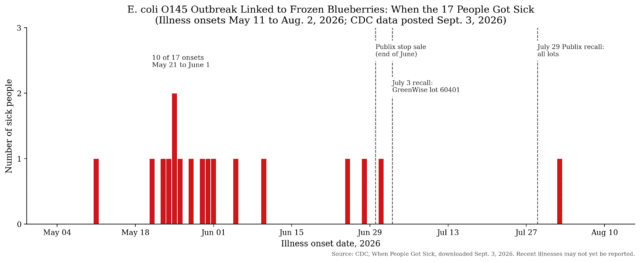
The onset curve tells its own story. Ten of the 17 got sick in a twelve-day window between May 21 and June 1. After that the onsets scatter: June 5, June 10, June 25, June 28, July 1. Then a single onset on August 2, a full month after the first recall and four days after Publix recalled every lot. That last case is why the freezer language matters. One discrepancy to flag: CDC’s timeline data end on August 2, while FDA’s case count box lists the last onset as August 6. One of the two is wrong, and the agencies should reconcile it. CDC also gives its standard caveats: many people are never tested, it takes three to four weeks to link a new illness to an outbreak, and the true count is likely much higher than 17.
What we still do not know
The source of the contamination. FDA’s remote assessment produced enough concern to trigger an all-lots recall and an import alert, but nothing public says what the inspectors found. E. coli O145 is a Shiga toxin-producing E. coli whose reservoir, like O157’s, is cattle and other ruminants. Frozen berries have a long history as vehicles for hepatitis A and norovirus, which travel with infected workers; a STEC outbreak on frozen blueberries is unusual, and freezing does not kill STEC. Whether this was irrigation water, animal intrusion in the field, harvest handling, or something in the packing plant is the question that decides whether it happens again. The 2010 romaine lettuce outbreak, traced back to a single farm in Arizona, was also O145.
The HUS count. CDC does not report hemolytic uremic syndrome cases in this outbreak. Six of 17 hospitalized is a 35 percent hospitalization rate, and the youngest patient is 2. Whether any of these people developed HUS, and how many are children, are numbers the public should have.
Whether the outbreak strain was found in product. Nothing in the CDC or FDA postings reports a positive product sample. The link is epidemiologic and traceback, which is enough to act on, but a product isolate would settle where in the supply chain the contamination sits.
Whether other retailers received berries from this supplier. FDA said on July 6 that the blueberries may have gone to other retailers. The Walmart expansion, two months later, confirmed that at least one did. If the same Chilean lots went into other private-label blends, consumers should hear about it now.
What to do if you bought recalled frozen berries
Check your freezer for the products in the table above and throw them out or return them for a refund. If you froze berries outside the original bag and cannot tell what they are, throw them out. Wash containers and surfaces the berries touched with hot soapy water or run them through a dishwasher. Restaurants and retailers should not sell or serve the recalled products. Anyone who ate recalled berries and has diarrhea lasting more than three days, bloody diarrhea, a fever above 102 degrees, or signs of dehydration should see a health care provider and mention the exposure.
Frozen blueberry E. coli outbreak: questions and answers
What strain of E. coli is in the frozen blueberries? E. coli O145:H28, a non-O157 Shiga toxin-producing E. coli. Symptoms usually begin three to four days after exposure and include severe stomach cramps, diarrhea that is often bloody, and vomiting. Most people recover in five to seven days; some, especially young children and older adults, develop hemolytic uremic syndrome, a form of kidney failure that can require dialysis and can be fatal or cause lifelong kidney damage.
Does freezing kill E. coli in berries? No. Freezing stops bacteria from growing but does not kill them. Recalled frozen berries are unsafe for as long as they are in the freezer.
Are fresh blueberries part of the recall? No. Every recalled product is frozen, and every one traces to a single Chilean supplier. Fresh blueberries and frozen berries from other suppliers are not implicated.
Marler Clark has represented victims of E. coli outbreaks since the 1993 Jack in the Box outbreak, including outbreaks linked to leafy greens, sprouts, ground beef, raw milk and produce. If you or a family member became ill with an E. coli infection after eating frozen blueberries or mixed berries and would like to speak with an attorney, the firm can be reached at 1-800-884-9840 or through marlerclark.com.