

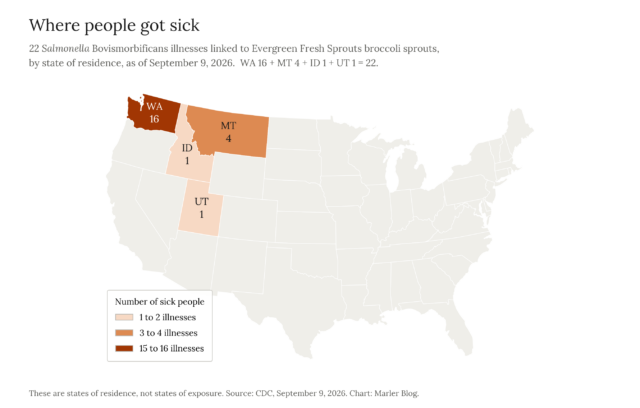
FDA and CDC both posted pages today on the broccoli sprout outbreak that Washington, Montana and Idaho have been working since the beginning of the month. FDA’s advisory and CDC’s investigation notice put the count at twenty-two people in four states — Idaho, Montana, Utah and Washington — with two hospitalizations and no deaths. Illnesses began between July 7 and August 26. Of the nineteen people interviewed, all nineteen reported eating sprouts and seventeen named broccoli sprouts specifically. The grower is Evergreen Fresh Sprouts, LLC of Moyie Springs, Idaho.
Six days ago, the public number was sixteen, in three states, with no recall. All three of those things have changed.
The count moved from sixteen to twenty-two, and the last onset moved eight days later.
On September 2 the Washington State Department of Health reported thirteen Washington cases with onsets from July 7 to August 18, plus two in Montana and one in Idaho. Montana’s health department said the next day that it expected its own count to climb once additional laboratory testing finished. It did. The national count is now twenty-two, Utah has appeared for the first time, and the last illness on file began August 26 rather than August 18.
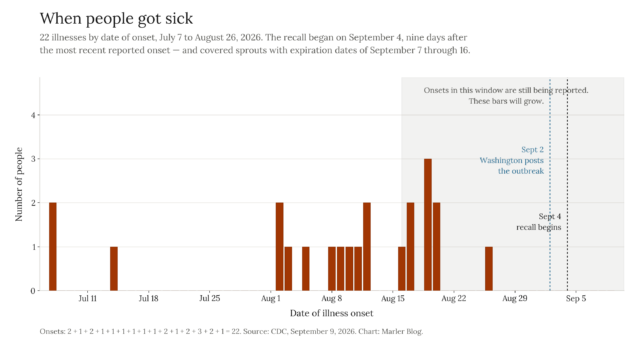
CDC gives the demographics: ages two to eighty-seven, median forty-eight, roughly even between men and women. A two-year-old is on that list. And the August 26 onset is a floor, not a ceiling — it takes three to four weeks to tie a new case to an outbreak, so the last two weeks of illnesses have not been counted yet. Seventeen of nineteen interview subjects naming broccoli sprouts is a very strong signal against a background of well under ten percent of the general population eating any sprouts at all in a given week.
A state lab, an unopened bag from a sick person’s kitchen, and a recall four days later.
Here is the sequence, and it is worth reading slowly. Washington posted on September 2. Montana posted on September 3. On September 4, Evergreen Fresh Sprouts began recalling broccoli sprouts — bags and clamshells with expiration dates of 9/7, 9/9, 9/11, 9/14 and 9/16 — on the strength of a positive Salmonellaresult from a sample collected and analyzed by Montana state officials. CDC says what that sample was: Montana investigators picked up an unopened package of broccoli sprouts from a sick person’s home, and whole genome sequencing showed it carried the same Salmonella Bovismorbificans strain that made everyone else sick. The federal pages went up on September 9.
The evidence that ended the argument was a bag somebody still had in the refrigerator, retrieved and sequenced by a state health department. Not a plant sample. Not a federal finding. Three state health departments and their laboratories built this case and they had it built before either federal agency had a page up. That is worth saying out loud, because the people who did it do not get to issue press releases about themselves.
In 2011 and 2014 the product samples never matched. That is what makes this one different.
This is Evergreen’s third outbreak since 2011. In 2011, twenty-five people in five states were infected with Salmonella Enteritidis from alfalfa and spicy sprouts sold under the Evergreen Produce label. FDA warned consumers directly on June 27 that year, a step the agency generally takes only when a company will not recall, and the co-owner told the trade press that recalling would amount to admitting guilt. The company recalled on July 1. In 2014, nineteen people in six states were infected with E. coli O121 traced to raw clover sprouts served at sandwich shops in Washington and Idaho. Twenty-five plus nineteen plus twenty-two is sixty-six people over fifteen years, from one grower.
In both of the earlier outbreaks, epidemiology and traceback identified the grower while the product samples came back negative for the outbreak strain. That is the ordinary shape of a sprout outbreak: the contaminated lot is eaten before anyone thinks to test it, and contamination clusters in a batch instead of spreading evenly through it. This time a sample matched, and the company recalled within days of the result without FDA having to warn the public over its head. Compared with 2011, that is a better response, and I will say so.
The recall reaches forward, not back.
Look at those five expiration dates again: 9/7, 9/9, 9/11, 9/14 and 9/16. Every one of them is this week or next. The illnesses in this outbreak began on July 7 and the most recent one on file began August 26. Raw sprouts have a shelf life measured in days. Every bag that made a person sick in this outbreak was eaten, or thrown out, weeks before this recall existed.
That is not a criticism of the recall. It is what a sprout recall is, and pulling the current run is the right call. It is a reason to be honest about what the recall can and cannot do. It clears the shelves going forward. It does nothing to explain why product coming out of this facility was contaminated in July, in August, and — on the evidence of a positive package with a September expiration date — in September. That explanation lives upstream: the seed lot, where it came from, how it was treated, and whether the spent irrigation water was tested during the runs that made people sick. None of it is public.
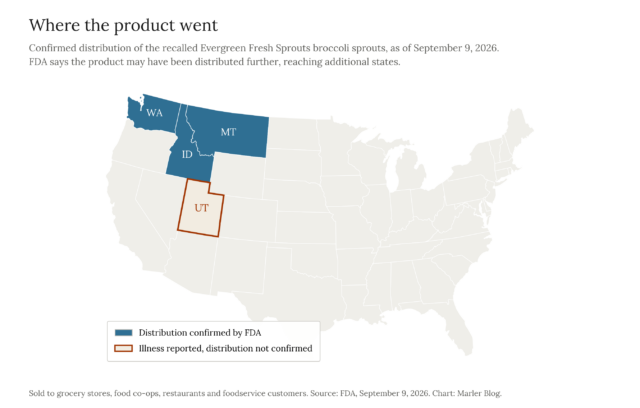
One more thing on the distribution. FDA has confirmed shipments to Idaho, Montana and Washington, and says product may have traveled further. Utah has a sick resident and is not on that list. States on a case map are states of residence, not states of exposure — a Utah patient may well have eaten sprouts on a trip — but it is a live question whether the distribution list is complete, and it is the sort of question a recall is supposed to answer.
The last federal inspection was in 2024, and nobody outside FDA can see what it found.
Phyllis Entis, who has been ahead of the agencies on this outbreak from the start, pulled Evergreen’s inspection record. FDA has inspected this company repeatedly since 2010. The inspection that followed the 2011 outbreak produced a formal warning letter. Most of the ones since, including the 2014 inspection carried out during that outbreak, were classified Voluntary Action Indicated, meaning the agency found things it wanted fixed but left the fixing to the firm. The most recent inspection was in 2024, also Voluntary Action Indicated, with no summary of the observations posted to FDA’s inspection database.
A company with two outbreaks behind it gets inspected, gets a classification that leaves correction to the company, and the public record stops there. FDA has the inspection report. The state epidemiologists who spent August chasing this strain did not have it in front of them, and neither did anyone buying a clamshell of sprouts at a co-op in Bellingham. That is a design problem in how inspection results are published, not a failure by the investigators who did the inspection.
What to do this week, and the three questions I would put to FDA.
If you have Evergreen Fresh Sprouts broccoli sprouts in the house, in a bag or a clamshell, throw them out or take them back, and wash whatever they touched with hot soapy water. Raw sprouts are grown in exactly the warm, wet conditions bacteria like, which is why they remain one of the few foods I tell people flatly to keep away from children under five, adults over sixty-five and anyone whose immune system is compromised. Cooking them is the only step that reliably works.
If you got sick, keep the package or a photograph of it and the receipt, and ask your laboratory or health department to preserve your isolate. Sequencing is what connects one person’s illness to an outbreak strain, and isolates are routinely discarded. We keep a running page on the Evergreen Fresh Sprouts broccoli sprouts Salmonella outbreak, and Food Safety News has been covering it as well.
The three questions: What seed lot produced these sprouts, and who supplied it? Did any of that seed go to another sprouter — which is exactly what traceback turned up last month in the alfalfa sprout outbreak that is still running, separately, in fifteen states? And what did the 2024 inspection find?
Two sprout outbreaks, two growers, one season, fifty-five sick in one and twenty-two in the other. The agencies are right that they are unrelated investigations. They are not unrelated problems.