Hey there Legal Rebels! 👋
I’m excited to share with you the 86th episode of the LawDroid Manifesto podcast, where I will be continuing to interview key legal innovators to learn how they do what they do. I think you’re going to enjoy this one!
If you want to understand the real difference between a chatbot and an AI agent, and where the risk actually lives when you hand your files over to one, you need to listen to this episode. Sateesh and I ran this as a live workshop at the third annual LawDroid AI Conference, walking through the architecture, the security tradeoffs, and the practical rules of thumb for building agentic workflows into your practice.
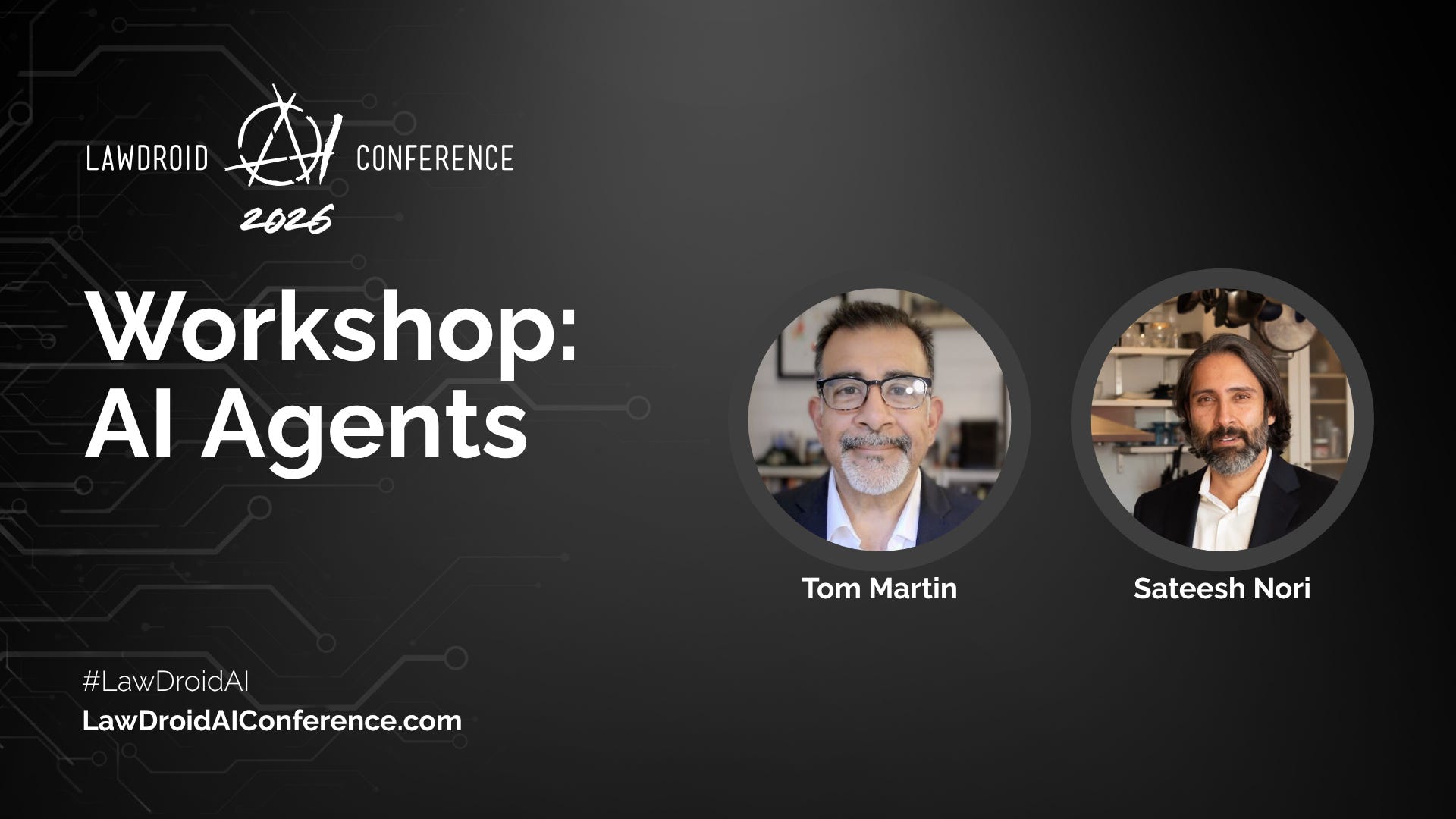
From Chatbots to Autonomous Agents: A Workshop on AI Agents in Law
Join me as I sit down with Sateesh Nori for a hands-on workshop recorded live at LawDroid’s third annual AI conference.
In this session, Sateesh and I break down the real difference between the AI chatbots most lawyers already use and the autonomous agents now emerging, agents that can read and write files on your own computer, follow a playbook built from your own expertise, and even spin up sub-agents to divide up a task.
We cover the security tradeoffs of giving an agent access to your local files, when a simple deterministic workflow beats a full agent, and the five golden rules for automating legal work responsibly.
We also demo Ally, a legal-specific AI assistant, and a small preview of what an AI “workforce” of named agents handling research, scheduling, and reporting might look like day to day. This episode is for any lawyer trying to figure out where agents actually fit into a real practice, not just the hype.
Key Takeaways
-
AI agents differ from chatbots in three key ways: they can read and write local files, retain memory across sessions, and act on an encoded “playbook” of a person’s skills and experience
-
Security matters more with agents than chatbots because they touch local files; use a paid plan to opt out of training, and keep a backup (like a synced Dropbox folder) of anything an agent can access
-
Not every task needs an agent; workflows offer more predictability and control, and Tom’s rule of thumb is to “choose the dumbest model that gets the job done”
-
A simple rubric helps decide agent versus workflow: is the problem ambiguous enough to justify it, does the task value justify the token cost, can critical risk be reduced, and is the cost of an error low and easily caught
-
Sub-agents let one orchestrating agent divide a dense document among multiple “workers,” which can improve both accuracy and cost by keeping each sub-agent’s context smaller
-
The METR time-horizon chart shows how long a model can stay coherent on a task; newer models can now operate coherently for many hours, a meaningful marker of agent capability
-
AI use has moved from “reductive” work, summarizing, condensing, cross-referencing, to more “enriching” and constructive work, building new documents and analysis from a base of skills and tools
-
Building a skill can start as simply as talking through a task with Claude, having it structure that knowledge, then refining it, creating a recursive feedback loop that mirrors how people learn by doing
-
Five golden rules for legal AI automation: describe the outcome rather than every step, batch similar documents together, manage sub-agent limits, cut losses quickly on unproductive paths, and always keep a human in the loop
-
Recording a walkthrough in a tool like Loom and having AI turn it into a standard operating procedure is a fast way to capture institutional knowledge into a skill
Notable Quotes
-
“My maxim is choose the dumbest model that gets the job done.” Tom Martin ([07:02 to 07:09])
-
“It does become a little unwieldy to have a human in the loop, which is kind of like putting us down for our intelligence if we get a million different documents coming in.” Sateesh Nori ([08:51 to 09:09])
-
“One analogy that I like is a custom agent or even a chat is reductive. It takes a lot of information and maybe brings it down, boils it down into bullet points, into a slide deck, into a haiku, into whatever you want. But it’s ultimately reductive. Whereas with skills you can actually build new things.” Sateesh Nori ([17:11 to 18:16])
-
“We want to help more people. We want to bridge the gap. We want the legal system to actually work. We want our democracy to be upheld. We want the rule of law to be followed.” Sateesh Nori ([33:05 to 33:15])
-
“It’s important to have that control, just as it is with anything.” Sateesh Nori ([42:09 to 42:17])
Clips
Choose the Dumbest Model That Works
When Agents Start Hiring Humans
Meet Casey — An AI Workforce
AI as Compound Advantage
Agents and chatbots are not the same, and treating them as interchangeable is where most of the risk and most of the wasted spend comes from. This workshop lays out a practical way to think about the choice: what an agent actually is under the hood, when a deterministic workflow beats one, how sub-agents can make document review both cheaper and more accurate, and the golden rules for keeping a human genuinely in control while still getting the efficiency gains. It closes with a sneak peek at Ally and an AI “workforce” already running in production for the show itself.
Closing Thoughts
We used to talk about AI as a reductive tool, something that condenses, summarizes, distills. What Sateesh and I got into here is the enriching side: agents that build on top of your own expertise rather than just compressing it. That’s a real unlock, but it comes with real responsibility too. The five golden rules we walked through aren’t abstract; they’re the difference between an agent that saves you hours and one that quietly deletes something you needed. If you’re experimenting with this in your own practice, start small, keep a human on the loop, and remember that the goal was never to build the fanciest agent. It’s to bridge the gap for the people the legal system was supposed to serve in the first place.
By the way, if you would like to meet other superlative legal innovators in person, and enjoy an exceptional awards gala celebration, don’t miss the Oscars of Legal Innovation: the American Legal Technology Awards, this October 25, 2026, in Boston. Reserve your Early Bird tickets today and save $100.