

Control capital for growth. Where venture ends and buyouts begin. By Louis Lehot, Partner, Foley & Lardner LLP. Growth to buyout, garage to global. Vol. I, №3 · Wednesday, September 30, 2026

Friends,
This week, we clarify the name of this newsletter for intentionality: the Growth Equity Docket. Same letter, same Wednesday. Now for the week…
On Tuesday the 10-year Treasury traded as high as 5.29 percent, a 19-year high, and the 30-year touched 5.61 percent, its highest since 2002. Oil fell more than 2 percent the same day. This week: why, what it does to a growth deal, where software trades, and the Buy, Sell or Wait takeaways. Next week: Joe Baratta’s exit from Blackstone, and the succession problem every fund, large or small, eventually has to solve.
Why Money Costs More
Every sponsor model turns on what the debt costs going in and what the company sells for coming out. Both hang off the 10-year Treasury, and four forces are pushing it up at once.
🔹 War. The Iran conflict has kept oil above $90 a barrel. In August energy prices were up 16 percent on the year and gasoline 27 percent, and headline inflation reached 3.4 percent.
🔹 AI building. Gartner puts this year’s data center spending at $1.37 trillion, and a lot of it is borrowed. SoftBank sold more than $11 billion of high-yield bonds this month to fund OpenAI. Those bonds compete with acquisition loans for the same buyers. Watch this space for news of a ticker tape parade of AI datacenter paper coming to a market near you…
🔹 Tariffs. The St. Louis Fed estimates tariffs added about half a point to inflation by the end of 2025.
🔹 Fewer workers. Net immigration slowed sharply in 2025 and may have turned negative. A tighter labor supply leaves less room to grow without prices moving.
Under all of it sits a federal deficit of about $2 trillion annually and roughly $1 trillion a year of interest. The Treasury has a lot of paper to sell, and buyers want more to take it.
Economists weigh these differently, and Tuesday is a useful data point: oil dropped and long rates still rose. Inflation without food and energy was 2.4 percent in August, so oil explains a good part of the headline number, and a ceasefire would help. It would not touch the deficit, the AI borrowing, the tariffs or the labor supply. Markets put the odds of another Fed increase on October 27 and 28 at about 70 percent. Underwrite to rates where they are. Treat a cut as upside, not a plan.
The Loan Desk
The price of money is up. The price of risk is not. High-yield bonds pay about 3 percentage points over Treasuries, still below the ten-year average. Credit is open. The base rate under it is what moved.
In a buyout, the short rate sets the coupon and the long rate sets the exit. Both are higher, so sponsors pay more to carry the debt, trim the exit multiple and bring that to the bid. Most growth equity deals carry no debt, so the entry is unaffected. The exit is not, because whoever buys the company in four years borrows at that day’s rates. Expect more of the price to show up as structure and less as headline valuation.
Software: Two Markets
Rob Bartlett’s team at Jefferies publishes the numbers we watch most closely. This month they show two software markets.
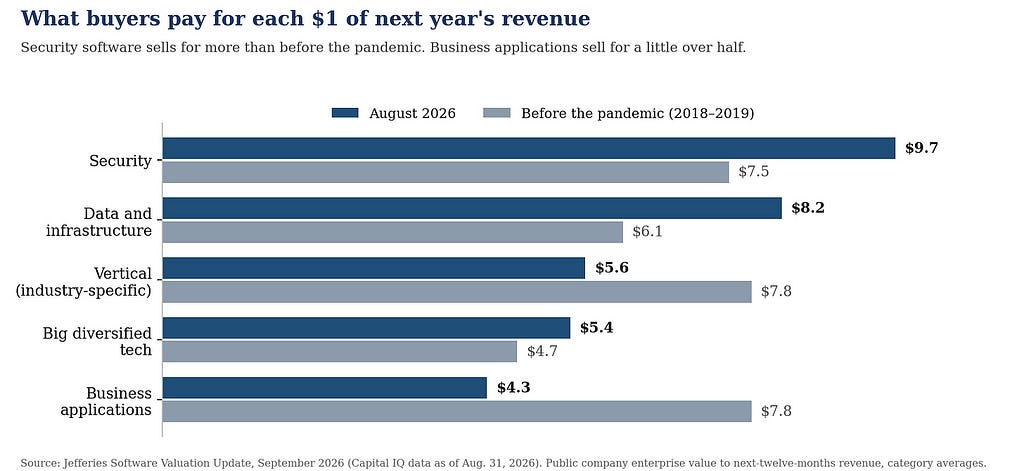
Security software trades at $9.70 per dollar of next year’s revenue, above its pre-pandemic level. Business applications, the per-seat products, trade at $4.30, a little over half of where they were. Over the past year security stocks rose 66 percent and business applications fell 21 percent.
Beating the quarter no longer moves the stock. Last quarter 87 percent of public software companies beat revenue estimates, and only 48 percent traded up afterward.
Rates are part of the story. With the 10-year near 5 percent, profit five years out is worth less today, so the market pays less for growth relative to cash. In November 2021 a point of revenue growth was worth about five points of cash margin. Today it is worth under two. Growth still wins, just by less, and in a private deal that gap is where earnouts, rollover and preferred terms get negotiated.
Buy, Sell or Wait: What the Panel Said
Thanks again to Jason Babcoke of Sumeru, Rob Bartlett of Jefferies, Harish Belur of Riverwood and Gargi Ray of Synopsys. The full write-up is on foley.com. What the room took home:
🔹 Twenty percent is the line. Above roughly 20 percent growth, software trades at about twice the multiple of slower peers, public or private. Miro, valued at $17.5 billion in 2022 on about $600 million of recurring revenue, just sold to Bending Spoons for about $1.36 billion.
🔹 AI is taking headcount before it takes software. Customers are running AI spend and payroll out of one budget: headcount flat, AI up. Installed software stays, but sales cycles run longer. One panelist called it 1995, not 1999.
🔹 Diligence has moved to the future. Buyers want the roadmap, the engineering bench, win-rate trends and a view on whether the product matters more as the models improve. Expect questions on who owns code written with AI tools and whether customer contracts permit training on customer data. Fixed a year out, those are housekeeping. Found mid-deal, they get priced.
🔹 You are in a process from the first investor meeting. A sale runs about a year, six months to get ready and six to run. Sponsors underwrite to their own return, typically three times the money in five years. Strategics buy to fill a product gap. Neither cares about the last round.
🔹 Growth still beats margin. The cost cutting of 2023 and 2024 was not rewarded the way boards hoped. A company that cannot fund four quarters of growth on its own is a financing candidate, not a sale candidate.
🔹 Keep the structure honest. Investors would rather pay a realistic price for plain common stock than dress up a stretch price with protections. Tie any earnout to one revenue line and one measuring period. AI and cyber exclusions in the deal insurance usually come back to the seller as special indemnities.
The room’s conclusion: waiting is a legitimate strategy. Drifting is not.
The Growth Tape
Technology. Cyera raised about $400 million at a valuation near $12 billion. Security still gets paid for growth.
Life sciences. Webster Equity Partners agreed Monday to take Lifecore Biomedical, a contract manufacturer of injectable drugs, private for up to $663.7 million. Holders get $6.28 a share in cash, a 50 percent premium, plus a right to up to about $3.39 more a share if 2028 through 2030 revenue and earnings targets are met, and the board has 30 days to shop for a better offer. Cash now, more later if the plan works, and a real market check. A correction to last week: the biotech IPO window is open for companies with clinical data, with 20 listings this year against eight in all of 2025, by BioSpace’s count.
In the Courts
🔹 Anderson v. Intel is argued at the Supreme Court on Tuesday, October 6. The question is what a 401(k) participant must show to challenge how plan fiduciaries chose investments. The answer shapes how fast private equity reaches retirement plans.
From My Desk
🔹 When the Call Comes: the first days after an unexpected approach, promised last week.
🔹 Private Equity’s $285 Billion Shock Year Still Has Real Openings, on Foley Ignite.
🔹 Where We Are on Software M&A.
On the Calendar
🗓 Ready for Anything: IPOs, SPACs and Capital Market Shifts, Tuesday, October 6, Foley San Francisco, with Open Future Forum. Register.
🗓 LP/GP Event with Jersey Finance, Monday, October 12, Foley San Francisco. Reply for a seat.
🗓 Investors on the Bay, a Fall Mixer, Friday, October 23, San Francisco. Register.
🗓 One Way Ventures Summit, Wednesday, October 28, San Francisco. Register.
🗓 General Counsel Executive Forum, Private Lunch, Friday, October 30, San Francisco. In-house counsel only. Request a seat.
🗓 IPO Readiness, Wednesday, November 18, San Francisco, with SVB, Protiviti and Heffernan. Reply for a seat.
🗓 2027 Outlook, Friday, December 11. Reply for a seat.
Thank you to Chris Yeh and everyone who came to Hard Things on Monday for a sharp conversation on blitzscaling in robotics and physical AI. Golden nuggent from Blitzscaling author Chris Yeh: look out for the robots (not the humanoids) that replace human tasks that are dirty, dull or dangerous (and not just vacuums and drones).
Closing Argument
🔹 Anyone borrowing in 2027: underwrite to today’s rates. A cut is upside.
🔹 Software founders thinking about a sale: 20 percent growth still roughly doubles the price. Start the cleanup a year before you need it.
🔹 Boards weighing an offer: part of the price may come later. Get the targets defined before you sign.
Rates set the backdrop. Preparation sets the price. The companies that are ready get to choose.
— Louis
#TheGrowthEquityDocket #AskASiliconValleyLawyer #FoleyIgnite #garage2global #growthequity #privateequity #buyouts #leveragedfinance #software #lifesciences #datacenters #techlaw
Standard disclosures: opinions my own, not my firm’s. Not legal advice. Attorney advertising. Prior results do not guarantee future performance. This newsletter is built the way I believe modern legal work should be done. I use AI for productivity and efficiency in research and drafting. The ideas are mine, the voice is mine, the edits are mine, I check the facts, and I own every word. Foley & Lardner LLP represents sponsors, lenders and companies, some of which may be active in the matters discussed. Software market data from Jefferies’ monthly software valuation update and quarterly software earnings materials, compiled from Capital IQ as of August 2026, used with permission. Rate and inflation data from the Bureau of Labor Statistics, Congressional Budget Office, Federal Reserve Banks of St. Louis and San Francisco, and Federal Reserve Board.