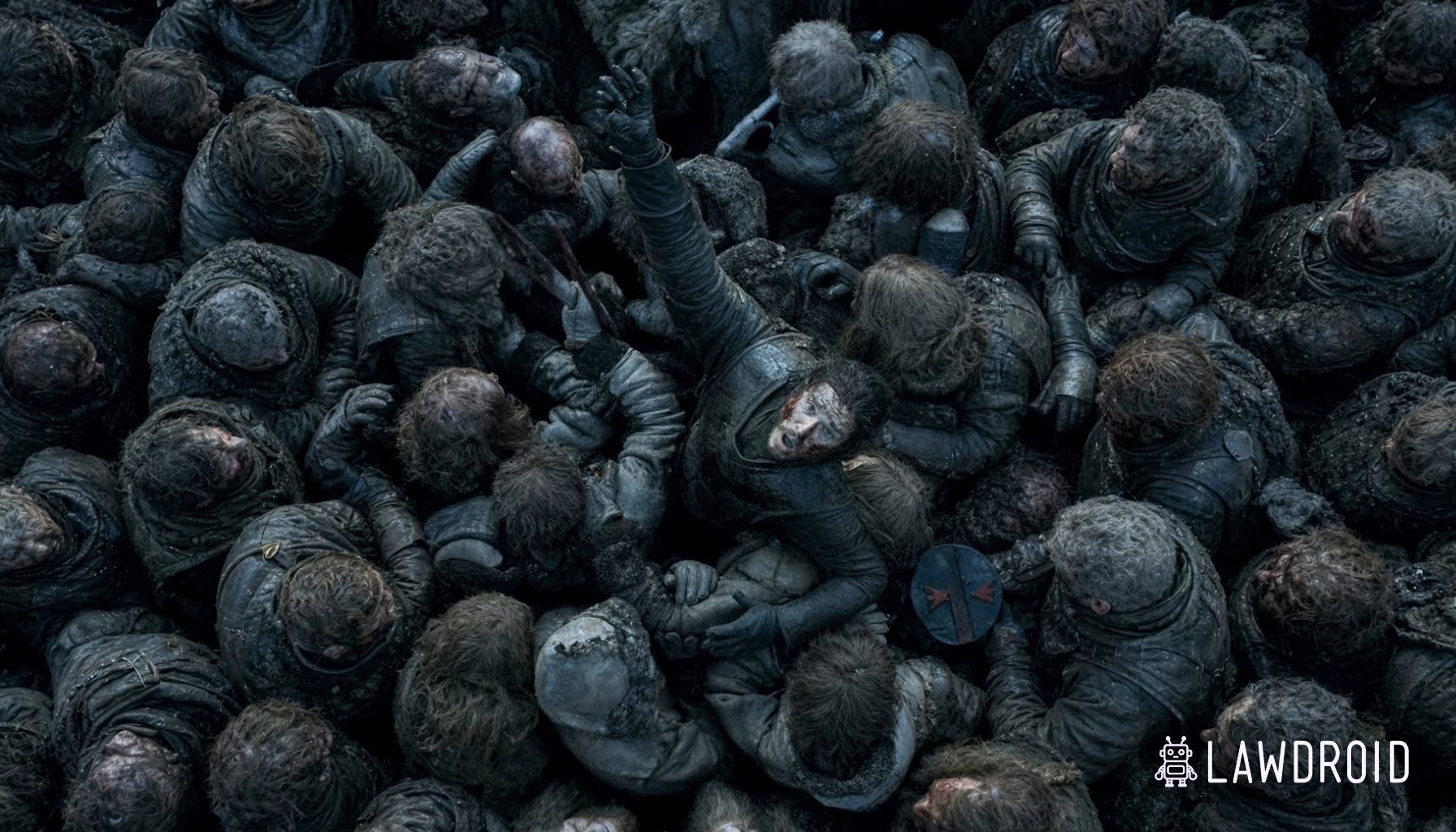
There is a moment in the Battle of the Bastards, the ninth episode of Game of Thrones’ sixth season, where Jon Snow has just watched his younger brother die a few strides short of safety. The plan, the careful plan, was to hold the line and let the enemy come to him. The plan dies with Rickon. Jon rides out alone. His horse is shot out from under him. He gets up, standing in the mud in front of the entire Bolton army, and the cavalry begins its charge: thousands of hooves, a wall of horses and steel bearing down on one man. He draws his sword. He does not run. He squares up to the charge because that’s who he is.
Then, when all hope appears lost, his own men reach him at the last second and the two armies collide with Jon at the center. He is knocked down. Bodies fall on top of him. The camera goes black with mud and armor, and for a long, awful stretch he is buried alive, clawing upward through the press of the dying, gasping for air. No opponent bests him. No single blow brings him down. He is nearly killed by the overwhelming mass of humanity.
I think about that scene when I watch curious people, lawyers and technologists alike, and I include myself among them, face what the last three years have thrown at us. The instinct that made them good at their work, the urge to engage the new thing and understand it, is the very instinct that can put them in jeopardy. I call this curiosity burnout: the condition that sets in when the velocity of change so far outstrips the human capacity to learn that curiosity, typically a rewarded instinct in professional life, begins to cost more than it pays in dividends.
If this sounds interesting to you, read on…
This substack, LawDroid Manifesto, is here to keep you in the loop about the intersection of AI and the law. Please share this article with your friends and colleagues and remember to tell me what you think in the comments below.
Curiosity Is an Investment with Diminishing Returns and Collapsing Incentives
We do not usually think of curiosity in economic terms, but it has always had an incentive structure. Learning costs something: hours, attention, the discomfort of being a beginner. And it pays something back: understanding, when things click and confusion resolves into understanding. It pays dividends in freedom and control, because a thing you understand stops happening to you and starts being something you can choose to act on. And it pays in advantage. The associate who read the arcane and lengthy statutory history nobody else bothered with became the partner everyone calls when that historical, statutory context matters.
Every investment has a payback period, and this one depended on a hidden assumption: that what you learned would stay true or relevant long enough for you to collect on it. The economist Fritz Machlup called this the “half-life” of knowledge, the time it takes for half of what you know about a field to become obsolete or wrong. Samuel Arbesman built a book around the idea, The Half-Life of Facts. In law, that half-life was durable as one kept up with the changes. A doctrine mastered as a junior lawyer paid dividends over time. The payback period on legal curiosity was a career.
Now consider what has happened to the half-life of what we learn about AI. A prompting technique that worked in January is irrelevant by June because the model no longer needs it. The interface you finally mastered is redesigned. The model you built a workflow around is sunsetted, and its successor behaves differently. That knowledge decays in months, sometimes weeks. And when the half-life of what you learn falls below the time it takes to learn it (let alone benefit from it), the arithmetic breaks. You pay the full cost of learning and collect none of the return. A rational person, faced with that trade enough times, stops making it. Curiosity gets priced out; burnout sets in.
Alvin Toffler’s Future Shock described the disorientation of too much change in too short a time. Information overload describes too much input / supply. Curiosity burnout is a demand problem. The demand for new information (curiosity) is itself eroded. The overloaded person still wants to know; they simply cannot get to it all. The burned-out person has stopped wanting to learn. That is a different injury, and a more serious one.
The Information Gap That Keeps Growing
Psychology has a good account of why curiosity works the way it does, and it explains why exponential change is so corrosive to it. George Loewenstein, in a 1994 paper, “The Psychology of Curiosity,” described curiosity as the feeling produced by an information gap: the space between what you know and what you want to know. The gap is a kind of deprivation, and the mind wants to close the loop.
Loewenstein’s most useful observation is that the intensity of curiosity depends on the type of gap. Curiosity is strongest when you know enough to see the gap clearly and the gap feels closable. The word on the tip of your tongue. The last clue in the crossword. But when the gap is too wide, when you do not know enough to know what you are missing, the pull weakens. And when the gap is unbridgeable, when no amount of effort will bring the far edge closer, the pull of curiosity goes slack.
Exponential change turns every information gap into a yawning chasm. You learn how to work with an AI model, and there is a new model. You begin to understand the tool, and there is a new category of tool. The frontier is receding faster than you can approach it (like a funhouse mirror), and the feeling is anything but fun. The same stimulus that once attracted us now pushes us away. The newsletter that used to be a pleasure becomes a reminder of our growing ignorance. The unread tab becomes a small daily reproach.
Three Ways Curiosity Burns Out
Christina Maslach, social psychologist and professor emerita at UC Berkeley, created the “burnout inventory” that has defined the study of burnout for more than four decades. It identified three dimensions: exhaustion, cynicism, and a diminished efficacy. Curiosity burnout runs through all three, and I suspect most readers will recognize themselves in at least one.
Exhaustion is the obvious one. It is the specific tiredness of being perpetually behind: the podcast queue you will never clear, the demo you keep rescheduling, the fourth AI newsletter you opened and closed without reading. It is a different fatigue from overwork. Overwork tires the body. Exhaustion tires the mind.
Cynicism happens when exhaustion sours. The lawyer who two years ago tested every new tool the week it launched now says, wake me when it settles. Why learn this when it will be replaced by spring? The cynicism is a defense, and a reasonable one, because it protects a depleted resource from further drain. But it is also a loss, because the person who says wake me when it settles is describing a moment that, on current evidence, will never arrive.
Diminished efficacy is where lawyers get hit hardest. Our profession is built on expertise that compounds. We spend decades acquiring a body of knowledge. The senior partner knows more than the associate, and that knowing is the basis of authority, compensation, and identity. AI collapses that hierarchy. A model released last month is exactly as new to the partner as it is to the summer associate. AI makes permanent novices of us all. The result is a creeping conviction, in people who have never felt it before, that they can no longer understand anything fully.
Pick Your Battles to Protect What’s Worthwhile
The instinctive initial response to exponential change is to attempt to keep up — learn faster, try harder. More newsletters, more demos, a better system for tracking releases. I have tried it. It does not work, and it cannot work, because the numbers don’t math. No individual learning rate can catch an exponential curve.
What works is choosing what curiosity to pursue wisely.
Surface curiosity is directed at the tools: the features, the interfaces, the model versions, the prompt techniques. Its half-life is weeks.
Substrate curiosity is directed at how these systems work and how they fail: that they are probabilistic, that they are trained to predict text and will predict it confidently when they should not. Its half-life is months.
But, there is a third level, and for lawyers it is the most durable of all: the client’s problem (purpose-driven curiosity). I have written before that lawyers solve problems, not tasks. The document is an artifact of the solution. It is not the solution. The technology for producing the artifact changes constantly, and it will keep changing, and you will never fully keep up with it. Client problems, human problems, however, stand the test of time.
Firms have a role here too. Most of the AI literacy programs I have seen reward surface curiosity: who has tried the most tools, who knows the newest features. That is a recipe for burning out your most curious people first. Measure substrate and purpose-driven understanding instead. Can this lawyer explain how the system fails? Can she tell when to trust it? Does he know which client problems it changes and which it leaves untouched? Those are the questions that still endure.
Closing Thoughts
Jon Snow survived the field of battle, but it is worth remembering how. He survives because he claws his way out, and because a second army, one he did not know was coming, arrives to break the crush. His sword did not save him, but his courage and good fortune did.
The curious among us are in much the same position today. The change is real and overwhelming. Our curiosity alone will not save us. In fact, indiscriminate curiosity may be the thing that buries us. There is simply too much coming over the hill, too quickly, for any one person to meet every new model, feature, paper, product, and prediction head-on.
That does not mean surrendering, but becoming more deliberate and judicious. Expertise may increasingly mean knowing what deserves your attention, what can safely be ignored, and what remains true even as everything around us changes.
You cannot stop the cavalry charge.
You can choose where to take your stand.
Draw your sword to protect what endures.
Tom Martin is CEO & Founder of LawDroid, Adjunct Professor at Suffolk University Law School, and Author of AI with Purpose: A Strategic Blueprint for Legal Transformation (Globe Law and Business). He is “The AI Law Professor” and writes his eponymous column for the Thomson Reuters Institute.
By the way, if you would like to meet other legal innovators in person, and enjoy an exceptional awards gala celebration, don’t miss the Oscars of Legal Innovation: the American Legal Technology Awards, this October 25, 2026, in Boston. Reserve your Early Bird tickets today and save $100.