

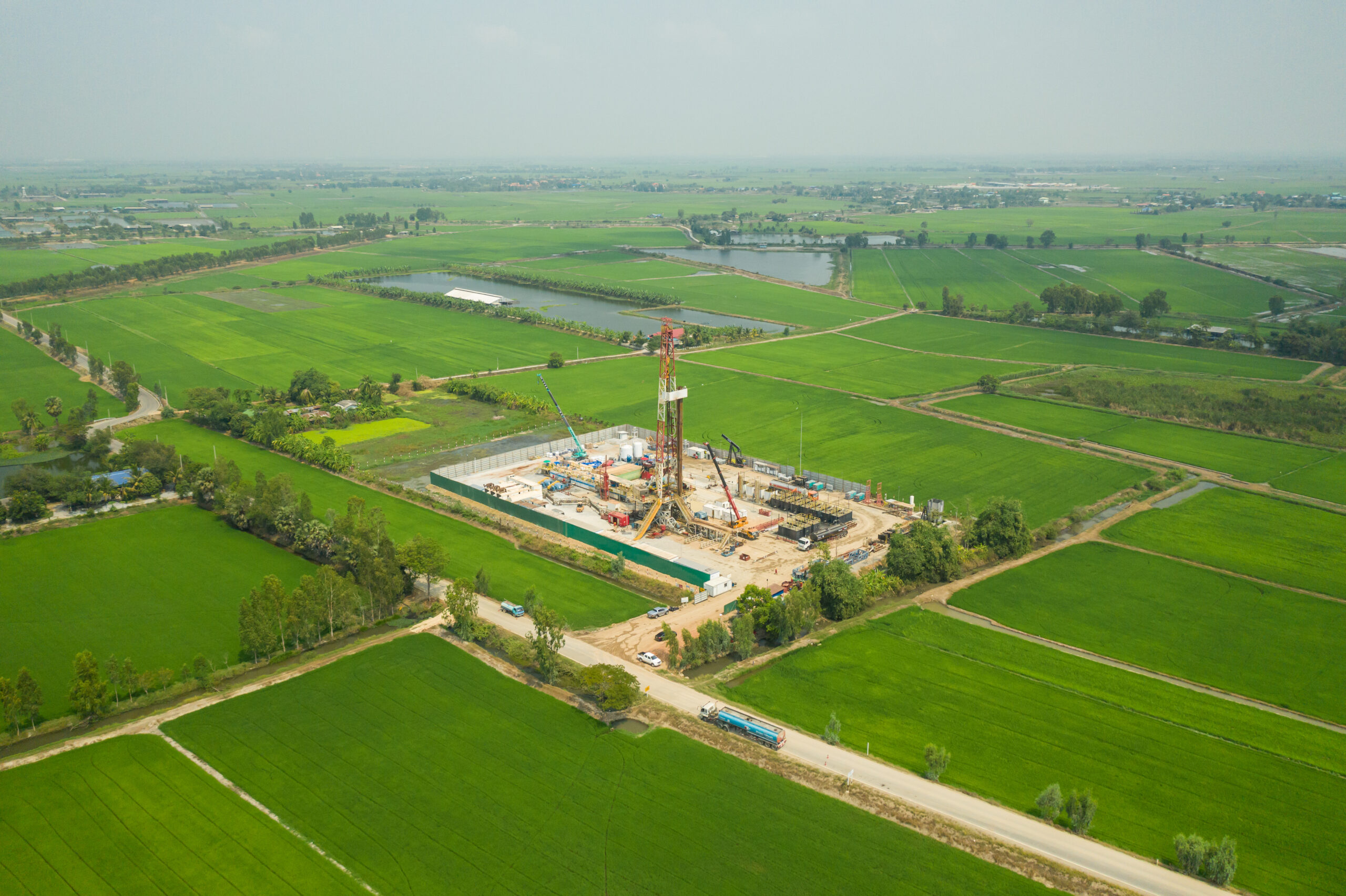
Our earlier post examined a hypothetical scenario in which a Texas carbon capture and storage (CCS) developer acquires only surface rights (plus a mineral owner’s surface waiver) over a depleted oil field, injects CO2 for geologic storage, and inadvertently restores the field to commercial oil productivity through CO2 enhanced oil recovery (CO2-EOR). Because Texas treats the mineral estate as dominant over the surface estate, and because a horizontal or directional well can often be drilled into the storage formation from an entirely separate surface location, Texas law may leave that CCS developer with no reliable way to stop a mineral owner from drilling into and producing from an active storage zone—with potentially severe recapture consequences for tax credits determined for such CO2 under Section 45Q of the Internal Revenue Code.
That prompted this follow-up question: is this a Texas-specific issue, or a structural feature of American oil and gas property law that CCS developers could encounter nationwide? We reviewed the property law of nine other states with significant CO2 storage potential, legacy oil production, and law or rules that presume the surface owner owns pore space—California, Illinois, Louisiana, Wyoming, New Mexico, North Dakota, Oklahoma, Colorado, and West Virginia. The results suggest that Texas is not an outlier. In many of these states, the mineral estate remains dominant, and no comprehensive statutory or common law mechanism reliably prevents a mineral owner from developing directly within an active CO2 storage zone.
The Common Thread: Mineral Estate Dominance
Nearly every state mentioned above follows the Texas model, namely that the mineral estate is dominant over the surface estate, meaning the mineral owner (or its lessee) has an implied right to use the surface, and the subsurface, to the extent reasonably necessary to develop the minerals.[1] The formulations vary, but the substance is consistent. Colorado, for example, describes the estates as “mutually dominant and mutually servient,” but the practical rule is the same: a severed mineral owner may use as much of the surface as is reasonably necessary to develop the minerals. Illinois, as another example, avoids classic dominant/servient terminology, describing the mineral owner’s surface rights as a “correlative right,” but the mineral owner may use as much of the surface as is necessary to develop the minerals, and lessees are held to a prudent operator standard. Under the Louisiana Mineral Code, mineral rights are not structured as a dominant estate, but rather as a mineral servitude burdening the surface, with each of the servitude owner and the surface owner obligated to exercise their rights with “reasonable regard” for the other. This effectively means that all the states reviewed have the same set up as Texas in regard to the issue that a mineral rights holder has the right to produce within the storage zone absent other rules.
CCS-Specific Statutes: Codifying the Gap
Each of the nine states examined has adopted CCS-specific legislation that addresses, either directly or indirectly, the complex interaction between mineral development and geologic CO2 storage.[2] Most of these states have taken a preservation approach that prioritizes traditional mineral rights. Wyoming’s statute preserves a mineral owner’s “otherwise lawful right” to drill or bore through a geologic sequestration site, subject only to Wyoming Oil and Gas Conservation Commission rules protecting against CO2 escape—though as of this writing, we identified no rules that would prevent drilling into a CO2 storage zone. Illinois has adopted similar preservation clauses.
Illinois’s Safety and Aid for the Environment in Carbon Capture and Sequestration Act (SAFE CCS Act) does not alter the common law doctrine of mineral estate dominance. Equally, Colorado’s CCS legislation notes that any conveyance of pore space rights does not change or alter the rights or dominance of a mineral estate. New Mexico’s approach prevents CCS developers from injecting into formations where the dominant mineral estate is actively producing, but the law notably does not contemplate injection into depleted formations that later become commercially viable for oil production.
West Virginia requires compliance with underground injection control permit rules and requires that a mineral owner’s interests will not be adversely affected by the project. Likewise, Oklahoma’s Carbon Capture and Geologic Sequestration Act requires that before a storage unit is created the Commission must find it “will not adversely affect or prohibit any potential future oil or gas production from such approved reservoir” (emphasis added). It also expressly protects a mineral owner’s right to drill through an approved storage reservoir and requires the Corporation Commission to establish drilling safeguards, but contains no prohibition on production from within the storage zone itself. The issue for both is that neither stops a CCS developer from gaining a permit to inject in a depleted oil reservoir. Injection of CO2 into a depleted oil reservoir does not adversely affect that reservoir—instead it is a boon.
Louisiana may have the broadest regulatory authority awarded to its implementing body: its CCS statute grants the Louisiana secretary of state express power to issue orders and regulations necessary to protect storage reservoirs against CO2 escape, including rules governing drilling into or through the reservoir, along with discretionary authority to prevent wells from being drilled in a manner that injures neighboring property. Unlike Wyoming, there is no statute explicitly preserving a mineral owner’s rights. While this represents a potentially robust regulatory tool among the nine states, it operates through agency rulemaking and discretionary enforcement rather than as an automatic, self-executing prohibition on mineral development. Therefore, each developer would be subject to whatever the secretary deems necessary.
North Dakota requires its Industrial Commission to confirm that a proposed storage facility either contains no commercially valuable minerals or that any impacts on mineral owners have been addressed by agreement before issuing a storage permit. Absent such an agreement, North Dakota law preserves the mineral owner’s right to drill through or near a storage reservoir, subject to Commission compliance requirements—making it one of the few mechanisms that requires an agreement that may prevent conflicts between storage operators and mineral developers. The only issue is whether the Industrial Commission would deem a depleted oil reservoir to contain commercially valuable minerals.
California seems to be the only state with CCS law that would prevent any such issues: a CCS operator cannot operate at a site unless they have a binding agreement in place among all relevant parties that prohibits drilling or extraction that may penetrate the storage reservoir. In other words, the hypothetical cannot exist in California because a project cannot operate unless it has agreements in place that prevent the hypothetical in the first place.
Damages Statutes and Accommodation
Unlike Texas, several of the states we reviewed give surface owners a statutory right to damages arising from oil and gas operations. It is worth being precise about what these statutes protect, because for some it is not what a CCS developer needs.
Colorado’s accommodation doctrine, codified at C.R.S.A. § 34-60-127, requires an operator to conduct oil and gas operations in a manner that minimizes intrusion on the surface, including by choosing alternative locations or methods where technologically sound and economically practicable alternatives exist. A CCS developer holding surface rights could argue that a mineral owner’s choice to drill directly into an active storage zone fails the accommodation standard. However, it could be an uphill battle if the only way to produce the oil is by producing the CO2. This seems likely to be the case.
Oklahoma, New Mexico, West Virginia, and North Dakota allow for claims of loss of land value due to damage caused to the surface by a mineral developer regardless of whether damages were caused by negligence.[3] While untested, a CCS Developer could potentially argue that the loss of stored CO2 was a loss of fair market value of property. In North Dakota specifically, there is even North Dakota Supreme Court case law that extends such compensation to a mineral developer’s use of pore space.[4]
On the other end of the spectrum, Illinois requires operators to pay reasonable compensation for damage to crops, trees, livestock, fences, roads, and structures, on top of a reasonably-necessary-use limitation on surface occupation.[5] Since there is no compensation for land value, it is not clear what recovery a CCS developer could make in the event that stored CO2 is released. California takes an even narrower, procedural approach: Cal. Civ. Code § 848 requires 30 days’ notice before surface-disrupting mineral operations and gives the surface owner injunctive relief for noncompliance, but does not create a freestanding damages remedy tied to surface use. However, since California avoids the hypothetical altogether, a damages approach is unneeded.
It is worth noting that all these regimes compensate a surface owner for physical disturbance to the land—crop loss, diminished property value, and damaged structures. None of them creates a cause of action tied to Section 45Q credit recapture. A CCS developer that recovers surface damages after a mineral owner drills into its storage zone will still face the tax consequences described in our original post. The question of these statutes is merely whether the developer could theoretically recover some damages for this loss.
Risk Mitigation: The Same Playbook, Wherever You Are
The multi-state picture reinforces rather than changes the risk mitigation approach we discussed previously for Texas projects. Developers and Section 45Q tax credit buyers in all states may consider the following solutions:
1. Acquire mineral rights. The most direct solution remains acquiring the mineral rights within the storage area, or at minimum the interval where CO2 will be stored, wherever the project is sited.
2. Require representations regarding commercial producibility. Tax credit buyers and project lenders could require representations and warranties that no commercially producible hydrocarbons exist within or adjacent to the injection zone, both at closing and on a continuing basis, regardless of state.
3. Obtain mineral owner easements or agreements before injection begins. This step is not merely advisable in North Dakota—it is a statutory precondition to permitting where the storage formation contains commercially valuable minerals. Even in states without that requirement, a negotiated restrictive covenant or no-drilling agreement is advisable.
Conclusion
The mineral rights risk we identified in Texas is not a Texas anomaly. Across nine additional CO2-storage-relevant states, the same basic property law structure recurs: the mineral owner may use the surface and subsurface as reasonably necessary to develop the minerals, and CCS-specific legislation, where it exists, generally preserves that right rather than curtailing it. Statutory damages regimes in several states compensate surface owners for physical disturbance to the land, but none of them compensate for Section 45Q credit recapture or any related tax penalty. No state reviewed has a law that completely displaces the need for developers to secure mineral rights or binding no-drilling agreements before injection begins. As CCS projects continue to move from development into operation across these states, mineral rights due diligence remains the primary safeguard against this risk.
Emily Cross Vayr contributed to this article.
[1] See La. R.S. 30:1104(E), 1104.2(I); Wyo. Stat. § 30-5-402(a); Kysar v. Amoco Prod. Co., 135 N.M. 767 (2004); Hunt Oil Co. v. Kerbaugh, 283 N.W.2d 131 (N.D. 1979); Revolution Resources, LLC v. Annecy, LLC, 477 P.3d 1133 (Okla. 2020); Gerrity Oil & Gas Corp. v. Magness, 946 P.2d 913 (Colo. 1997); Thornsbury v. Cabot Oil & Gas Corp., 749 S.E.2d 569 (W. Va. 2013); Callahan v. Martin, 43 P.2d 788 (Cal. 1935); Cal. Civ. Code § 883.110; Shell Oil Co. v. Manley Oil Corp., 124 F.2d 714 (7th Cir. 1941); Miller v. Ridgley, 117 N.E.2d 759 (Ill. 1954).
[2] See La. R.S. 30:1104(E); La. R.S. 30:1104.2(I); Wyo. Stat. § 35-11-316(k)(ii); Wyo. Stat. Ann. § 30-5-501; N.M.S.A. § 74-14-7(B); N.D.C.C. § 38-22-01 and sequential; O.S. tit. 27A, § 3-5-106, § 3-5-107(E)(4) and (E)(5), § 3-5-107(G)(6); W. Va. Code Ann. § 22-11B-9, 22-11B-4(c); 415 ILCS 185/10(f); Cal. Pub. Res. Code § 71464(b); Colo. Rev. Stat. Ann. § 34-60-140.
[3] See N.M.S.A. § 70-12-4; Mosser v. Denbury Res., Inc., 898 N.W.2d 406, 417 (N.D. 2017); Okla. Stat. Ann. tit. 52, § 318.5; W. Va. Code Ann. § 22-7-4.
[4] Mosser v. Denbury Res., Inc., 898 N.W.2d 406, 417 (N.D. 2017).
[5] 765 Ill. Comp. Stat. Ann. 530/6.