
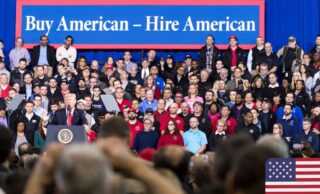
 Since taking office in 2017, President Trump has made no secret of his “Buy American, Hire American” initiative. The President recently took another step to promote American industry by signing an Executive Order on January 31, 2019, (the “Order”) which instructs all agencies to “maximize the use of iron and aluminum as well as steel, cement, and other manufactured products produced in the United States in contracts, sub-contracts, purchase orders, or sub-awards.”
This recent Order comes on the heels of Executive Order No. 13788, signed on April 28, 2017, which required federal agencies to “scrupulously monitor, enforce, and comply with Buy American laws, to the extent they apply, and minimize the use of waivers, consistent with applicable law.” Executive Order 13788 also mandated federal agency action on Buy American laws at specified dates, as well as subsequent reporting on implementation of Buy American laws. In short, agencies were instructed to follow the law and report back.
While Executive Order 13788 targeted recipients of “federal grants,” the recent Order amends that language to include those receiving “Federal financial assistance,” as defined in 2 C.F.R. § 200.40—federal assistance received by private entities in the form of grants, cooperative agreements, direct appropriations, loans, etc. Thus, private entities receiving public funds will be “encouraged” to use domestic sources when procuring goods or services.
Pursuant to the Order, each agency head has 90 days to “encourage recipients of new Federal financial assistance awards pursuant to a covered program to use, to the greatest extent practicable, iron and aluminum as well as steel, cement, and other manufactured products produced in the United States in every contract, subcontract, purchase order, or sub-award that is chargeable against such Federal financial assistance award.” Within 120 days, each agency head must identify any “tools, techniques or conditions that have been used . . . to maximize the use of iron and aluminum as well as steel, cement, and other manufactured products produced in the United States” and report those, along with a proposed strategy to encourage greater use of domestic products, to the President and the U.S. Trade Representative.
Congress passed the Buy American Act (“BAA”) during the Great Depression to protect American industry from foreign competition for federal procurement contracts. The BAA affords generous pricing preferences to offerors who certify their compliance with the domestic purchasing requirements stated in the act. Specifically, the BAA requires public agencies to procure articles, materials, and supplies that were mined, produced, or manufactured in the United States, except under five exempt circumstances. See 41 U.S.C. § 8302(a).
The BAA is one of several federal statutes implementing domestic purchasing requirements, including the “Buy America Act” and related regulations applicable to certain federal infrastructure and federal stimulus projects. See 49 U.S.C. § 5323(j) (mass transit grants); 23 U.S.C. § 313 (federally-funded highway grants); 49 U.S.C. § 24305(f) (federal grants to Amtrak); 49 U.S.C. § 50101 (grants to the Federal Aviation Administration); 48 C.F.R. § 25.600, et seq. (projects using funds appropriated by the American Reinvestment and Recovery Act).
Much like the Executive Order No. 13788, the current Order leaves a lot to be determined. Both Orders instruct agencies to take action “consistent with applicable law.” Both Orders require agency heads to develop policies within a specified time. EO No. 13788 gave agency heads 150 days to “develop and propose policies” to ensure the use of domestic products. By year end 2018, the Government Accountability Office (“GAO”) reported that the Department of Defense (“DOD”) was currently training 18,000 personnel, and Department of Homeland Security (“DHS”) was training 1,400 personnel on BAA requirements. The focus of the training—whether in response to the under application or over application of BAA—remains to be seen.
Similarly, under the current Order, agency heads have 120 days to come up with a plan to encourage those receiving federal financial assistance to use domestic products. Those plans will presumably describe what challenges agencies will face in the process, as domestic preference programs present administrative and financial hurdles on purchasers. It is possible, if not likely, that BAA training will be amplified among those receiving federal financial assistance, resulting in stricter enforcement of BAA requirements. Although this Order clearly illustrates that the President is continuing to pursue his Buy American strategy, the impact will be defined over time.