

Last week, I had the opportunity to speak to a group of CEOs in the Greater Milwaukee Area as part of Vistage Worldwide, Inc.’s executive coaching program that was hosted by Xymox Technologies Inc. The presentation focused on the geo/political headwinds in the Middle East and their resulting impact on U.S. business operations. It was conducted in two phases: In phase 1, I provided an overview of the geopolitical environment, with a particular focus on the ongoing Israeli-Palestinian conflict that has resulted in the Houthi’s effective blockade of the Red Sea, causing global supply chain disruption. In phase 2, participants were presented with a fictitious business scenario and tasked to solve a business problem caused by the disruption of supply chains resulting from the Red Sea blockade, using a Design Thinking problem-solving framework.
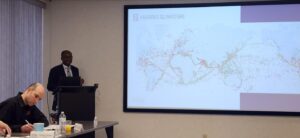

In putting this presentation together, my goal was to show the importance of geopolitics to global trade and provide business practitioners with practical strategies for mitigating the adverse effects of political risks on business operations. The ongoing Israel-Palestine conflict provided a good case study due to its indirect impact on global trade. The Houthi effective blockade of the Red Sea provided a focal point because normally about 12% of global trade passes through the Red Sea and the Suez Canal, representing 30% of all global container traffic. However, due to the blockade, major shipping companies have rerouted their shipping routes through the Cape of Good Hope, South Africa. That rerouting of maritime transport operations adds about ten (10) to thirty (30) days to the journey, depending on the vessel’s speed and the destination. Thus, even if it were just a single part of a company’s supply chain loaded aboard one of those ships, that could cause significant delays to the company’s operations, leading to closure in extreme cases. The added distance also requires extra fuel to power the vessel. These shipping costs are passed on to the manufacturer and thereafter transferred to consumers downstream. The disruptions not only impact delivery time and fuel costs alone but also the supply of ships, representing about one-third (1/3) of the world’s container ship capacity. To serve the same services frequently, more ships are needed, especially for container ships. According to Sea-Intelligence, the switch to the around-Africa route will require 1.45 million to 1.7 million twenty-foot units of additional ship capacity. This disruption not only impacts Europe-Asian trade but also US-Asian trade because much of the trade coming from Asia to the East Coast goes through the Suez Canal, out of the Strait of Gibraltar, across the Atlantic Ocean.
The Houthi blockade of the Red Sea highlights the interconnectedness of geopolitical events and global supply chains. As businesses navigate the challenges posed by these disruptions, the imperative to build resilient and adaptable supply chain strategies becomes more evident.
The post Red Sea Blockade: Why Understanding and Anticipation of Political Risks is a Survival Skill for Businesses Large and Small! appeared first on Harris Sliwoski LLP.