
The Federal Emergency Management Agency (FEMA) provides funding to eligible applicants under the Public Assistance (PA) program to help applicants in responding to and recovering from presidentially declared major disasters and emergencies. For PA applicants who are denied PA funding, there is a mandatory administrative appeal process managed for and by FEMA. If that appeal is denied, dissatisfied PA applicants may pursue an independent arbitration managed and conducted by the Civilian Board of Contract Appeals (CBCA). This arbitration process allows FEMA applicants a final, independent adjudication of their PA program eligibility and funding decisions, arbitrated by administrative law judges.
Link to What Is the Arbitration Process? What Is the Arbitration Process?
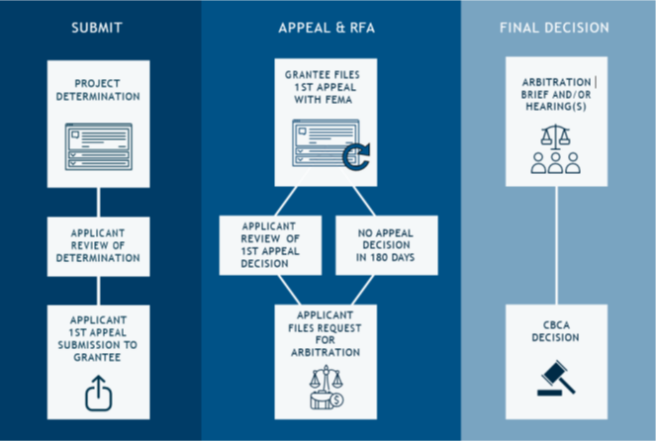
*Graphic from FEMA Public Assistance Arbitration Fact Sheet, v.4
Link to Who Is Eligible for Arbitration? Who Is Eligible for Arbitration?
To be eligible for arbitration, a PA applicant’s request must meet all three of the following conditions:
- The dispute arises from a disaster declared after January 1, 2016;
- The disputed amount exceeds $500,000 (or $100,000 if the applicant is in a “rural area,” defined as having a population of less than 200,000 living outside an urbanized area); and
- The applicant filed a first-level appeal with FEMA within the timeframes established in 44 CFR § 206.206, and FEMA denied the first appeal or has not provided a first appeal decision within 180 calendar days of receiving the first appeal submission.
The timeliness requirement for an applicant to file a first appeal to FEMA is very important, as failure to satisfy this requirement precludes an applicant’s ability to pursue CBCA arbitration. 44 CFR § 206.206(b) requires electronic submission of the first appeal within 60 calendar days through FEMA’s web-based grants management system.
Link to When Can an Eligible Applicant Seek CBCA Arbitration? When Can an Eligible Applicant Seek CBCA Arbitration?
An eligible PA applicant who has filed its first appeal with FEMA and received an unsatisfactory response is entitled to make an arbitration request in two circumstances (44 CFR § 206.206(b)(3)):
- Within 60 calendar days from the date of the first appeal decision; or
- If FEMA fails to issue a first appeal decision within 180 calendar days, an applicant may withdraw that pending appeal and file a request for arbitration within 30 calendar days of withdrawing.
The FEMA regulations also provide for a second appeal option, but if an applicant pursues a second appeal, that decision precludes the opportunity for a CBCA arbitration. That is, an applicant can pursue either a second FEMA appeal or a CBCA arbitration, but not both.
Link to What Must the Request for Arbitration Include? What Must the Request for Arbitration Include?
CBCA regulations detail the arbitration process and requirements (48 CFR §§ 6106.601 – 6106.613).
First, to initiate a CBCA arbitration, an applicant must email a “request for arbitration” simultaneously to (1) the CBCA; (2) the FEMA grant recipient; and (3) the applicable FEMA regional administrator.
The request for arbitration must include:
- a written statement specifying the amount in dispute;
- all documentation supporting the position of the applicant;
- the disaster number; and
- the name and address of the applicant’s authorized representative or counsel.
Typically, because a FEMA-level appeal has already been filed, the request for arbitration documents are often just the contents of the dispute and the appeal. However, this also an applicant’s last chance for advocacy and should be treated as such.
Link to What Are the Procedures and Timelines During the Arbitration? What Are the Procedures and Timelines During the Arbitration?
Once a request for arbitration has been filed, the process moves fairly quickly. Ordinarily, within 14 calendar days after docketing, the CBCA judge — or panel of judges — will hold a telephonic scheduling conference, which will result in the arbitration schedule.
Parties may, but are not required to, present additional evidence beyond what was contained in the initial request for arbitration.
FEMA will generally file a response to the arbitration request within 30 calendar days after receiving the docketing notice.
The parties can elect to present their positions in a hearing, on a written record (a “paper hearing”) or a combination of the two. This hearing is typically conducted within 60 calendar days after the initial conference unless the board chair approves a later date.
Once the CBCA panel advises the parties that the arbitration is closed, it will generally resolve the dispute within 60 calendar days. The CBCA’s decision is considered final, not subject to appeal, and is only judicially reviewable to the extent provided by the Federal Arbitration Act (9 U.S.C. § 10).
Link to Wait, I Have More Questions! Wait, I Have More Questions!
If you have any questions about FEMA CBCA arbitrations — or about FEMA appeals generally — please do not hesitate to contact Nathaniel Greeson* or Aron Beezley.
*Nathaniel Greeson was FEMA counsel for many years and has extensive experience with the relevant FEMA programs and regulations. The Bradley team has several former CBCA clerks with directly relevant experience at the Board. Finally, Bradley has a dedicated Disaster Planning, Recovery & Relief Practice Group to handle all aspects of assistance and representation.