
As AI models evolve into multi-modal, reasoning-capable systems, traditional fine-tuning and RLHF are proving insufficient. Cognitive Fine-Tuning (CFT) represents a breakthrough training paradigm that shapes not only what an AI says, but how it arrives at its conclusions.
By conditioning the internal reasoning pathways, assigning confidence levels to intermediate logic, and fostering epistemic self-awareness, CFT produces models that think more like humans do — with explicit, auditable reasoning chains.
This article introduces the principles, techniques, and challenges of Cognitive Fine-Tuning, providing AI researchers, developers, and enterprises with a roadmap for building the reasoning engines of the next generation.
1. Introduction — From Outputs to Thought Processes
AI training has historically focused on two endpoints:
- Pretraining, which teaches models to predict language patterns.
- Reinforcement Learning from Human Feedback (RLHF), which aligns models to preferred user responses.
This surface-level tuning works for simple systems, but as AI applications expand into legal, medical, and scientific reasoning — the process matters as much as the output.
Enter Cognitive Fine-Tuning (CFT) — a technique designed not just to improve answers, but to condition the reasoning flows that produce those answers. It’s the shift from response training to thought process training.
2. Defining Cognitive Fine-Tuning
What is Cognitive Fine-Tuning?
Cognitive Fine-Tuning (CFT) is the direct optimization of an AI’s internal reasoning processes during the fine-tuning phase. It focuses on:
- Shaping logical chains inside the model.
- Assigning confidence scores to reasoning steps.
- Encouraging explicit reasoning transparency.
How It Differs from RLHF
| Dimension | RLHF Focus | Cognitive Fine-Tuning Focus |
|---|---|---|
| Training Objective | Aligning final output to preference | Calibrating internal reasoning process |
| Human Involvement | Rating outputs | Rating both outputs & reasoning steps |
| Output Scope | Surface-level text only | Text + reasoning trace + confidence |
| Example Feedback | “This is accurate” | “This step uses faulty logic” |
3. Why Traditional Fine-Tuning Falls Short
Historical Training Stages
| Training Stage | Objective | Limitation |
|---|---|---|
| Pretraining | Language modeling on large corpora | Static — no dynamic reasoning calibration |
| Supervised Fine-Tuning | Task-specific adaptation | Overfits to narrow tasks |
| RLHF | Align outputs to human preferences | No traceability into reasoning flows |
The Missing Piece — Reasoning Calibration
Most fine-tuning pipelines optimize answers, but they don’t evaluate the thought pathways used to produce those answers. This means:
- Internal contradictions go undetected.
- Outputs may seem plausible but lack logical foundation.
- There’s no structured way to trace or refine faulty reasoning.
4. Techniques Behind Cognitive Fine-Tuning
CFT applies techniques drawn from multi-step reasoning, uncertainty calibration, and traceable logic conditioning.
1. Chain-of-Thought (CoT) Injection
The model is explicitly trained to break down its thinking into discrete reasoning steps, even for simple queries.
prompt = """
Q: How many tiles cover a floor 10m x 8m if each tile is 0.5m x 0.5m?

Let's think step by step.
"""
# Expected response (with CoT fine-tuning)
"""
Step 1: Floor area = 10 x 8 = 80 sq.m.
Step 2: Each tile covers 0.25 sq.m.
Step 3: 80 ÷ 0.25 = 320 tiles.
"""
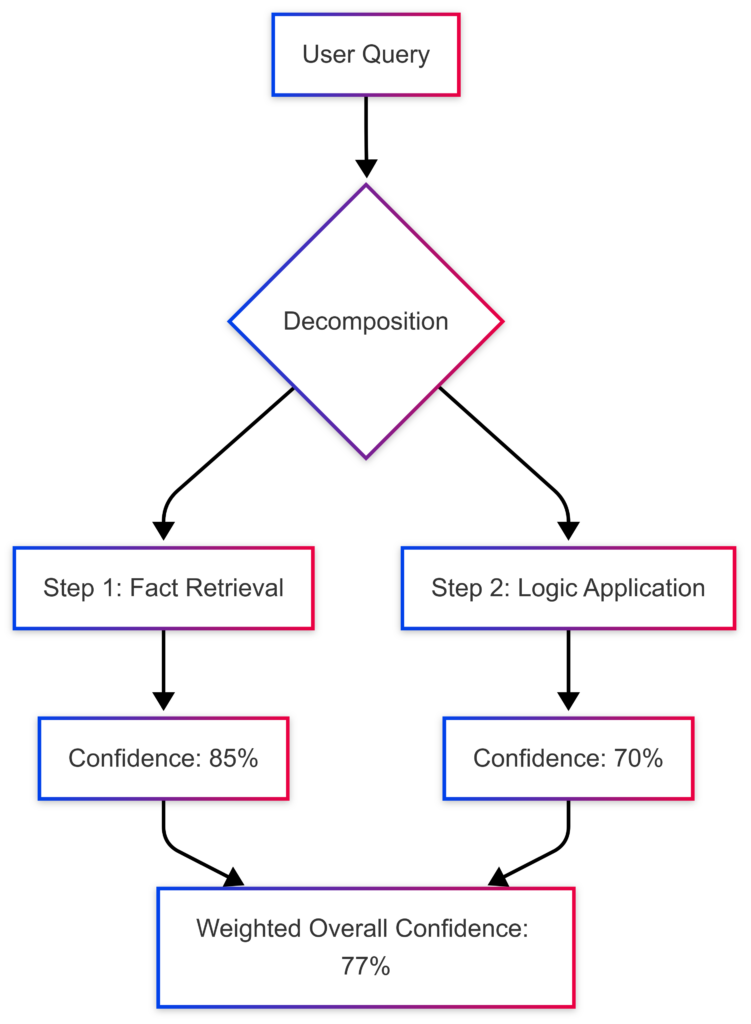
2. Confidence Injection
The model learns to attach internal confidence scores to individual reasoning steps and the final output.
3. Epistemic Shadowing — Comparing Past vs. Present Reasoning
For recurring topics (e.g., legal cases), models are trained to compare current logic chains against past answers — catching drift and contradictions.
4. Process-Level Supervision
Human reviewers don’t just rate outputs. They also evaluate:
- Whether logic was correctly sequenced.
- Whether confidence scores were reasonable.
- Whether external knowledge was properly incorporated.
5. Real-World Applications — Where CFT Shines
| Domain | Cognitive Fine-Tuning Contribution |
|---|---|
| Scientific Analysis | Multi-source citations with confidence scores |
| Legal Reasoning | Stepwise logic tracing & precedent tracking |
| Healthcare Diagnosis | Transparent diagnostic chains & risk flags |
| Financial Auditing | Traceable decision paths for compliance |
| Autonomous Agents | Self-verifying planning & error checking |
6. Case Study — Legal AI with Cognitive Fine-Tuning
Before CFT
A legal AI trained via RLHF gives:
“The contract clause is likely unenforceable under jurisdictional precedent.”
- No reasoning shown.
- No confidence score.
- No citation.
After CFT
The same query returns:
“Based on analysis of relevant case law, this clause may be unenforceable.“
- Reasoning Chain:
Step 1: Identify applicable jurisdiction.
Step 2: Retrieve recent similar rulings.
Step 3: Assess clause language for conflict. - Confidence: 72%
- Citations: 4 referenced cases
7. Challenges in Cognitive Fine-Tuning
| Challenge | Description |
|---|---|
| Compute Overhead | More tokens for CoT + confidence = higher cost |
| Evaluation Load | Reviewers must judge reasoning, not just answers |
| Reasoning Drift | Subtle shifts in reasoning paths need tracking |
| User Fatigue | Excessive reasoning verbosity in casual tasks |
Balancing Transparency vs Usability
| Use Case | Reasoning Visibility Target |
|---|---|
| Casual Queries | Minimal, CoT optional |
| Scientific Analysis | Full reasoning trace + confidence |
| Regulatory Decisions | Full trace + source citations |
8. Future of Cognitive Fine-Tuning
| Trend | Impact |
|---|---|
| Personalized Cognitive Graphs | Per-user reasoning memory |
| Confidence-Layered UX | Dynamic confidence-based UI hints |
| Hybrid Process Orchestration | Combining CFT with external reasoning graphs |
| Context-Adaptive Reasoning | Automatic depth adjustment per query |
9. Conclusion — Teaching Models to Think
Cognitive Fine-Tuning marks the end of shallow alignment and the beginning of epistemic training. Models are no longer just language engines, but reasoning engines — capable of explaining their own thoughts, calibrating their own confidence, and adapting their logic to new situations.
For AI developers and safety researchers, CFT offers a vital new lever for building reliable, transparent, and accountable AI systems.
“The true frontier isn’t in the next token —
It’s in the thoughts that chose it.”
Call to Action
Explore the evolving landscape of fine-tuning and prepare for a future where cognition itself becomes the core asset of AI systems.
Stay tuned for the next article in our cutting-edge AI series.
The post The Rise of Cognitive Fine-Tuning — Beyond Traditional Pretraining and RLHF appeared first on Adyog | Creative Design and Digital Product Development Company.