


Imagine driving home from work and seeing smoke rising from beneath your car’s hood. You pull off the road and into a nearby parking lot. You call your spouse to say there is a problem with the car and within seconds, the car erupts in flames. Luckily, you exited the vehicle safely before the fire began. Luckily, no one else was in the car.
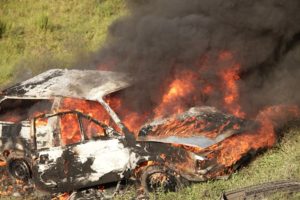
This scenario was described to me recently by my brother. His wife’s car burst into flames as she was driving home from work a few months ago. An electrical failure caused a fire in the engine compartment. The vehicle was completely destroyed, but thankfully, she recognized the danger signs before it was too late and exited the car unharmed. Vehicle fires like this one happen more than one might expect and can have catastrophic consequences in terms of lives lost, severe injuries and property, damage.
According to the National Fire Protection Association (NFPA), fire departments responded to an estimated average of 152,300 vehicle fires per year between 2006 and 2010. Of the cases studied, these automobile fires caused an average of 209 civilian deaths, 764 civilian injuries and $536 million in direct property damage. Automobile fires were involved in 10 percent of all reported fires in the United States and accounted for 6 percent of all U.S. fire deaths. The NFPA found an average of 17 vehicle fires were reported per hour. These fires were responsible for the deaths of an average of four people every week.
The New Jersey Department of Community Affairs Division of Fire Safety reported startling statistics on vehicle fires in New Jersey in 2015. In that year alone, a vehicle fire occurred in New Jersey every two hours and 42 minutes. Vehicle fires killed 12 people in New Jersey in 2015 — 16 percent of all civilian fire deaths that year. A single vehicle fire can cause multiple civilian fatalities. Tragically, on July 11, 2015, three young people were killed in a vehicle fire in Rockaway Township, New Jersey.
There are various reasons for vehicle fires. Approximately two-thirds of all reported vehicle fires were related to mechanical or electrical failures or malfunctions. According to the NFPA, “Collisions and overturns were factors in only 4 percent of highway vehicle fires, but these incidents accounted for three of every five (60 percent) automobile fire deaths.” While only 2 percent of vehicle fires started in fuel tanks or fuel lines, these incidents were responsible for 15 percent of the reported automobile fire deaths.
Vehicle and car fires often are fatal. One such car fire resulted in the death of actor, Paul Walker, in November 2013. More recently, on March 3, a car crash resulting in a vehicle fire claimed the life of a motorist on the Newark-Elizabeth border in New Jersey.
Vehicle fires frequently have devastating and tragic consequences, not just for vehicle occupants, but also for first responders. On Feb. 2, 27-year-old New York Police Department officer Bianca Bennet was killed and a second off-duty officer was critically injured responding to a vehicle fire following a one-car accident that left the vehicle engulfed in flames.
It is easy to see how dangerous and destructive vehicle fires can be. The importance of prevention and response to vehicle fires cannot be overstated. The NFPA compiled a list of vehicle safety tips to help prevent and respond to car fires:
Preventing Vehicle Fires:
- Take the car for regular service by a professional auto mechanic.
- Look for leaks. If leaks are found, something is wrong, and the vehicle needs to be fixed.
- Know danger signs, such as a fuse that blows more than once. This could be a sign of cracked or loose wiring or electrical problems.
- Look for rapid changes in fuel or fluid levels or engine temperature.
- Avoid transporting gasoline and other flammable liquids whenever possible.
- If transporting gasoline, make it as little as possible and keep it in a certified, sealed gas can. Keep a window open for ventilation.
- Never transport gas cans or propane cylinders in the passenger compartment of a vehicle.
- Never park a car where flammable materials, such as grass, are touching the catalytic converter.
- Follow the rules of the road. Driving safely will help avoid collisions, which are a major source of car fires.
Responding to a Vehicle Fire:
- If there is smoke or other danger signs, pull over as quickly and safely as possible.
- Once stopped, turn off the engine.
- Get all occupants out of the vehicle and move away from the car.
- Never return to a burning car. Keep a safe distance away from it — at least 100 feet.
- Call 911 to report the fire.