
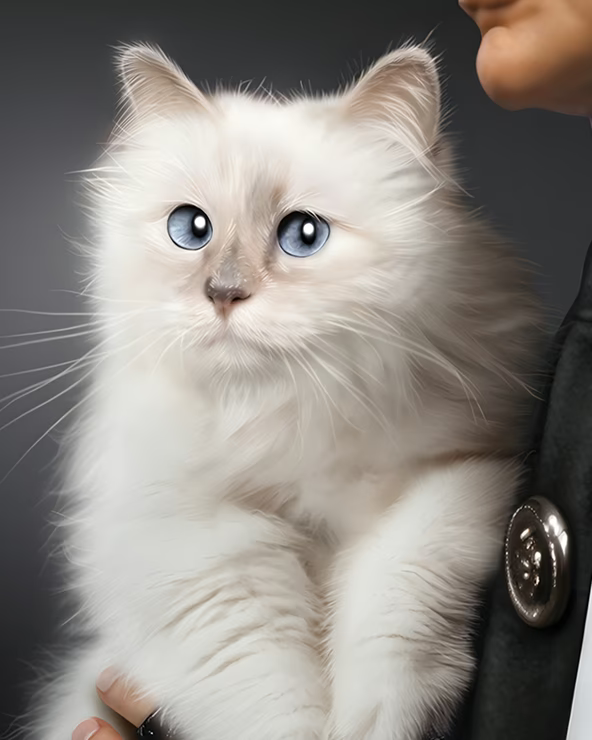
Karl Lagerfeld, the great German fashion designer, lived in a surreal kind of grandeur. The creative director of both Chanel and Fendi, he owned apartments in Paris, Rome, and the Côte d’Azur, as well as villas in Biarritz and his native Hamburg; enormous collections of Art Deco furniture, antique jewelry, and couture garments; a personal library of some 300,000 books, by his own estimation; paintings and sculptures by Jeff Koons, Takashi Murakami, and John Baldessari; three Rolls-Royces; a curious assemblage of 509 iPods; and hundreds of pairs of his trademark wraparound sunglasses and fingerless biker gloves. According to a conversation that his biographer, William Middleton, had with the Parisian florist Lachaume, his annual flower budget appears to have been about 1.5 million euros. Lagerfeld never married or had children, and when he died of cancer, in 2019, the press quickly began to speculate about the immense fortune he’d supposedly left behind, which a number of outlets, including Bloomberg, Forbes, and The Guardian, ballparked at more than $200 million. Speculation also swirled about where these riches would end up.
More than seven years later, here is what is known for certain about the details of Lagerfeld’s will and estate: nothing. (Under French law, such matters are not made public.) But plenty has been rumored. Various figures close to Lagerfeld have been suggested as beneficiaries, including several male models and fashion executives, his bodyguard, his housekeeper, and the princess of Monaco. Even so, from the start, one improbable name has stood out: Choupette, Lagerfeld’s blue-cream Birman cat.
In the years before he died, Lagerfeld often spoke in extraordinary ways about the role Choupette played in his life. Listen to just a fraction of his avowals: “I never thought that I could fall in love with an animal like this.” “She is the center of the world. If you saw her, you would understand. She is kind of Greta Garbo.” “She has lunch and dinner with me, on the table, with her own dishes. She never touches my food. She would never eat on the floor.” “I have only one great love, my cat, Choupette.” And, ruefully, “There is no marriage, yet, for human beings and animals.”
Choupette came into Lagerfeld’s life over the 2011 Christmas holiday. A young model with whom Lagerfeld had a close friendship, Baptiste Giabiconi, asked whether he might leave his four-month-old kitten at Lagerfeld’s home while he visited family in Marseille. Somewhat reluctantly, Lagerfeld, who had previously had little time or affection for cats, agreed and found himself besotted. When the kitten was reclaimed by Giabiconi, Lagerfeld moped, and beseeched that Choupette be returned to him for good, a wish soon granted.
Choupette’s fame swiftly grew, and Lagerfeld routinely extolled the extravagance of his cat’s day-to-day life: how she ate chef-prepared meals off the best china, traveled by private jet, appeared with models on magazine covers, and starred in advertising campaigns. Lagerfeld proclaimed her the most famous cat in the world and declared that her advertising work had made her independently wealthy. “She has her own fortune from things she did,” he stated. “She’s a rich girl!”
Once he adopted her, few Lagerfeld interviews failed to include testimony to Choupette’s outsize role in his life, albeit clearly one that reflected his own particular tastes and needs. “She’s peaceful, funny, fun, graceful, she’s pretty to look at, and she has a great gait,” he’d explain, “but her main quality is that she doesn’t speak. It was love at first sight.”
In his later years, Lagerfeld had intense attachments to select younger men he adopted as muses, but he is not believed to have had conventional romantic relationships. (As a younger man, he had a partner of nearly 20 years, Jacques de Bascher, who died from AIDS in 1989.) Lagerfeld often spoke as though his was a life that sidestepped sex entirely, though he once told Vice magazine: “I personally only like high-class escorts. I don’t like sleeping with people I really love.” Either way, if the manner in which he chose to live could be considered to have left a void, Choupette seems to have filled it. In a period when the designer was no longer close-shaven, he observed, “With this facial hair, I am really starting to look like Choupette. We are like an old couple. She even grooms the beard—we sleep on the same pillow and she spends her time licking it.”
Then reality intervened. Lagerfeld had learned he had cancer several years before his death in a Paris hospital on February 19, 2019, but this was information he had shared with almost no one. To ensure that Choupette was properly taken care of after he was gone, he designated his housemaid Françoise Caçote, who had long been the cat’s primary lady-in-waiting (and diarist), as her ongoing caretaker. During Lagerfeld’s last days, she surreptitiously brought Choupette to his hospital room. Once, not long before Lagerfeld’s death, Choupette caused great panic by disappearing, feared lost in the wider hospital, until her tail was spotted sticking out from her hiding place in Lagerfeld’s en suite bathroom.
As the post-death arrangements were made (Lagerfeld would be cremated with a piece of aquamarine jewelry bearing Choupette’s likeness), the media speculation about Lagerfeld’s estate began. The narrative that this involved Choupette had been primed by Lagerfeld himself, who had referred to how, should he die first, Choupette would be lavishly provided for. Although some reports that week allowed that any bequest to Choupette was, as yet, unconfirmed, a fair few were more absolute—led, as many such narratives are, by the British press, even its supposedly more respectable sectors. Their cumulative message was clear: “A cat belonging to the fashion designer Karl Lagerfeld, who died on Tuesday, is reportedly in line to receive up to $300m (£230m) of his estate” (The Telegraph); “Karl Lagerfeld’s cat, Choupette, may be set to inherit some of his £150 million fortune” (the Daily Express); “Karl Lagerfeld’s cat Choupette is reportedly set to inherit some of the formidable fashion designer’s £150m fortune” (the Independent).
The swirl of scuttlebutt about other beneficiaries, totals, tax liabilities, and relative shares has continued ever since, and there are consistent reports that, even now, no one has received any money. Nonetheless, it has been printed as established fact that, separate from his will, Lagerfeld had arranged a sizable sum, generally said to be about $1.5 million (though sometimes as much as $4 million), to ensure that Choupette would live on in the style to which she had become accustomed. She was, it was sometimes claimed, the richest cat in the world.
A little over seven years after Lagerfeld’s death, I’m sitting in an office building that towers above the Parisian suburb of Courbevoie with a man named Lucas Bérullier. Bérullier is Choupette’s agent.
Bérullier never met Lagerfeld, but he is fluent in the lore. “There’s a story,” he recalls, “when he adopted Choupette, at early stages and she was still young, everything was white in his apartment, and she was like a white fur ball. And he was so scared of someone or himself sitting on her or hurting her that he had every piece of furniture changed into black.”
Bérullier runs a company called My Pet Agency, one he started nearly a decade ago after seeing an unfilled opportunity for representing pets with potent social-media engagement. My Pet Agency’s menagerie is dominated by dogs, which Bérullier says are generally more obliging than cats. One of the dogs he has represented is Messi, the French border collie prominently featured in the film Anatomy of a Fall, though Bérullier points out that the company handled only Messi’s “social-media and special campaigns,” not his acting work. (Yes, this is a world where an animal might have more than one agent.) Most of the rest are cats, though along the way there has also been Buckley the cow, Cheepy the Australian cockatoo, Jiro the otter, Spike the beetle, and Mr. Pokee the smiling hedgehog.
As the business grew, Bérullier was aware that there was one megafamous pet living nearby in Paris that he would love to bring into his stable. While Lagerfeld was alive, Bérullier never found a way to make contact, but the summer after his death, an initial connection was finally made. Bérullier’s wife, a makeup artist, was doing a job in Lagerfeld’s studio, and she got to talking with Lagerfeld’s former bodyguard and confidant Sébastien Jondeau about Choupette. Bérullier soon went to visit Françoise Caçote and Choupette, and everything was agreed. “She needed someone to help harmonizing and structuring the communication,” he says. “Someone on her side defending what was best for her and what was best for Choupette.”
These days, Choupette lives in an apartment with Caçote somewhere in Paris, but I’m told that neither cat nor caregiver is receiving visitors right now. Bérullier says that a large part of his job, when it comes to matters relating to this particular client, involves turning people down.
He says that commercial opportunities are screened according to a number of criteria: Beyond financial considerations, there are questions as to whether such offers are suitable for Choupette and for Lagerfeld’s legacy. There are moral considerations, too. “We believe that Choupette only works with animal-cruelty-free brands,” he explains. “A brand that uses fur, we would have to decline a collaboration.”
Bérullier shares one more practical accommodation made for the most important shoots: Whenever prudent, there will be a cat double on set, ready to do whatever Choupette might not. They don’t use just one regular stand-in—it depends on what might be required that day: “We know the one that is very human-friendly, the other one that is playful, the one that has the eyes that look the same or the tail that looks the same.” It’s clear that he does not consider this duplicity, more the reality of dealing with animal actors—and one, he points out, that is routine in moviemaking. He notes that the Choupette camp doesn’t go out of its way to disguise footage from a double, and that eagle-eyed Choupette fans can often tell.
Bérullier also demystifies some other assumptions that lie at the very core of how Choupette is commonly perceived. The multimillion-dollar fees that Lagerfeld alluded to Choupette commanding were for campaigns where the clients were largely paying for Lagerfeld’s name, and also for Lagerfeld being the photographer, designer, and art director. Bérullier doesn’t share Choupette’s current rate card but suggests that the numbers involved are substantially more modest. “Let’s be honest, we can’t ask millions for a post or a shoot,” he says.
Likewise, he punctures the notion, one that Lagerfeld sometimes explicitly stated, that Choupette has her own seven-figure bank account. “The law is the law,” he says. “A cat can’t own a bank account.” (When I ask whether there couldn’t be some kind of corporation holding the money, he says that if this were so, it would be a matter of public record.) Furthermore, he suggests that we should be skeptical of stories that Caçote has already received a million-plus sum on Choupette’s behalf. The one printed story of this kind that Bérullier verifies is that Lagerfeld did, before his death, give Caçote the apartment in which she and Choupette live, but he notes that even this came with substantial unaddressed French tax liabilities.
As for the will itself, here are some more details of what has been rumored. The will was apparently written in April 2016, and there are commonly said to be a number of beneficiaries. Many accounts suggest the former bodyguard Sébastien Jondeau and two of Lagerfeld’s male-model muses, Baptiste Giabiconi and Brad Kroenig. It is generally agreed that the Lagerfeld executive Caroline Lebar is also named. Sometimes, but not always, mentioned are the former Chanel creative director Virginie Viard; the writer and style consultant Amanda Harlech; a second Lagerfeld executive, Sophie de Langlade; Kroenig’s son Hudson (Lagerfeld’s godson, who started modeling for Lagerfeld on the runway at age 2); another model friend and protégé, Jake Davies; Princess Caroline of Monaco; and Caçote. (Animals may not inherit directly under French law.)
It is said that a key reason for the delay in settling Lagerfeld’s estate is a long-standing legal fight with the French tax authorities. One area of dispute may stem from the repercussions of the belated discovery that Lagerfeld’s home in Monaco, where the tax regime is famously gentler, was technically in France. But there may well be more than that. There is talk of a complicated web of international corporations potentially structured to reduce tax liability, and it was reported several years before Lagerfeld’s death that he was under investigation for tax evasion. An added layer of intrigue was the apparent disappearance of Lucien Frydlender, Lagerfeld’s accountant of 30 years and the estate’s putative executor, who reportedly died in Israel in 2024.
The latest rumored turn in the seemingly never-ending drama of the Lagerfeld estate came earlier this year. It had been reported in 2024 that the beneficiaries had agreed on terms to settle with the tax authorities. According to the German magazine Bunte, in December 2025 the will had at last been finalized, but then had apparently been challenged by an unknown party. This had come to light, Bunte asserted, because Lagerfeld’s surviving blood relatives had received a letter informing them of this development. These relatives, who are not believed to be in the will, had apparently been notified because, should it be ruled that Lagerfeld had no valid will, his estate would then be divided among them.
Lagerfeld was born in Hamburg in 1933. (For many years, he would claim to have been born in 1938, something he would later attribute to his discomfort at having been born in the year of the Nazis’ rise to power.) Lagerfeld’s father—who, incidentally, was a member of the Nazi party—had been married before, and Lagerfeld had an older half-sister, Thea. It is from that line of the family that his surviving German niece, Thoma Theodora Friederike, the countess von der Schulenburg, comes. She is quoted in the Bunte article as saying that she would “emphatically reject” any inheritance.
But Lagerfeld also had a full sister, Martha Christiane, who was two years older than him. When she was in her mid-20s, she took a job in Seattle as an au pair. There she met a tax inspector named Robert Johnson; they married and moved back to his hometown of Portland, Connecticut, where they raised three boys and one girl.
Most of Choupette’s public life in the years since Lagerfeld’s death has been rather more low-key. Her most regular client is a high-end German cat-accessories-and-toys brand called LucyBalu. Just before Christmas, she did a shoot for a Maisons du Monde home-decor range. Last year, she was announced as the French voice of the mischievous cat Azraël in the French version of the Smurfs movie (Les Schtroumpfs ), though that was more clever marketing than anything else. She filmed some promotional footage but, cat being a universal language, no French-cat noises were overdubbed in place of the original sounds.
For more information see Chris Heath “The Richest Cat in the World” The Atlantic, May 18, 2026.