

Friends,
Two notable events occurred this week that matter for anyone doing deals:
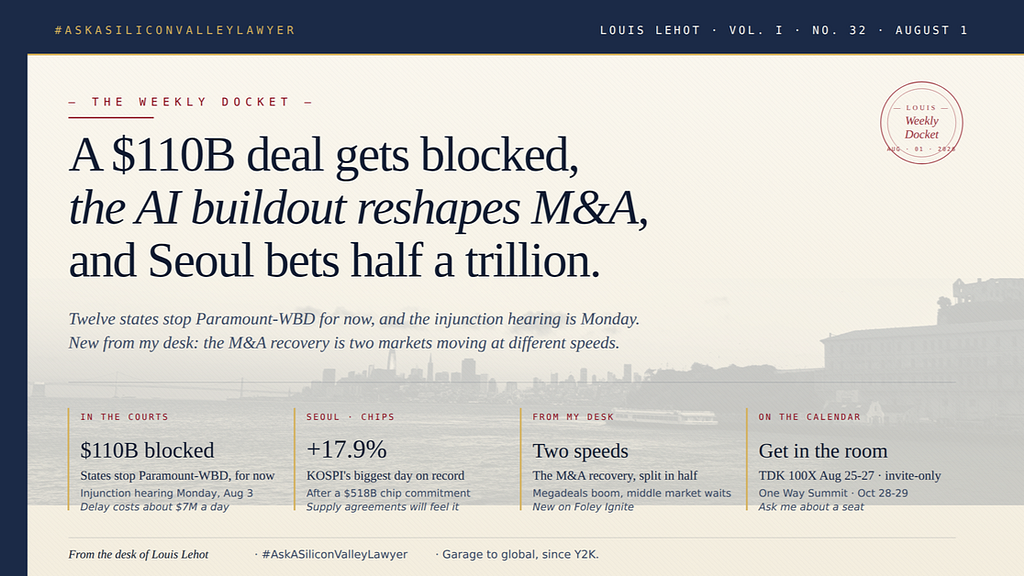
- Twelve states kept a $110 billion merger from closing even though federal and European regulators had already cleared it, and the court hears the motion for a longer freeze on Monday.
- The earnings reports from the largest technology companies confirmed how much capital is moving into AI infrastructure, which is changing who is buying what.
As always, my firm announced some new deals and published some new pieces.
We spent Monday evening with friends for our third annual summer investor reception on the rooftop of The Graduate Hotel in Palo Alto.
Here is the week.
In the Courts
◊ The Paramount-Warner Bros. merger is on hold. Twelve state attorneys general, led by California, sued to block the $110 billion deal, and a federal judge in Oakland entered a restraining order that bars closing or any step toward integration. Paramount has since agreed not to close until five days after an antitrust trial, or June 2027 at the latest, and the court hears the preliminary injunction motion on Monday. The DOJ cleared this deal in June and Europe approved it with conditions, and the states proceeded anyway. The delay is expensive: a ticking fee of roughly seven million dollars a day starting October 1, and seven billion dollars owed to Warner if the deal has not closed by June 2027. The states paused Nexstar’s purchase of Tegna the same way, so I do not think Paramount will be the last.
◊ The Section 232 pharmaceutical tariffs began taking effect on Friday for the first group of named companies. If your business makes or buys drug products across borders, this is the week to reread the sourcing, pricing, and pass-through provisions in your supply agreements.
Recent Deals
◊ Foley represented Drizzy in its US structuring and pre-seed financing. Drizzy is a peanut butter brand founded in Sydney and now headquartered in the United States and Australia, and its round was backed by RiverPark Ventures, Nucleus Ventures, and Alexis Ohanian. Cross-border founders still build a leg of the stool here in the United States, and getting the structure right at the start costs far less than fixing it later.
◊ Foley advised Iris Telehealth on a secured financing commitment from Symbiotic Capital. Iris provides behavioral health services to health systems and community healthcare organizations. Lenders are still willing to commit to digital health companies that solve concrete problems for providers.
The Tape, Briefly
The five largest technology companies reported this week, and the market sorted them one by one. Microsoft and Amazon rose after tying their capital spending to demand they could show, Meta and Alphabet fell after they could not, and Apple reported record revenue and briefly became the first five trillion dollar company. Nearly two trillion dollars moved among those names in five days, and the S&P 500 still ended the week higher, within about two percent of its record. The jobs report comes next week. Two things in all of that matter for deals:
◊ The AI buildout is reshaping who buys what. Amazon reported the first $200 billion revenue quarter on record and raised its planned capital spending to $220 billion, and Microsoft’s cloud business passed $100 billion in annual revenue. Spending at that scale has consequences for deal flow. The largest technology companies are now acquiring power generation rather than simply contracting for it, which is moving M&A activity into energy and infrastructure, and the buildout is competing for capital that might otherwise fund acquisitions elsewhere. I wrote about that dynamic in the piece below.
◊ South Korea committed $518 billion to semiconductors. The Korean market responded with the largest single-day gain in its history on Friday. Companies that depend on Korean memory should expect the shortage to show up in pricing and allocation, and it is worth reviewing supply agreements with that in mind.
◊ The IPO window widened beyond tech. Jersey Mike’s brought a roughly one billion dollar offering to the New York Stock Exchange this week and Reformation followed at about a quarter of that size, two consumer brands rather than AI companies. In Shanghai, memory maker ChangXin came to the STAR Market with a roughly $8.6 billion raise, the largest in that board’s history. When sandwich chains and apparel brands can list alongside chipmakers, the window is not carrying just one story, and that is a good sign for anyone preparing for 2027.
From My Desk
Two new pieces this week:
◊ The M&A Recovery: Two Markets Moving at Different Speeds. First-half deal value is up 28 percent, the strongest start since 2021, but nearly half of that value comes from deals above five billion dollars, and without them aggregate value is down. Capital is concentrating in AI infrastructure while middle-market sellers face valuation gaps and expensive financing. The piece covers what sellers in each market should be doing about it.
◊ Seoul Bets Big: What South Korea’s $518 Billion Semiconductor Gamble Means for Global Tech Companies. This one covers what the commitment means for companies that build on Korean chips, from supply security to where the next fabs and partnerships are likely to land.
Around the Firm
◊ Thank you to everyone who joined us for our Annual Investor Summer Reception on Monday. And thank you to my co-hosts, Murray Newlands, Hull Xu, Tiaan De Nysschen and Erika Wu. It was a gorgeous summer evening in Palo Alto with old friends and new ones on the rooftop of The Graduate Hotel. There is a short video from the evening here. If you invest and would like to join us next time, reply to this email.
On the Calendar
◊ TDK Ventures 100X. August 25 to 27, San Francisco. TDK’s invite-only deep-tech summit is three weeks out. If you are building in hard tech and would like an introduction, let me know.
◊ One Way Summit. October 28 and 29, San Francisco. A thousand immigrant founders and the investors who back them, and I will be on the program.
Closing Argument
◊ If you are negotiating a large deal, read the Paramount stipulation and the ticking fee provisions. Assume state review is possible even after federal clearance, and build the outside date, the delay economics, and the interim covenants accordingly.
◊ If you are preparing to sell, the two-speed market is real. Buyers are paying up for companies near the AI infrastructure build and testing everyone else’s claims carefully, so prepare the financials, the growth story, and the data behind any AI claim before you go out.
◊ If you are raising or investing, I am always glad to make introductions between the two. Reply anytime.
— Louis