


The CDC closed its investigation of the multistate Salmonella Enteritidis outbreak linked to shell eggs on September 3, 2026. The final count is 134 people sick in 18 states, 34 of them hospitalized, and no deaths. Illnesses began on dates ranging from November 21, 2025 to August 12, 2026. Epidemiologic, laboratory, and traceback evidence pointed to shell eggs produced and distributed by Midwest Poultry Services, L.P., which recalled more than 1.5 million dozen eggs from its Texas farms on July 22, 2026. The recalled eggs are past their expiration dates and should no longer be on shelves.
The outbreak by the numbers
| Total illnesses | 134 |
| States | 18 (AR, AZ, CA, CO, GA, IL, LA, MI, MO, MS, NC, NM, NV, NY, OK, SC, TX, WV) |
| Hospitalizations | 34 (35%) |
| Deaths | 0 |
| Illness onset dates | Nov. 21, 2025 to Aug. 12, 2026 |
| Ages | Under 1 to 86; median 42 |
| Ate shell eggs | 46 of 54 interviewed (85%) |
| Outbreak identified by PulseNet | April 2026 |
| Recall | July 22, 2026 — 1,589,577 dozen eggs |
| Investigation closed | Sept. 3, 2026 |
Sources: CDC final update and FDA outbreak investigation, both September 3, 2026.
Texas accounted for 99 of the 134 cases. Louisiana had 8, Arkansas 5, Arizona 4, New Mexico 3, and Georgia and Oklahoma 2 each. Eleven states reported a single case: California, Colorado, Illinois, Michigan, Missouri, Mississippi, North Carolina, Nevada, New York, South Carolina, and West Virginia.
Where people got sick

Case counts by state of residence. Built from the CDC data table released with the final update.
Where the recalled eggs went
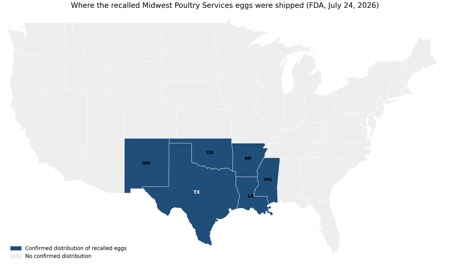
FDA confirmed distribution of the recalled eggs to Texas, Oklahoma, Louisiana, Arkansas, New Mexico, and Mississippi, and cautions that product could have reached additional states. Recalled eggs were sold at Kroger stores in Texas and Louisiana; Brookshire Grocery stores in Texas, Oklahoma, Arkansas, and Louisiana; and smaller retail and foodservice outlets in those states plus Mississippi and New Mexico. Foodservice customers in Texas, Oklahoma, and Louisiana also received them. Twelve of the 18 states with cases lie outside the confirmed distribution area. Source: FDA.
When people got sick
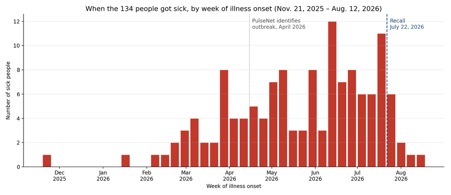
Epidemic curve by week of illness onset, from the CDC timeline data. Twenty-seven people got sick before April 1, 2026, the month PulseNet flagged the cluster. Ninety-nine more got sick between April 1 and July 21, the day before the recall. The two biggest weeks of the outbreak came in mid-June (12 cases) and mid-July (11 cases). Eight people fell ill on or after the recall date, the last on August 12. Those late cases likely reflect eggs already in refrigerators when the recall was announced.
How investigators tied the eggs to the illnesses
Whole genome sequencing showed the bacteria from the 134 patients were closely related, meaning they likely shared a source. The outbreak strain is related to a Salmonella Enteritidis strain isolated from chicken, eggs, and backyard poultry. Sequencing also predicted nonsusceptibility to ciprofloxacin and resistance to nalidixic acid, so some illnesses may not have responded to commonly prescribed antibiotics.
Of the 54 people interviewed about what they ate in the week before they got sick, 46 (85%) reported eating shell eggs. FDA’s traceback, based on where sick people bought or ate eggs, identified Midwest Poultry Services as a common source for some cases. The company collected samples at its Texas farms; those samples tested positive for Salmonella, and its third-party lab’s sequencing matched the outbreak strain. The company shared those results with FDA on July 21 and recalled the eggs the next day. FDA then inspected the Texas operation and collected environmental samples, three of which matched the outbreak strain by whole genome sequencing.
One change between FDA’s first update and its last deserves attention. On July 24, with 98 cases in 17 states, FDA said the recalled eggs were a likely source “in part,” that the producer did not account for all the illnesses, and that investigators were looking for other sources. The September 3 final update dropped that qualifier and identified Midwest Poultry Services eggs as a likely source of illnesses for the outbreak without naming any other source. Sources: FDA July 24 update.
Who is Midwest Poultry Services?
Midwest Poultry Services, L.P., which has done business as MPS Egg Farms since a 2019 rebrand, is a family-owned egg producer headquartered at 800 Wabash Road in North Manchester, Indiana. The Strauss family traces the business to an 1875 grain mill on the Eel River; Midwest Poultry Services itself was established in 1968 when the Strauss family partnered with the Manwaring family to bring egg production in house. Bob Krouse, who married into the family in 1983, was chief executive officer when the Texas farms were acquired in 2020, and his sons Dan and Sam Krouse are the sixth generation to lead the company. Source: The MPS Story.
The Texas farms at the center of this outbreak came from MPS’s April 2020 purchase of Feather Crest Farms, a 70-year-old Texas producer with two farms, in Kurten (Brazos County, near Bryan-College Station) and Center (Shelby County, in East Texas). That acquisition added about 1 million hens and 96 employees, bringing MPS to roughly 11 million hens producing about 9.35 million eggs a day at the time. Source: Feedstuffs, April 23, 2020.
The company’s recall FAQ says it found the problem “on two of its farm locations in Texas through proactive environmental monitoring practices,” began diverting eggs from those farms to a breaking plant for pasteurization, and is not distributing fresh eggs produced on its Texas farms at this time. The July 22 recall notice stated the company was “not aware of any specific illnesses linked to its products.” Two days later FDA reported 98 illnesses linked to the eggs. Sources: MPS Egg Farms recall FAQ and FDA recall notice.
What was recalled
The recall covered white shell eggs and brown cage-free shell eggs produced and distributed from the Texas farms between June 6 and July 3, 2026, with sell-by or best-by dates from July 20 through August 17, 2026. Recalled cartons carry plant code P-1950 or 0840962 and a Julian date between 157 and 184, printed in date-coding ink on the side of the carton. Retail brands included Kroger (medium, large, extra large, and jumbo, in 12-, 18-, 30-, and 60-count cartons), Simple Truth Cage Free brown eggs, Brookshire’s, Country Morning, and Sunups, along with Grade A and AA bulk eggs sold to foodservice in 15- and 30-dozen cases. The full product table with UPCs is on the FDA recall page.
What this outbreak tells us
The timeline is the story. The first illness in this cluster began the week before Thanksgiving 2025. PulseNet, the national database of bacterial DNA fingerprints, identified the outbreak in April 2026. The recall did not come until July 22, and it came because the company’s own environmental testing and third-party sequencing turned up the outbreak strain, not because regulators had already traced illnesses to a specific farm. In the fifteen weeks between the PulseNet signal and the recall, 99 people got sick. That is nearly three quarters of the outbreak.
Salmonella Enteritidis in eggs is a problem the industry and FDA have been working on since the Egg Safety Rule took effect in 2010. That rule requires large producers to test their houses for SE, and it exists precisely because SE can infect a hen’s ovaries and be deposited inside an intact, clean-looking egg before the shell forms. Washing does nothing for that. Environmental monitoring caught this problem, eventually. The open question for FDA, which inspected the Texas operation and found the outbreak strain in three environmental samples, is what the testing history at those two farms looked like between November and July, and whether earlier positives were acted on.
The 34 hospitalizations represent 35% of cases, and CDC notes that some illnesses may not have been treatable with commonly recommended antibiotics. Anyone who was hospitalized, or who is still dealing with reactive arthritis or irritable bowel after a confirmed infection, should keep their medical records and lab results. Most people recover, and as the CDC notes, the real number of sick people is far higher than 134 because most never get tested.
Salmonella: what to know
Symptoms usually start 12 to 72 hours after eating contaminated food and include diarrhea, fever, and abdominal cramps lasting four to seven days. Children under five, adults over 65, and people with weakened immune systems are at highest risk. Cook eggs until the yolk and white are firm, and cook dishes containing eggs to 160°F.
Why did people get sick in 18 states when the recalled eggs were only confirmed in six?
Three reasons, and they are not mutually exclusive. First, FDA’s distribution list is what the agency could confirm from the company’s shipping records, and FDA itself cautions that product could have reached additional states. Bulk eggs sold to foodservice in 15- and 30-dozen cases are routinely resold through secondary distributors and repacked under other labels, and that trail is much harder to follow than a branded retail carton. Second, CDC maps cases by where people live, not where they ate. Texas, Louisiana, and the Gulf Coast draw visitors, and a resident of Michigan or New York who ate eggs at a Texas restaurant in June counts as a Michigan or New York case. Third, the outbreak strain is related to a Salmonella Enteritidis strain found in chicken, eggs, and backyard poultry generally, and FDA’s July 24 update said Midwest Poultry Services did not account for all the illnesses. Some of the single cases in far-off states may have had a different source that shares the same genetic fingerprint. The core of the outbreak is not in doubt: 99 of the 134 cases were in Texas, and 118 were in the six distribution states.
Are the recalled eggs still in stores?
No. The recalled eggs carried sell-by or best-by dates of July 20 through August 17, 2026, and FDA says they should no longer be available for sale. If you have eggs in the refrigerator with plant code P-1950 or 0840962 and a Julian date between 157 and 184 printed on the side of the carton, throw them out and clean any surfaces or containers they touched.
How did investigators know the eggs came from Midwest Poultry Services?
Four independent lines of evidence. Whole genome sequencing showed the bacteria from all 134 patients were closely related. Interviews found that 46 of 54 people (85%) had eaten shell eggs the week before they got sick. FDA traced where sick people bought or ate eggs and identified Midwest Poultry Services as a common source. Then the company’s own farm samples, sequenced by its third-party lab, matched the outbreak strain, and FDA’s inspection of the Texas operation found the outbreak strain in three environmental samples.
Why did it take from November 2025 to July 2026 to recall the eggs?
The first illness began November 21, 2025, but a single case is not an outbreak. PulseNet, CDC’s national database of bacterial DNA fingerprints, did not identify the cluster until April 2026. Traceback from there takes time, because investigators have to interview patients, collect receipts and shopper-card data, and follow eggs back through retailers and distributors to a farm. The recall came on July 22, one day after the company shared its own positive test results with FDA. Ninety-nine people got sick between April 1 and July 21.
Was this strain resistant to antibiotics?
Sequencing predicted nonsusceptibility to ciprofloxacin and resistance to nalidixic acid. Most people with Salmonella recover without antibiotics, but CDC says some illnesses in this outbreak may not have been treatable with commonly recommended antibiotics and may have required a different drug. That matters for the 34 people who were hospitalized.
How does Salmonella get inside an egg?
Salmonella Enteritidis can infect a hen’s ovaries and be deposited inside the egg before the shell forms. The egg looks clean and intact; washing the shell does nothing. That is why FDA’s 2010 Egg Safety Rule requires large producers to test their henhouse environments for SE and, if positive, to test eggs and divert them to pasteurization. Midwest Poultry Services says its environmental monitoring is what found the problem.
I ate eggs and got sick. What should I do?
See a health care provider and ask for a stool test; Salmonella is confirmed by culture, and a confirmed result is what links you to the outbreak. Keep any carton, receipt, or shopper-card record. If you were hospitalized, keep your discharge papers and lab reports. Symptoms usually begin 12 to 72 hours after eating contaminated food, and lingering problems such as reactive arthritis or post-infectious irritable bowel can appear weeks later.
Can I bring a claim if I was part of this outbreak?
Yes. A producer that sells contaminated eggs is responsible for the harm they cause, and a lab-confirmed match to the outbreak strain plus a documented egg exposure is the foundation of a claim. Marler Clark has represented Salmonella victims across the country, including in outbreaks linked to eggs. Call 1-800-884-9840.