

Golf has a long reputation as a gentleman’s sport, one in which a self-enforced ethical code makes cheating exceedingly rare. If a golfer breaks a rule of the game, he or she is expected to self-report the violation and accept

Golf has a long reputation as a gentleman’s sport, one in which a self-enforced ethical code makes cheating exceedingly rare. If a golfer breaks a rule of the game, he or she is expected to self-report the violation and accept

Civil litigation—especially for the defense—often feels like a purely reactive process, a series of responses to an opposing party’s actions. But in reality, it shouldn’t be—especially for organizations who have the resources to have a dedicated legal department and technology
For the past several months, dating back to the release of Exterro and EDRM’s E-Discovery Maturity Quiz in September, this blog has looked at a variety of ways for organizations to either self-assess their e-discovery maturity, improve it,

Nuvasive, Inc. v. Kormanis (M.D. N.C. Mar. 13, 2019) shows that when the duty to preserve is triggered, it’s imperative that parties take immediate measures to preserve data in a variety of locations including personal cell phones.
Overview
In this employment/breach

Hopefully, unlike a certain former protagonist on Game of Thrones, you differentiate between “feeling angry” and “burning a city down.” Seriously, though, if you’re having a tough time getting custodians to comply with your legal holds, you might want to
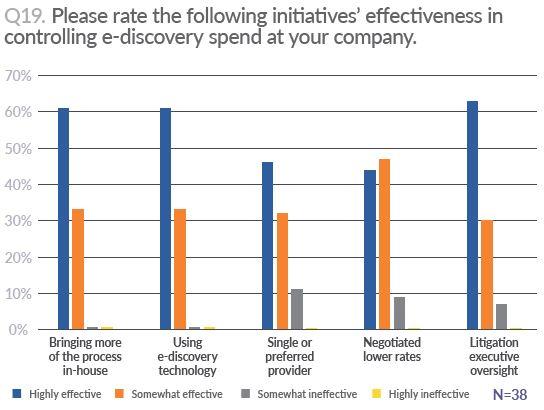
Anyone with more than a passing acquaintance with this blog knows we believe that, for many organizations, in-sourcing e-discovery operations and implementing an e-discovery platform make good sense. The benefits are clear-cut and real. It helps you ensure you’re complying

We conduct a fair amount of research into the e-discovery marketplace here at Exterro. Whether it’s into the composition and practices of in-house legal teams or the federal judiciary’s opinions on managing e-discovery, we try hard to provide valuable insight

Clearly understanding the requirements for spoliation sanctions under Rule 37(e) will save you a lot of time, especially when you haven’t confirmed whether data is irretrievable or not. Unfortunately, the defendant in Envy Hawaii LLC v. Volvo Car USA LLC learned

Of course you do have a defined process. No e-discovery professional worth his or her salt would be satisfied with a reactive fire drill every time litigation or an investigation started. But if you’re just getting started on your e-discovery

For many organizations, e-discovery often ends up as a reactive fire drill, rather than a standard business process. Perhaps the IT is unaware of potential litigation risks and has to scramble to preserve electronically stored information (ESI) before it is