

Skip to content

Menu

LexBlog, Inc. logo
NetworkSub-MenuBrowse by SubjectBrowse by PublisherJoin the NetworkGet StartedSubscribeSupportContact
Search
Close

Unlawful to Rollerblade?: An Important Lesson in Product/Service Naming

By Steve Baird® on April 2, 2009
Email this postTweet this postLike this postShare this post on LinkedIn

This kind of sign is all over the place. They are readily available for sale on-line too, see here, here, and here. In fact, a similar one is posted on every level of at least one parking garage in downtown Minneapolis. What does it mean to you? How about to the Rollerblade® brand?
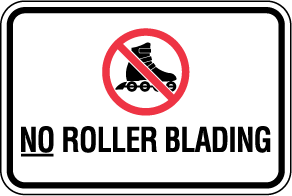
For example, would you be “o.k.” skating in the vicinity of the sign wearing, say, K2® brand in-line skates, or perhaps, Nike® Bauer® in-line skates? Would the owner of the real estate who posted the sign agree? Would Nordica® agree, as the owner of the ROLLERBLADE® mark? Doubtful.

Similar misuses of the ROLLERBLADE® brand appear in city and township ordinances and in meeting minutes across the country. Some make “unlawful” the operation of a “skateboard or rollerblade” except on sidewalks. Others forbid “rollerblading (which is the same as inline skating).” Yet others seem to only forbid “rollerblading” when there is a “dog in tow.” Ah, right. Some progressive cities have had the foresight to forbid not only “rollerblading,” but “roller skating” too, closing the potential branding loophole defense, for us trademark types.

How does this happen? Seth Godin’s recent blog post “Where’s the Baxter?” may have some application here, perhaps with a little embellishment by yours truly. Mr. Godin correctly reminds us of the importance of creating a “name” for a new product, especially when “you make something remarkable,” or “its something that hasn’t been done before,” basically, when “you’ve created something worth talking about,” and it may disappoint others to learn when they like the name too, it “is already taken.” When something is “taken” in the naming context, we’re talking about brand names, not generic names. The former can be owned, the latter cannot. So, brand names seem to get the most attention prior to launching a revolutionary new product or service.

Getting much less attention, and deserving far more, is the need to create an acceptable generic name too, especially when the new product is truly “remarkable,” and appears headed for creating a new category. For example, had Rollerblade® adopted, embraced, and promoted “in-line skates” as the generic name for the category it “pioneered” in the early 1980s, it seems unlikely the misuses would be as prevalent as they are today. How do we know it didn’t take these early steps? Besides my imperfect consumer recollection from the decade of the 1980s, I rely on the clunky patent-like generic product description set forth in the original ROLLERBLADE® trademark registration (1985), covering “boots equipped with longitudinally aligned rollers used for skating and skiing.” Uh, not a very consumer-friendly sound-bite. As far as I can tell, it wasn’t until the close of the 1980s that the term “in-line skating” or “in-line skates” began to appear, at least, in Rollerblade® trademark filings, see the 1990 U.S. registration for TEAM ROLLERBLADE®. A decade is a lot of history to erase.

Photo of Steve Baird® Steve Baird®

View my professional biography

Just so you know, I’m all about brands and the law, both professionally and personally. I regularly annoy family and friends in retail stores by focusing on product labels—not to buy the product, but to read the fine print…

View my professional biography

Just so you know, I’m all about brands and the law, both professionally and personally. I regularly annoy family and friends in retail stores by focusing on product labels—not to buy the product, but to read the fine print and ask, “Who owns these brands” and “Did they really register those marks?” To understand the depth of my passion for brands and helping clients achieve their business goals, legally, you must understand that my interest in business and branding goes back to the late 1960s. The very first brand I recall profiting from was Jiffy®. Even before being old enough to deliver papers for the Iowa City Press Citizen, between episodes of Bewitched®, I would bake cupcakes and walk my finished product door-to-door, sampling along the way, of course, throughout our Kimball Road neighborhood, mostly selling them to husbands whose wives didn’t bake enough (probably watching Bewitched®), according to them at least. One hundred percent profit margins are easy when you can use the necessary equipment and raw materials directly from Mom’s kitchen. Mass producing “hot pads” (pot holders, not real estate) and selling them door-to-door was another favorite childhood business venture at the ripe age of six. Graduating to lawn-mowing age worked well with my paper routes because I could easily see who needed help cutting their grass and, in some cases, avoiding neighborhood ridicule. Yes, you’re right, Dad loaned me his Lawn-Boy® mower on weekends, rent-free, and even bought the gasoline (Dad was not brand loyal at all with gasoline, so I have no brand memory there). Another pure profit opportunity. Let’s just say that Mom and Dad were generous, unsecured investors in my development and future. Thanks Mom and Dad, I now understand the meaning of overhead and capital improvements! I bucked a lot of family tradition and jokes to become a lawyer and a trademark guru. There is not one lawyer in the family tree, as far as my sister knows (and she would know). Nearly everyone is, or was, a teacher of some kind. That must be where my passion for educating others about the legal implications of branding comes from. Basically, I have been speaking about the legal implications of branding since the early 90s, after permitting my pharmacist’s license to expire (after being a victim of an armed robbery where Dilaudid® was on the top of the gunman’s list of desired controlled substances), and shortly after working for an 86 year old federal judge whose chambers had a nice view of the White House in Washington, D.C. While I’d like to say that the movie My Cousin Vinny inspired me to become a lawyer, it was released two years after I graduated from law school. So, really, I guess it just inspired me to be a better lawyer and leader. For now, you can call me a “thought-leader” in the trademark world, and the thankful leader of a very talented group of creative and insightful lawyers and staff who are dedicated to putting our intellectual property clients in the best possible position to achieve their business goals. When I’m not in the office, “cracking the whip,” making sure others in the group keep their bios on this blog short and sweet, working (which isn’t to say I’m not still thinking about my clients’ businesses), or soaking it up in the hot-tub with my soul-mate, I am a dedicated family man – a.k.a. the chauffeur. Until they reach the driving age, I’ll continue to shuttle my four wonderful kids around to their athletic and other events, at which you can find me cheering in the stands.

Email
Show more Show less
  • Posted in:
    Intellectual Property
  • Blog:
    DuetsBlog
  • Organization:
    Winthrop & Weinstine, P.A.
  • Article: View Original Source

Call us at 1-800-913-0988 or email sales@lexblog.com.

Facebook LinkedIn Twitter RSS
The Library at LexBlog
  • About LexBlog
  • The Field We Built
  • Library at LexBlog
  • Our Beliefs
  • Our Team
  • Contact LexBlog
  • Disclaimer
  • Editorial Policy
  • Terms of Service
  • Get Started
  • Publishing Solutions
  • Compass
  • Submit a Request
  • Support Center
  • System Status
Copyright © 2026, LexBlog, Inc. All Rights Reserved.
Law blog design & platform by LexBlog LexBlog Logo