

In its list of 500 Greatest Albums of All Time, the Rolling Stone ranked the 1967 album The Velvet Underground & Nico at number 13 – not bad for the band’s very first album. The album had a simple cover, some would say iconic, cover:

And get this: the banana peel was actually a sticker that you could peel off to reveal a pink pop art unpeeled banana underneath! Although, based on my baseball card experiences, I’m sure it ruined the resale value. Whether it was a marketing ploy, or just something that the band or Andy Warhol thought would be fun, I don’t know. I do know that it is a great combination of pop art with interactive/participatory art and combined with music!
I’ve owned the album (cd) for maybe 10 to 15 years. It’s good, but I admit I never listened to it frequently, and not for a long time. I do remember always being slightly confused as to the relation between Velvet Underground and Andy Warhol was. Although I was interested in the answer, the interest never lasted long enough to look it up. That is, until recently when I found out trademark law was now involved.
Based on my confidential, verified, inside sources at Wikipedia, Andy Warhol became their manager in 1965 and helped them get a record deal. The band was sort of a “house band” at Warhol’s studio, some parties, and on his traveling art tour named Exploding Plastic Inevitable. He designed the banana drawing for the cover and was listed as a producer on the album.
Back to the law. The remaining members of the band filed a lawsuit against the Andy Warhol Foundation for the Visual Arts (the Warhol Foundation) for trademark infringement and requesting declaratory judgment regarding the ownership of the copyright in the banana image. You see, the Warhol Foundation had agreed to license the banana image to Apple for use with iPhone cases. The Velvet Underground was concerned that consumers would believe that the Velvet Underground had somehow endorsed or authorized this use since, they argued, the banana image had gained secondary meaning associating the banana image with the Velvet Underground.
So the question becomes: who owns the copyright and what effect does that have on any trademark rights? This is an interesting situation where the Warhol Foundation could have a valid copyright in the image, but the Velvet Underground could have a valid trademark in the same image. There are many issues regarding the copyright: was there an implied license, was it a work for hire, or, in my opinion the most likely to be applicable, whether laches prevents the Foundation from pursuing any claim. The Velvet Underground continued to sell the album with the banana design, used it in promoting their tours, registered it as a trademark in 1994 (but abandoned it by failing to file a Section 8 declaration… ouch), and even licensed its use in an Absolut Vodka ad:
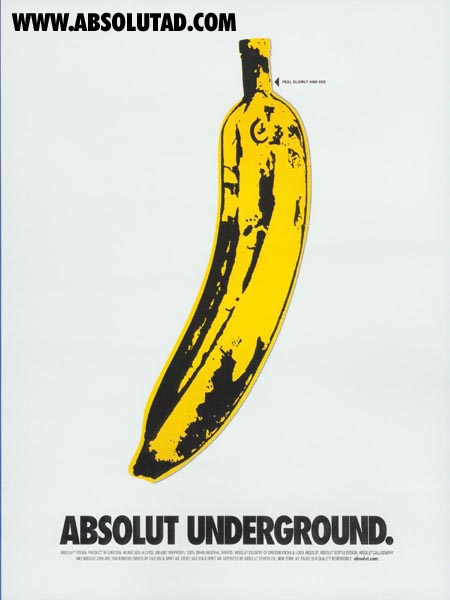
Note that Absolut licensed the banana image from Velvet Underground, not from the Warhol Foundation. The ad easily could have read ABSOLUT WARHOL but, for whatever reason, Absolut either believed that the band owned the rights to the image, or in fact associated the mark with the band rather than Andy Warhol. If you read the Rolling Stone link you’ll have notice this line: Rejected as nihilistic by the love crowd in ’67, the Banana Album (so named for its Warhol-designed cover) is the most prophetic rock album ever made.” This reference to “the Banana Album” (capitalized, no less) and “the most prophetic rock album ever made” comment in a prominent national music magazine is pretty good evidence to support a claim of secondary meaning. Plus, it doesn’t appear that Andy Warhol ever “used” the design as a mark.
Like most cases involving fun and interesting legal issues, the parties recently settled the case. While the facts in this situation are rare, it isn’t difficult to imagine a situation more plausible. A person or company could make unauthorized use (or ambiguously authorized use) of a copyrighted image as a trademark and achieve acquired distinctiveness in a short time through extensive (and successful) marketing and advertising efforts, especially through an effective digital/social media blitz. As far as I am aware, L.A. Gear still has the fastest time at the “Secondary Meaning” combine, clocking in at a crisp 5 months (L.A. Gear Inc. v. Thom McAn Shoe Co., 988 F.2d 117 (Fed. Cir. 1993)). That is quick enough to develop secondary meaning without a competing copyright claimant to lose their rights. So can an individual obtain a valid trademark exist even though each time it is reproduced it gives rise to a claim of copyright infringement? (assuming there are no contractual issues and that the copyright owner has made no use of the mark). It certainly wouldn’t make much financial sense, but it appears legally plausible.
Please note: I am not advising anyone to “borrow” another’s copyrighted image to use as a trademark just so we can see what happens. But I promise to write about it if you do.