
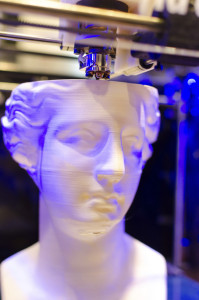
 Suppose that you have a unique configuration for your physical object. You find out that your competitor has scanned the configuration of your object and is printing the object with a three-dimensional (3-D) printer. Is there anything you can do? The answer is YES!
Let’s suppose you have created a physical object such as a lamp. The base of the lamp has a decorative configuration that is capable of existing independently of the utilitarian aspects of the lamp. The decorative configuration has a unique design that gives an aesthetic appearance that is not functional. However, you did not file for a design patent and the time period has passed for obtaining patent protection. Now, a competitor is scanning your lamp base and reproducing the decorative configuration through 3-D printing and competing against you. Is there any other form of intellectual property protection that you can use to prevent this situation from continuing?
Yes, copyright protection can be used because a copyright exists in the decorative configuration of the lamp base. Under 17 U.S.C. § 102(a), copyright protection subsists in original works of authorship fixed in any tangible medium of expression, now known or later developed, from which they can be perceived, reproduced, or otherwise communicated, either directly or with the aid of a machine or device. As such, a copyright can exist in the decorative configuration of the lamp base because the configuration of the lamp base can be reproduced with the aid of a device, such as a 3-D printer.
However, you need to register your copyright on the decorative configuration for the lamp base before you sue for infringement. Under 17 U.S.C. § 101, “pictorial, graphic, and sculptural works” include three-dimensional works of artistic craftsmanship insofar as their form but not their mechanical or utilitarian aspects. The design of a useful article shall be considered a “pictorial, graphic, and sculptural work” only if, and only to the extent that, such design incorporates pictorial, graphic, or sculptural features that can be identified separately from, and are capable of existing independently of, the utilitarian aspects of the article.
Under 17 U.S.C. § 501, anyone who violates any of the exclusive rights of the copyright owner is an infringer of the copyright. The test for copyright infringement is whether the accused infringer had access to the copyrighted work and whether the accused infringing work is substantially similar to the copyrighted work. To establish copyright infringement, “two elements must be proven: (1) ownership of a valid copyright, and (2) copying of constituent elements of the work that are original.” Feist Publ’ns. Inc. v. Rural Tel. Serv. Co., 499 U.S. 340, 361, 111 S.Ct. 1282, 1296, 113 L.Ed.2d 358 (1991). “If the plaintiff does not have direct proof of copying, the plaintiff may show copying by demonstrating that the defendants had access to the copyrighted work and that the works are ‘substantially similar.’” Herzog v. Castle Rock Entm’t, 193 F.3d, 1241, 1248 (11th Cir. 1999).
In the above example, your competitor had access to the copyrighted configuration because they scanned your physical lamp base. Moreover, they made a copy of the copyrighted configuration by using a 3-D printer to print a copy of the lamp base. The 3-D printed lamp base is substantially similar to the original scanned physical lamp base. Thus, your competitor is liable for copyright infringement. See Meshworks, Inc. v. Toyota Motor Sales U.S.A. Inc., 528 F.3d 1258, 1270 (10th Cir. 2008). Is it worth filing a lawsuit against your competitor for copyright infringement?
The copyright laws allow an owner of a copyright that is infringed to sue for an injunction to stop any further infringement or recover damages for infringement. Under 17 U.S.C. § 502, any court having jurisdiction of a civil action arising under this title may grant temporary and final injunctions on such terms as it may deem reasonable to prevent or restrain infringement of a copyright. Under 17 U.S.C. § 504, an infringer of a copyright is liable for either (1) the copyright owner’s actual damages and any additional profits of the infringer or (2) statutory damages. The copyright owner may elect, at any time before final judgment is rendered, to recover, instead of actual damages and profits, an award of statutory damages for all infringements involved in the action, with respect to any one work, for which any one infringer is liable individually, or for which any two or more infringers are liable jointly and severally, in a sum of not less than $750 or more than $30,000 as the court considers just.
Based on the above scenario, you can sue to stop your competitor from reproducing your copyrighted configuration for the lamp base and/or to recover damages either actual or statutory that have occurred. Therefore, your competitor can be liable for unauthorized scanning and/or 3-D printing of a copyrighted physical object.