

As of August 17, 2016, and according to the Center for Disease Control (CDC), there are 2260 cases of Zika virus in the United States, 14 of which were “locally acquired mosquito-borne cases” (all 14 of those are in Florida), and the remainder of which are “travel associated.” The CDC also reports 8035 cases of the virus in U.S. Territories; of those, 8000 are locally acquired, with the remaining 35 labeled as travel associated.
Clearly, it is time for employers to become more fully educated on this situation, both to protect employees and to be able to answer questions and concerns that those employees raise about working in an environment in which mosquitos might be present. Here at six tips, in an easy-to-remember format (BUG OFF!), for dealing with Zika:
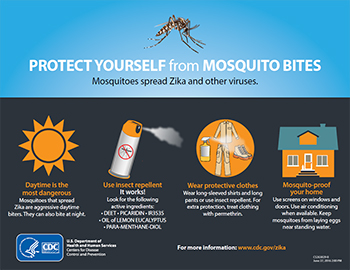
- Become knowledgeable about available resources and pass that information along to employees on a regular basis. The primary information source currently is the CDC’s website, which is updated frequently and includes factual information, posters for easy reference, and links to other useful sites.
- Use mosquito repellent that includes an FDA-approved repellent ingredient, such as DEET, and make sure that such repellent is available for employees who work outside, especially in areas which have been designated as high risk.
- Get rid of standing water on work sites, as such areas frequently are breeding grounds for mosquitos. Mosquitoes breed in standing water, not just in puddles, cans, bottles, and flower pots, but any still water that is not made inhospitable to breeding. This makes it critically important to maintain appropriate chlorine levels in pools and water storage tanks, as mosquitos will not breed in chlorinated water.
- Offer information and guidance to allow employees to make informed decisions about travel to areas in which Zika is prevalent. Both the CDC’s website and the website and blog of OSHA contain helpful and easy-to-understand information.
- Form a team to monitor workplace areas for instances of potential exposure, and to minimize those possibilities. Instruct team members that questions related to absenteeism for Zika-related reasons (real or perceived) should be directed to Human Resources in order to avoid complaints of lack-of-accommodation for health-related reasons.
- Find alternatives, when necessary and possible, for outdoor work in mosquito-infected areas. Some possible alternative might be switching work from daylight to night-time hours (when mosquitos are less aggressive), supplying mosquito repellent (both in individual form and in broader work areas), and allowing pregnant woman to temporarily move into other open positions (if such a move is requested) to avoid mother-to-fetus infection.
Employers who implement the above six steps will be able to avoid or control much of the potential exposure to employees.
In addition, OSHA/NIOSH has suggested – but not yet mandated – that employers consider delaying employee travel to Zika-affected areas, especially for workers who are or may become pregnant or whose sexual partners may become pregnant. (CDC is recommending that pregnant women in any trimester not travel to an area in which active Zika virus transmission has been reported.)
CDC has published Zika Travel Information by region, which provides information in making travel-related decisions or implementing precautions when traveling.
OSHA suggests that all travelers – whether feeling sick or not – returning to the United States from an area in which Zika has been reported should take steps to prevent mosquito bites for three weeks so they do not pass Zika to mosquitoes that could spread the virus to other people.