

Baker’s dozen = 13 (not 12)
Easy.
Foot = 12 inches (the length of the average man’s foot)
Of course. I learned this in the second grade.
2 by 4 = 1.5 inches by 3.5 inches
What?
4 by 4 = 3 ½ inches by 3 ½ inches
No way.
5/4 inches by 4 inches = 1 1/8 inches by 3 ½ inches
Mind. Blown… unless you’re a carpenter or in the construction industry.
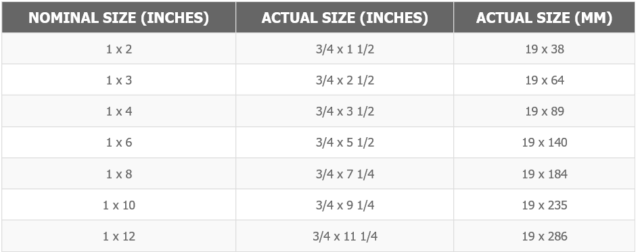
In the United States, softwood lumber is governed by the American Softwood Lumber Standard which was developed by the American Lumber Standard Committee, in accordance with the Procedures for the Development of Voluntary Product Standards of the U.S. Department of Commerce. That’s a mouth full. However, the lumber standard is a government-approved codification of longstanding industry practices. And, while dimensional lumber is cut to a specific length, width, and depth, there is a difference between the nominal size (what the lumber is referred to) and its actual size.
The table below provides an illustration.
These labelling practices are being challenged in two separate class action lawsuits which were filed in the Northern District of Illinois against Menard and Home Depot. The lawsuits allege that the retailers have advertised their lumber products using specific product dimensions when, “unbeknownst to consumers, the product dimensions advertised are not the actual dimensions of the products being advertised.” In addition, plaintiffs in the suit against Menards allege that “[d]efendant has received significant profits from its false marketing and sale of its dimensional lumber products.” Both lawsuits are seeking $5 million in damages.
Menard and Home Depot are being taught a lesson that the food and beverage industry knows well – compliance with regulations and government-approved industry standards will not shield you from false advertising lawsuits.
In 2014, Lowes settled a similar lawsuit filed on behalf of California consumers by District Attorneys from five counties across the state, alleging that Lowes “unlawfully advertised structural dimensional building products for sale.” Under the terms of the settlement, Lowes was required to correct the nominal descriptions for its 2 by 4 lumber products or remove the noncompliant materials from its shelves. The settlement also required that “common descriptions” be followed by actual dimensions, and the dimensions were required to include abbreviations such as “in.” “ft.” or “yd.” instead of symbols such as ‘ or “ when providing measurements.
The lawsuits raise an interesting question about “common knowledge” and the “average consumer.” While consumers who are in trades and construction understand that lumber products are labeled based on their “nominal” designations, it is not likely that less sophisticated consumers understand the distinction.
Relatedly, these cases may also signal a new litigation trend targeting DIY (Do It Yourself) consumers. With the help of Pinterest and YouTube, we can accomplish just about anything. This is great for businesses, in that markets are opening up to waves of new consumers who are cooking, crafting, building, and repairing unlike ever before. However, an unexpected downside may be an increased risk of litigation when common practices and jargon to some become potentially false and/or misleading representations to others.