

Sandwiched between 90 degree days in a Minnesota summer, the idea of Halloween wasn’t on my radar – until I learned about the latest dispute between candy giants Mars and Hershey’s.
Mars and its subsidiary own many well-known candy brands, including M&Ms, Snickers, Twix, Skittles, Life Savers, and others. Not to be outdone, Hershey maintains its own stable of popular brands in addition to Hershey brand, including Kisses, Reese’s, Twizzlers, and others. Even though the parties are major competitors, it appears the two bonbon behemoths don’t frequently compete in proceedings at the Trademark Trial and Appeal Board, except for extensions of time to oppose and a handful of oppositions settled quickly.
In light of the history, Hershey may have been spooked when it first learned that Mars filed a Notice of Opposition last month against Hershey new application to register the mark SCARY in connection with “Candy.” The Notice of Opposition (available here) claims that the term SCARY is “highly descriptive” and “generic” in connection with candy, especially candy sold or promoted during the Halloween season. Mars alleges that “SCARY is like ‘HAUNTED’ ‘SPOOKY’ or ‘BOO,’ only SCARY is more frequently used.” In light of this, Mars alleges that “SCARY is no more capable of being a trademark for candy than is TRICK OR TREAT.”
Mars’s arguments have some bite. I don’t recall the specific brands from my candy hauls on the streets of my Iowa hometown, but I remember a lot of Halloween imagery: ghosts, pumpkins, monsters, and others. Yet I’m not sold on the idea that SCARY is descriptive, let alone generic, for candy. To be descriptive, a term must immediately describe “an ingredient, quality, characteristic, function, feature, purpose, or use of the specified goods or services” (according to the Trademark Manual of Examining Procedure). Scary doesn’t seem like it describes the candy, but instead merely the marketing used to advertise the candy. Establishing that SCARY is generic is even more difficult, because “generic terms are terms that the relevant purchasing public understands primarily as the common or class name for the goods or services” (TMEP). If there is a genus specifically for candy marketed for trick or treating, the genus is probably “Halloween Candy,” not “Scary Candy.”
A claim that might have a better chance of success, however, is that the term SCARY does not function as a trademark, but instead is understood by consumers as conveying information about the goods. Consumers might perceive the term scary as indicating the candy is meant for use in the Halloween season, or that the term SCARY is somehow ornamental or informational. Unfortunately, Hershey filed the application on an intent-to-use basis, so Hershey has not yet used the mark. As a result, it is difficult to evaluate whether Hershey’s use constitutes use as a trademark.
While Mars has a colorable claim, I don’t see SCARY as crossing the line into the descriptive category of the marks. I think SCARY is likely used by a number of third-parties, but I think this means that consumers perceive SCARY (and similar variations) as being a weak designation of source, but not necessarily descriptive. Notwithstanding, Mars has legitimate concerns. If Hershey obtains a registration, Hershey could take a broad view of the scope of its rights, seeking to prevent others from using SCARY or similar terms, even against third-parties who may be making a non-trademark use in connection with Halloween candy. For example, Mars uses the term SPOOKY on the candy below: 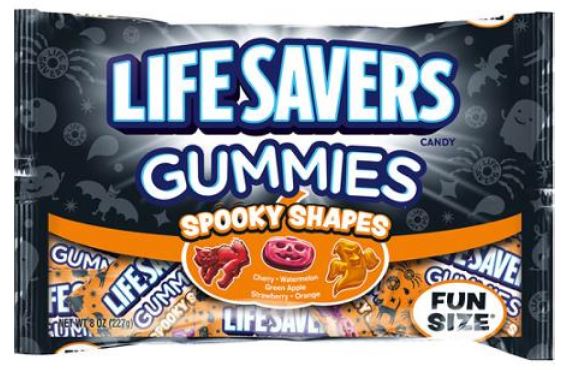
Mars might be fighting to protect itself and others in the industry from the potential of Hershey wielding a SCARY registration as a sword to unfairly inhibit competitors from using certain Halloween imagery. This goal seems reasonable under the circumstances, even if the claim of “mere descriptiveness” has some weaknesses. It would not be the first time a trademark owner relied on a registration to push competitors away from non-infringing uses.
Notwithstanding Mars’s good intentions, it might be difficult for Mars to claim a “white hat” in this battle, at least with a straight face. Mars owns its own registration for SPOOKY SHAPES for “candy” (disclaiming SHAPES). With that in mind, Mars might be wishing it hadn’t alleged that “SCARY is like . . . SPOOKY” in the Notice of Opposition. If SCARY is like SPOOKY, then it is hard to see why Mars’s use of SPOOKY is a legitimate trademark use, but Hershey’s use of SCARY is not. While the statement doesn’t prevent Mars from prevailing, it does suggest that the purported harm to the industry may be exaggerated. But who knows, perhaps Mars has a few tricks up its sleeve.