

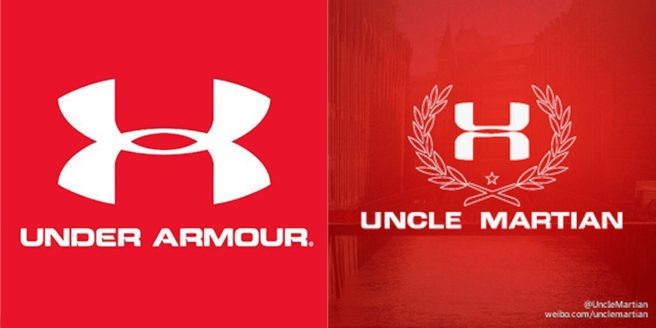
Though the Under Armour vs. Uncle Martian dispute at first seemed like just another story about a blatant Chinese ripoff, destined to be forgotten with the next month’s news cycle, it was back in the news recently with the report that Under Armour conclusively prevailed in its trademark infringement case against Tingfeilong Sporting Goods, the Chinese sports manufacturer behind the “Uncle Martian” brand. According to Under Armour’s lawyers, the Fujian People’s Higher Court issued an injunction requiring Tingfeilong to stop using the infringing “Uncle Martian” trademarks, destroy all infringing products, pay RMB 2,000,000 in damages, and publish a statement to “eliminate the adverse effect” of its infringement. This ruling followed a preliminary injunction issued on November 2, 2016.
The court’s ruling is surprising in two ways. First, it’s surprising that the court issued an injunction at all. Chinese courts are known for being reluctant to issue injunctions because they don’t have the same enforcement power as U.S. or EU courts and issuing an injunction they know will be ignored just makes them appear weak.
Second, it’s surprising Tingfeilong continued using its Uncle Martian logo — the infringement is about as blatant as you can get short of an outright copy, and the social media commentary in China was withering. I speculated Tingfeilong’s strategy was to get a bunch of free publicity for their cheesy product launch and the “Uncle Martian” name, then quietly drop the infringing logo and continue selling products using the “Uncle Martian” name. That may still be its strategy, but the penalty may be enough to put them out of business, assuming it ends up paying it. Tingfeilong has appealed the ruling, and I could imagine a settlement that involves Tingfeilong agreeing not to use the infringing logo so long as it can still use the “Uncle Martian” word mark. Or maybe other shenanigans are afoot – according to the CTMO website, the “Uncle Martian” word marks are now owned by another Chinese company, Quanzhou Changwan Trading Co. (泉州昌万贸易有限公司).
In an interview with Law360, Under Armour’s US counsel offered three lessons from the case. I’ve paraphrased those lessons below in underlined text, with my further comments afterward in italics.
- Chinese courts are willing to grant injunctions. Obviously this case is a step in the right direction, but one case is hardly enough to establish a trend. China is not a common law system and a ruling by the Fujian Higher People’s Court’s does not set a precedent. That we even have to discuss this point is noteworthy; in any court system providing meaningful injunctive relief, this case would be a slam-dunk. But it’s not the case that this sort of relief will be readily and easily available. As I understand it, the key to this case is the significant and indisputable evidence of infringement presented by Under Armour at the time it requested an injunction. To submit that amount of evidence takes a lot of time and effort – it’s not just pasting a bunch of screenshots into a complaint. Note that the Uncle Martian knockoffs were first announced last April, and the preliminary injunction wasn’t issued until November. I’m sure Under Armour would have loved to have a TRO in May – as would have happened in the US or EU — but there’s no way they could have prepared the evidence in time.
- Local counsel is crucial. Unquestionably true. Non-Chinese firms are not allowed to practice law in China, so it is legally impossible to proceed without a Chinese local counsel. And as with any case here in the US, the better the local counsel, the better your odds. But as the Law360 article implies, to an increasing degree in China what makes local counsel “good” is not their connections with local government officials or their guanxi but rather their expertise in the legal field at issue. That is: if you have a trademark infringement case, hire a firm that excels at IP and has a history with those cases.
- Chinese courts outside Beijing, Shanghai, and Shenzhen are issuing sophisticated, consistent legal rulings. Again, though this ruling is certainly a step in the right direction, one ruling does not make a trend. And the facts in this case were pretty much served up on a silver platter for the court. It would be a stretch to call this a sophisticated ruling, when it was obvious to just about everyone who commented on social media that this was trademark infringement. Another key point is that if you want any shot at enforcing a court ruling in China, you need to file your case in a court with jurisdiction over the defendant. If the company knocking off your products is based in Xi’an, you probably will need to file in Xi’an, like it or not. It should go without saying that you will be better off filing in a second tier city court that has jurisdiction than getting your case tossed out of a court in Shanghai for lack of jurisdiction.
I would add one additional takeaway, which is implicit in the commentary on the Uncle Martian ruling and hopefully second nature to anyone reading this blog. The only reason Under Armour was even in a position to file this lawsuit was because it had already registered its trademarks in China. This was not a case of an American company trying to prove its trademarks were famous in China; this was simply a company enforcing its trademark rights that already existed.