

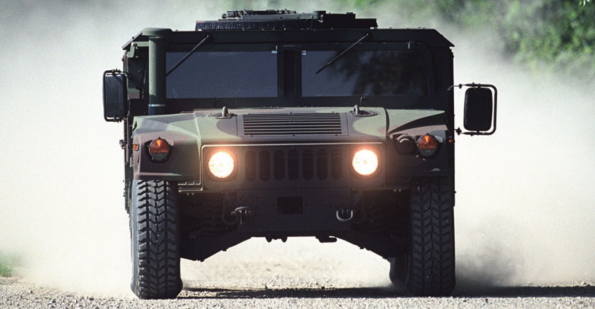
AM General, manufacturer of Humvee military vehicles, has sued Activision Blizzard for trademark infringement, based on the use of the “Humvee” and “HMMWV” marks for the virtual military vehicles displayed in Activision’s Call of Duty video games. See the complaint here, filed last week in the Southern District of New York. For those of you who are not avid video-gamers, Call of Duty is a military-themed first-person shooter game–and it’s one of the best-selling games in the world, selling more than 250 million copies since 2003.
AM General owns federal trademark registrations for the marks HUMVEE (Reg. No. 1697530) and HMMWV (Reg. No. 3026594), for use in connection with the military trucks that the company manufactures. (“HMMWV” is an acronym referring to High Mobility Multipurpose Wheeled Vehicle.)
This dispute raises issues similar to those I’ve discussed in recent posts (such as here) regarding the gap between trademark use in the real-world, versus trademark use in the virtual realm, such as in video games, which involve depictions of arguably related goods or services. Here, it is questionable whether consumers would be confused as to source. There is no indication that AM General sells video games, or that Activision sells military vehicles.
For example, in E.S.S. Entm’t 2000, Inc. v. Rock Star Videos, Inc., 547 F.3d 1095, 1100 (9th Cir. 2008), the court held that consumer confusion was unlikely based on a video game’s reference to the mark “Play Pen,” referring to a real-world strip club, because: “The San Andreas Game is not complementary to the Play Pen; video games and strip clubs do not go together …. Nothing indicates that the buying public would reasonably have believed that ESS produced the video game or, for that matter, that Rockstar operated a strip club.”
Nevertheless, confusion as to source isn’t the only actionable type of confusion–there’s an argument that consumers could be confused as to whether there is an affiliation, sponsorship, or approval between Activision and AM General as to the Call of Duty video games and the references to the HUMVEE and HMMWV marks, such as a licensing deal. Such an argument is reinforced by AM General’s allegations in the complaint that it has licensed the use of its HUMVEE mark in several other video games.
However, Activision may also have several defenses, including a nominative fair-use defense. The defense of nominative fair-use may apply where a defendant uses a mark solely to describe and refer to the plaintiff’s product, but not the defendant’s product, for purposes such as comparison, criticism, or simply a point of reference. Here, it would seem that Activision is using the HUMVEE and HMMWV marks nominatively, to refer to AM General’s military vehicles, rather than any of Activision’s products.
A free-speech defense may also apply for artistic expression under the First Amendment. The Rock Star Videos case, cited above, has relevant discussion of this defense in a similar context. In that case, the court applied the Second Circuit’s “Rogers test,” under which “an artistic work’s use of a trademark that otherwise would violate the Lanham Act is not actionable unless the [use of the mark] has no artistic relevance to the underlying work whatsoever, or, if it has some artistic relevance, unless [it] explicitly misleads as to the source or the content of the work.” Rock Star Videos, 547 F.3d at 1095 (quoting Rogers v. Grimaldi, 875 F.2d 994, 999 (2d Cir. 1989)). The court held that this defense was established, because the San Andreas video game was an artistic work; the reference to the “Play Pen” mark for a strip club had “at least some artistic relevance” (this is a low threshold–the level of relevance “merely must be above zero”); and the reference did not explicitly mislead consumers as to the source of the work. Id. at 1099-1101.
Similarly here, Activision could argue that its video game and the references to AM General’s marks are merely artistic expression; that the references to the HUMVEE and HMMWV have at least some non-zero level of artistic relevance; and such references do not explicitly mislead consumers.
It will be interesting to see the defenses raised by Activision and how this dispute ultimately plays out. Activision’s answer to the complaint will be due in a couple weeks. How do you think this case will be resolved? Stay tuned for updates.