

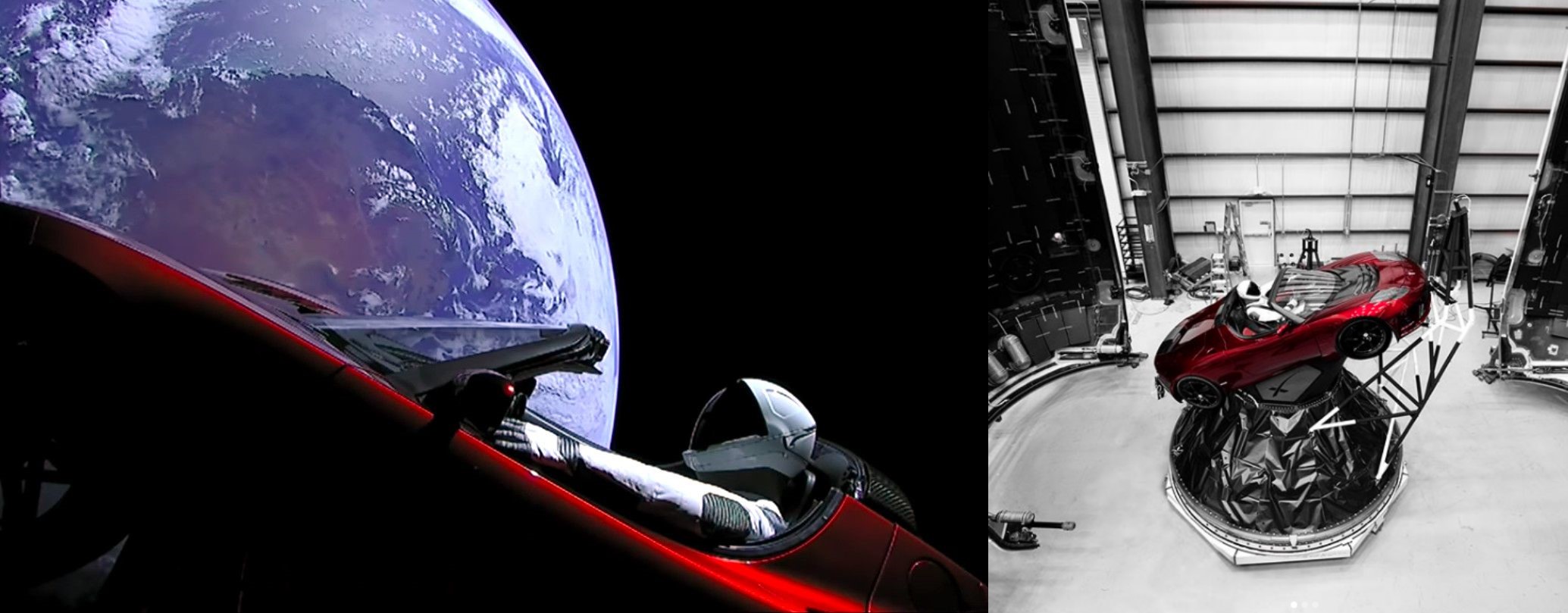
Today I write with a thought-provoking question: Just who owns the trademark rights to Telsa/SpaceX’s Spaceman Roadster? Tesla? SpaceX? Perhaps even humanity?
If you didn’t catch it, SpaceX recently launched its first Falcon Heavy three-booster rocket designed to carry large payloads into space. In a stunning feat of engineering and genius marketing, the rocket sent SpaceX CEO (and Telsa CEO) Elon Musk‘s Tesla Roadster toward the Sun (where it will orbit for billions of years), all while returning two of the three boosters to the same location from which the rocket departed.
It might seem incredible to believe, but the NASA-defined space object “Tesla Roadster (AKA: Starman, 2018-017A)” is now traveling away from the Earth on its trajectory to the Sun. You can track the object using NASA’s HORIZONS system and even watch a live feed from its on-board cameras.
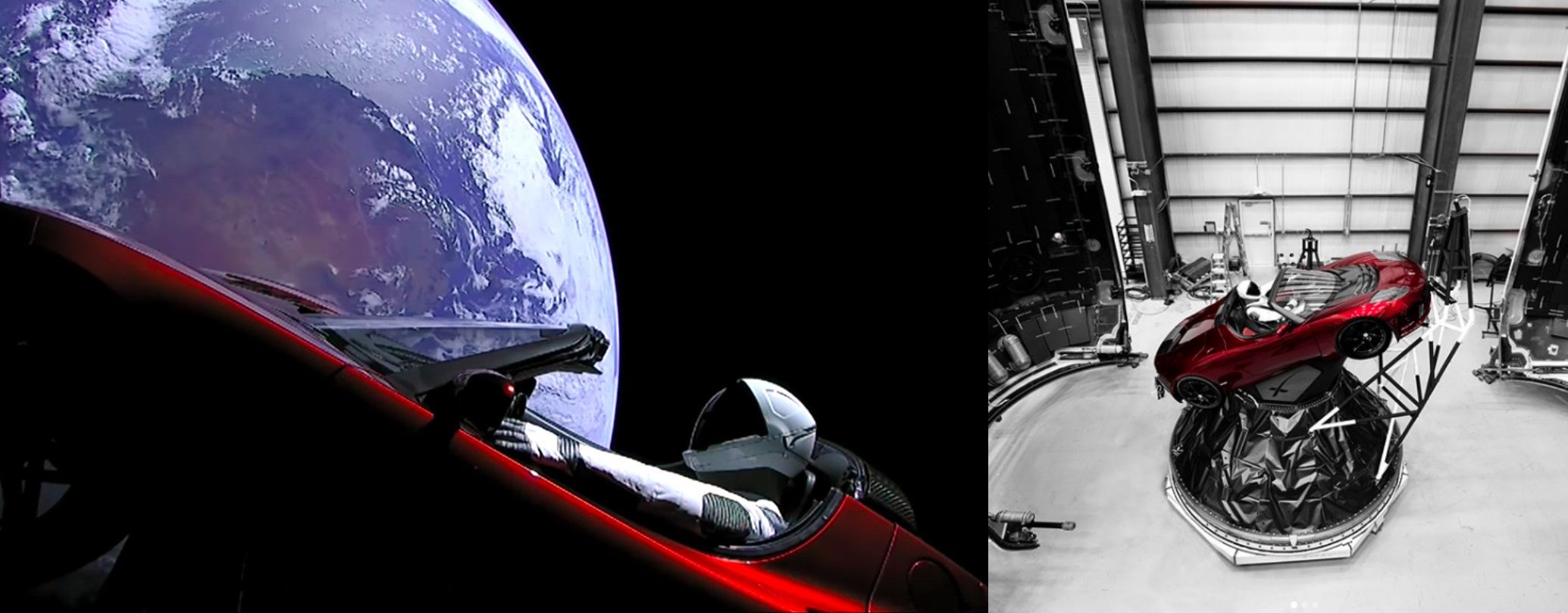
Yes, these are real pictures: credit, credit.


If you haven’t seen the launch and booster touch down, now is the time; it is truly awe-inspiring and one of the biggest feats of the decade. It may also be the most ambitious marketing promotion for a product and service (the Falcon Heavy) ever, establishing both Tesla and SpaceX as innovative, intelligent, and forward-thinking brands. And that gets me thinking: Spaceman (or some similar description), as a potential name, symbol, or device, could constitute a trademark. But because two separate companies, Tesla and SpaceX, are involved in launching the car into space, just who has a right to the mark? And does Spaceman itself operate as a mark identifying either company as its source?
The answer could hinge on whether either company decides to use the mark to designate itself as the source of certain goods or Spaceman, for that matter. The primary purpose behind trademark protection is to reduce information and transaction costs, while protecting investment in the creation and promotion of marks that do just that. Thus, a fundamental inquiry in trademark infringement cases is whether use of a mark causes consumer confusion as to the source of a good or service. So far, both companies have touted the Falcon Heavy achievement. But Spaceman itself does not clearly indicate one source over the other. Of course, the Roadster identifies Tesla as its source, but the rocket on which it is affixed designates SpaceX as the means for its position in space. Maybe that is enough of a distinction to make the mark part Tesla and part SpaceX.
I would like to believe that both companies’ CEO, Elon Musk, would think of Spaceman not as a symbol of either business, but rather a symbol of human achievement and what is to come. Indeed, both companies have grand visions for humanity. SpaceX’s mission is “to enable humans to become a spacefaring civilization and a multi-planet species.” Telsa is purposed on “accelerat[ing] the transition to a sustainable energy future.” To any other-worldly being, Spaceman itself identifies Earth and its people as its source. In this way, Spaceman is similar to other satellites within the solar system, which identify Earth as progenitor. Perhaps, then, it is fair to say that we all have a stake in the symbol. What do you think?