

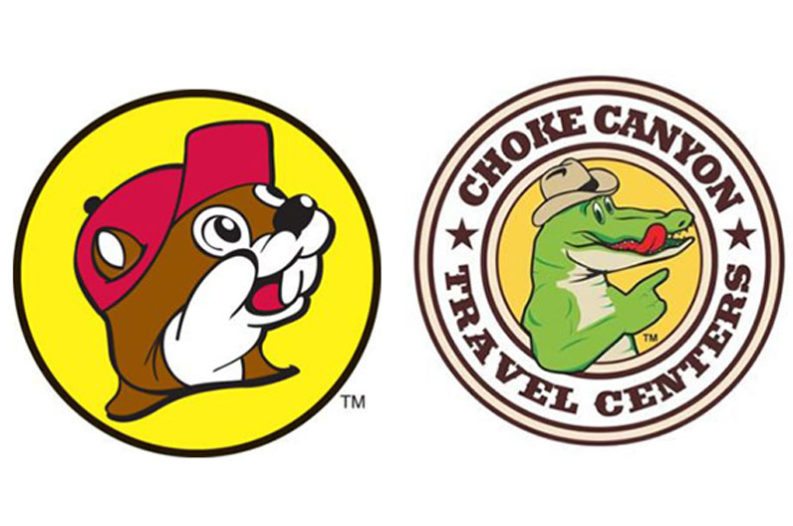
Recently, we have been covering updates from a trademark infringement, dilution, and unfair competition action between Buc-ee’s and Choke Canyon, two rival Texas convenience stores with endless rows of gas pumps and checkout lanes (everything’s bigger in Texas, you know; even gas stations). About a month ago, a Texas jury found that the Choke Canyon alligator logo infringes on Buc-ee’s beaver logo:
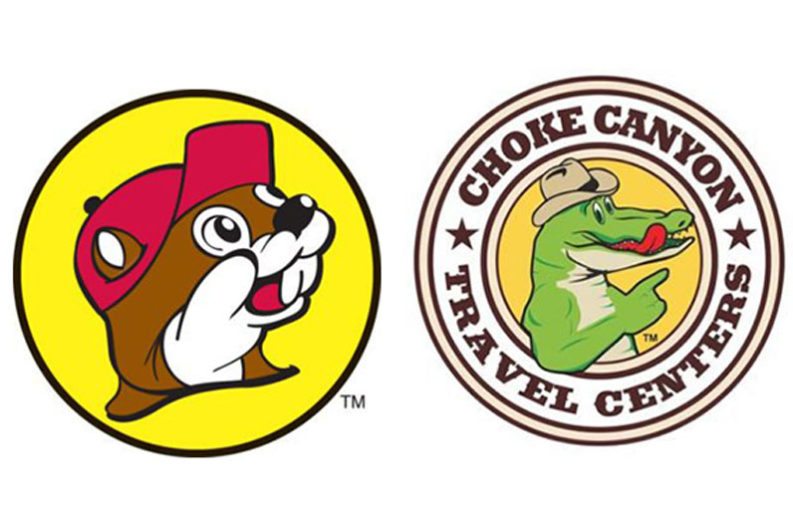
But as I pointed out when covering the jury’s verdict, it wasn’t clear exactly why these two logos are confusingly similar and to what extent. Could it be the fact that both of the logos contain cartoon animals, who wear hats, who face right, who are smiling, who have red tongues, against a yellow-ish background? Some combination of these features? Additional features? The jury’s verdict doesn’t say; the jury only decided that the Choke Canyon logo infringed, but they weren’t asked to explain why.
However, the jury did send one note to the judge while deliberating, giving some clue as to infringement. In that note, the jury asked, “Does the logo to be considered by the jury in rendering an infringement judgment include a version without words?” To which the Judge responded, “Yes.” Not much insight, but at least we know the jury did not focus on Choke Canyon’s circular ribbon.
The reasons for the finding of infringement often have considerable implications. After such a finding, typically the prevailing trademark owner desires injunctive relief (in addition to damages) against the infringer–in the form of a court order prohibiting the infringer from using the too-similar mark. That form of equitable relief cannot be determined by a jury and has to come from the judge. Still, it seems like it might be useful for the judge, in crafting the injunction, to know why the jury felt the marks were so similar as to create customer confusion. This intuition has recently come to bear as the litigation between Buc-ee’s and Choke Canyon has progressed past trial.
Earlier this week, Buc-ee’s moved for a permanent injunction against Choke Canyon (you can read the motion here). Buc-ee’s seeks a permanent injunction barring Choke Canyon’s use of a whole host of similar logos, which were part of a package of example uses submitted to the jury and sampled below:


Buc-ee’s says that Choke Canyon’s proposed injunction is not expansive enough because it does not include or cover any of the black and white logos, only the colorful ones. Buc-ee’s says it “fought tooth and nail”–great imagery, given that it is represented by a beaver mascot–to obtain the finding of infringement of all marks, regardless of whether they include color. But the color similarities (the red tongues and yellow backgrounds) seem pretty important in the context of an infringement battle that otherwise comes down to smiling beaver versus a thumbs-up alligator.
Even though the jury may have technically considered all of the examples provided by Buc-ee’s, an injunction is an equitable remedy, and the Lanham Act (15 U.S.C. §1116) provides that courts shall issue injunctions “according to the principles of equity and upon such terms as the court may deem reasonable.” As part of this inquiry, courts consider (1) whether the trademark owner has suffered irreparable injury, (2) whether damages are adequate to compensate for the injury, (3) whether, considering the balance of hardships between the trademark owner and infringer, the requested relief is warranted, and (4) whether the public interest would be disserved by a permanent injunction. Courts frequently grant only limited or qualified injunctions and tailor them to the facts of the case, sometimes by restricting certain formats and locations and requiring disclaimers or corrective advertising.
This is all to say that the scope of an injunction in this case and others depends on the circumstances and the court’s view of what is equitable and reasonable–a flexible standard. In trademark, courts focus on what relief is necessary to remedy and prevent consumer confusion, as well as the potential effects an injunction would have on lawful competition–an important factor that should not be overlooked in this case (perhaps not only as to the parties, but also as to the precedent the court might set generally). What do you think that might be? Leave a thought in the comments below.