

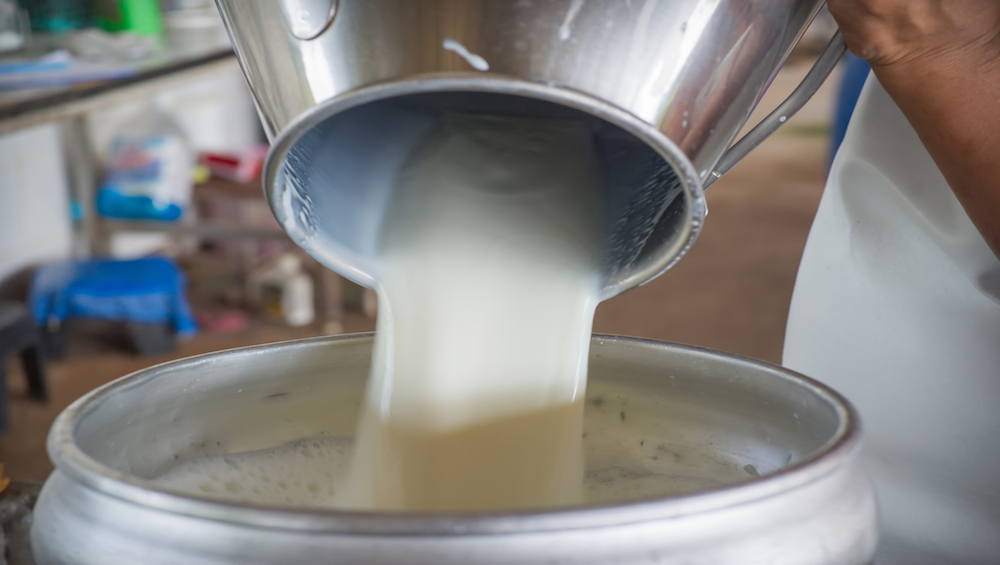
Massachusetts Gov. Charles D. Baker has vetoed permissive raw milk language in a bill to help coastal areas pay for recent storm damage and instead proposed lawmakers consider stronger regulation of milk that does not undergo pasteurization.
“Consumption of unpasteurized milk can result in foodborne illness and possible death due to bacterial infections, especially among infants, children, pregnant women, immunosuppressed patients, and the elderly,” Baker said in his veto of Section 22 of House Bill 4835.
“The risk of foodborne illness due to consumption of raw milk increases with the number of people handling the raw milk prior to consumption, and the length of time between production and consumption. As such, it is important that any expansion of the sale of raw milk in the Commonwealth be done in such a way that it protects those who choose to consume it.”
Section 22 would have expanded the distribution of raw milk in the Commonwealth by allowing the delivery of unpasteurized milk, by allowing dairy farmers to sell unpasteurized milk at non-contiguous farm stands, and by allowing distribution of unpasteurized milk through community-supported agriculture systems (CSAs).
Instead, Baker wants the Massachusetts General Court, (the state legislature) to grant the Commissioner of Public Health the power to promulgate rules and regulations to reduce the risk of milkborne illnesses associated with the consumption of unpasteurized, raw milk that is permitted to be sold on the farm where it is produced.
Baker favors language saying:
“Such rules and regulations may include, but shall not be limited to, the sanitary and operational standards for the transportation, receiving, handling, storage, processing, packaging, labeling, and sale of milk intended for human consumption prior to pasteurization.
“Such rules and regulations shall consider applicable publications of the Food and Drug Administration, Public Health Service, United States Department of Health and Human Services, or any successor agency with like regulatory powers; provided, however, that the commissioner of public health may adopt more stringent standards in order to minimize the risk of milk-borne illness to the public.”
Sale of milk intended for human consumption prior to pasteurization would be then be permitted at a farm stand owned or operated by the producer of the milk that is not on the site of the farm at which the milk was produced. A license from the public health commissioner would be required for off-farm sales, but not for sales at the farm where the raw milk is produced.
The public health commissioner would be empowered to “make such rules and regulations as may be necessary for the enforcement of this section. Such rules and regulations may include, but shall not be limited to, the sanitary and operational standards for the production, transportation, receiving, handling, storage, processing, packaging, labeling, and sale of milk intended for human consumption prior to pasteurization. “
Baker wants Massachusetts law to be consistent with the federal regulations of the Food and Drug Administration while allowing the commissioner to “adopt more stringent standards in order to minimize the risk of milk-borne illness to the public.”
The Republican governor’s strong stance in the interest of public health is not welcomed by all.
Mary Dagoberto, a raw milk advocate and outreach coordinator for the Northeast Organic Farming Association (NOFA), told local media that “giving the health department authority over raw milk sales and deliveries is equivalent to banning it.”
The NOFA currently maintains information on 26 Massachusetts raw milk dairies on its website.
Massachusetts currently restricts raw milk sales to on-the-farm transactions only, but “buying clubs” operating on the edge of current law are known to exist. Baker wants the new law to go into effect on July 1, 2020.
(To sign up for a free subscription to Food Safety News, click here.)