

Who comes to mind when I list the following character traits: lives in a dystopian metropolis, has a deceased parent, fights criminals, rides a motorcycle, has seemingly-superhero strength, is fearless, has dark hair, and–oh, by the way–his name is “Wayne.” More than that, you learn all these facts about Wayne by watching a trailer for a series about Wayne on YouTube, which informs you throughout that Wayne is a character “from the guys who wrote Deadpool,” a fictional superhero. Take a look for yourself:
It should probably come as no surprise that many people watching the trailer–myself included–thought this Wayne might be “Bruce Wayne,” the well-known secret identity of Batman. The comments to the official trailer demonstrate as much. Consider, for example, the “top comment” for the trailer:

The Bruce Wayne most consumers know is the wealthy orphan owner of Wayne Enterprises by day, crime-fighting superhero by night. YouTube’s Wayne shares many of the same traits (except, perhaps, the wealth), and one could certainly believe that the Wayne series might be an origin story for one of the most popular superheros of all time. Of course, by the end of the trailer, you get the impression that the Wayne you’re watching probably isn’t (though there’s no disclaimer):


In total there are over 7,200 comments for the trailer at the time of writing this post. Since the official trailer, YouTube has released additional teaser trailers for the series, each making it clearer that Wayne probably isn’t Batman. Yet, viewers still aren’t quite sure:
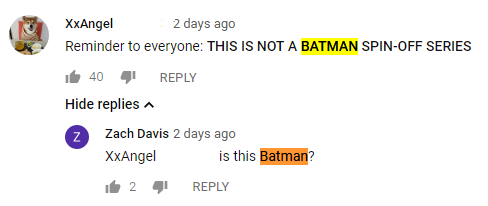
What I find interesting about these comments is that they are a readily-available (though perhaps unreliable) data set for proving, or disproving, the existence of customer confusion. Assume that DC Comics, the owner of the Batman mark and Bruce Wayne character (which does not appear to have been registered, but to which DC Comics could have common law rights and copyright protection) could sue YouTube for infringement or dilution. Arguably, the comments on the Wayne trailers show that consumers are drawing a connection between DC Comics and the Wayne series given the name, mood of the series, and common character traits with Batman. In this, YouTube may be free riding on Batman’s popularity. Depending on just how many comments reference Batman, the comments themselves could serve as strong quantitative data of confusion–akin to the kind of survey data usually used to prove that element of a trademark claim.
On the other hand, many of the comments for the series do not reference Batman or Bruce Wayne. Do non-references indicate a lack of confusion, or perhaps a confusion that is dispelled quickly after watching the trailers? This relates to the doctrine of “initial interest confusion,” which is temporary confusion dispelled before a sale or some other commercial harm, but still may be actionable because the party creating the confusion free rides on another’s mark to gain attention. Since widespread access to the Internet, initial interest confusion cases have increased tenfold, but courts disagree about the vitality of the rule. Regardless, that confusion appears to persist in this situation–as demonstrated by the comments for each new trailer–shows that the confusion here may be of the continuing and uncured variety on which many trademark claims are based.
Wayne fully releases on YouTube in January 2019. There do not appear to be any lawsuits pending at the moment. And there does not appear to be a “Wayne” trademark registration for the series. But if YouTube (or the series’ creators) file for one, DC Comics could oppose the registration–and has done so for similar marks in the past. We’ll keep you updated with any new developments! In the meantime, let us know what you think in a comment below.