

In a recent post, we discussed whether patent applications could provide insight into the blueprints of extraterrestrial spacecraft. Yet, an enigmatic question looms large: would the powers that be genuinely consider patenting such advanced technology, fully aware that patent applications might see the light of day? Or might there be a more clandestine approach, a proverbial cloak of invisibility wielded by the men in black?
Under the Invention Secrecy Act of 1951, federal law prevents the disclosure of new technologies and inventions that may present a national security threat to the United States. Under this act, the Commissioner of the United States Patent and Trademark Office (USPTO) has the authority to highlight patent applications for scrutiny by U.S. defense departments (e.g., various three-letter and four-letter government agencies), ensuring certain innovations remain confidential. This veil of secrecy could extend to concepts and items conceived by individual civilians. Patents falling under such a secrecy directive are accessible to defense bodies, have export limitations, and are considered classified. Accordingly, the publication of such patent applications, or even the granting of a patent, could be delayed or altogether suppressed. These orders are in place to protect sensitive technologies from falling into the wrong hands. As of 2022, USPTO records show that there were 6,057 secrecy orders in effect.
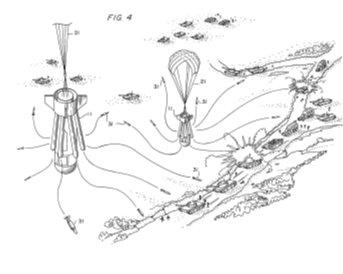
Inventions that are protected under a secrecy order have involved a spectrum of technologies, including infrared detection systems, radar-absorbing ceramics, and missile targeting systems. While we cannot authenticate this independently, indications suggest that U.S. Patent No. 10,514,240 was once subjected to secrecy orders. The disparity between the date of filing and the date of issuance provides a significant clue. Additionally, the B1 kind code indicates that the application was not published. Finally, Fig. 4 of the ‘240 patent shows that this is the type of invention we’d like to keep secret.
For inventors in the midst of patent proceedings, a secrecy order can indeed feel like a formidable obstacle. It not only precludes the award of a patent but also imposes a strict governmental veil over the invention, accompanied by comprehensive procedures to safeguard the contained ideas. Meanwhile, the now-secret patent application remains a patent pariah: Neither the USPTO nor anyone else can cite it as prior art in a patent proceeding. The secret application can continue in patent prosecution until it is otherwise allowable, at which point it will remain a secret. Assuming the application is allowable, the USPTO will then issue the application once the secrecy order is lifted.
The question arises: Could the government use secrecy orders to suppress the disclosure of extraterrestrial technology? Theoretically, yes. The Commissioner has broad authority to issue secrecy orders, and these orders can last for decades. If a governmental body or private company did attempt to patent recovered alien technology, the patent application could be indefinitely kept secret. The existence of secrecy orders thus throws a monkey wrench in the attempts to scour patent applications for evidence of extraterrestrial innovations.
Further, if attempts to patent alien technology ever came to light, the validity of such patents would come into question. Even under the broadest of interpretations, patentable subject matter extends to only man-made discoveries. As the cosmos of patent law continues to expand, perhaps AI is not the only non-human inventor that will eventually knock at the Supreme Court’s door.