
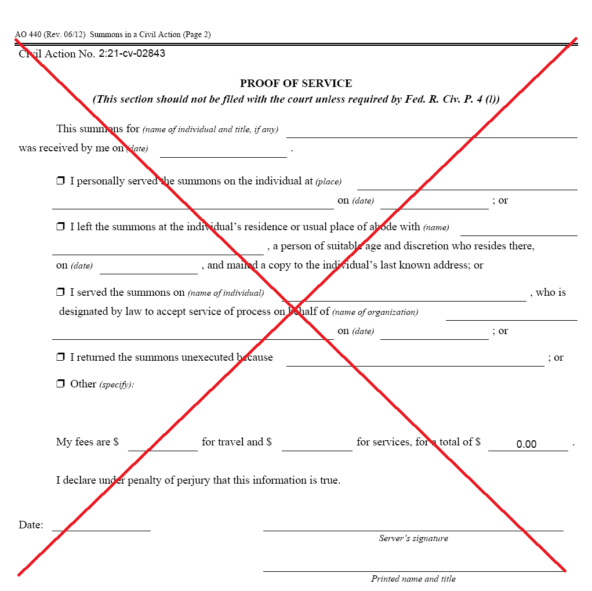
A habit I got into a few years ago: yank the second page of the standard federal Summons in a Civil Action (Form AO440) before sending it overseas for service. That’s the Proof of Service page– a simple set of check boxes and blanks that are completed by a process server when it’s served in Philly, Boston, or Baltimore.
Why do I pull it? Simple. It’s not the proper form to prove service abroad, whether pursuant to Article 5 of the Hague Service Convention or not.
Here’s the pertinent rule:
Rule 4. Summons
(l) Proving Service.
(2) Service Outside the United States. Service not within any judicial district of the United States must be proved as follows:
(A) if made under Rule 4(f)(1), as provided in the applicable treaty or convention; or
(B) if made under Rule 4(f)(2) or (f)(3), by a receipt signed by the addressee, or by other evidence satisfying the court that the summons and complaint were delivered to the addressee.
Proof for Article 5 Service
When you send an Article 5 Request to a foreign government, you have to fill out a globally standard, four-page set of forms, as prescribed by the treaty itself (“the form attached to the present Convention“), commonly referred to in U.S. practice as a USM-94.* Technically, you only fill out three pages, because page 2 is a blank of the Certificate prescribed in Article 6 (“in the form of the model annexed to the present Convention.”).
The treaty tells you how to prove up service, not the standard 440– don’t let the clerk tell you otherwise. If they do, remind them that (1) Rule 4(l)(2)(A) incorporates the Article 6 mandate and (2) the Supremacy Clause is still a thing (I’m sure I read that in ConLaw someplace).**
Proof of service not under Article 5
For non-Article 5 serves overseas– whether pursuant to Hague Article 10 or simply to FRCP 4(f)– the standard form doesn’t paint a complete picture because it doesn’t spell out the authority applicable to the effort. You’ve got to bring something more to the party, or defense counsel will feed you your lunch. Give the judge something to hang her hat on, and OC probably won’t even try to quash.
How is that done? With an affidavit citing chapter and verse of your legal basis for service.
- Served privately according to the foreign country’s law? Cite 4(f)(2)(A) and whatever foreign rule directed your method (include Hague Article 10(b) if that’s appropriate).
- Served pursuant to a Letter Rogatory? Don’t worry– the foreign court and the State Department will make things abundantly clear for the U.S. court.
- Serving by mail under 4(f)(2)(C)(ii) or other means ordered by the court pursuant to 4(f)(3)? Affidavit, again citing those rules and a crystal clear statement of why the method doesn’t violate Hague strictures (hint: it very well might, so don’t play fast & loose with this stuff).
Foreign Authorities’ view of Page Two
For the most part, receiving authorities know that the second page of the 440 is merely a standard, and that it isn’t truly an operative document. I’ve included it in scenarios where my client has insisted on using their own translations, and it’s never been a problem. But that doesn’t mean it won’t be down the road, and that would be an awfully silly pretext for rejection.
In reality, most foreign authorities don’t scrutinize these documents closely enough for this to be a problem, but it’s an easy way to prevent the pretext.
On the flip side, if it’s omitted and a foreign authority sees “Page 1 of 2” but no second in the pairing, that could itself offer that authority a pretext for rejection. The easy way to avoid the question altogether?
Pull it before filing it
“Page 1 of 2” appears at the top of the operative summons when the clerk issues the standard AO440. But if only page 1 is filed… it says “Page 1 of 1” and there’s no issue.
Translation savings
Ultimately, you save a few bucks because if you don’t have to serve it, you don’t have to translate it.
Handy little practice tip.
* For help in filling out the USM-94 itself, visit the Hague Envoy platform at, naturally, usm94.com. or see our How-To post here.
** This applies equally in state court actions– the treaty still overrides local requirements as to form of proof. See “The Hague Certificate– all the proof you need.“
MICHIGAN EDITION: yep, pull the second page of the MC-01 as well. See here for more on the quirks of the Mitten State.