

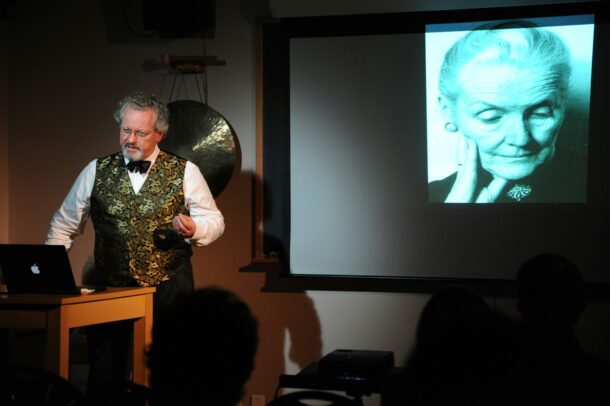
Suppose you have an invention and disclose it in a slide show to an audience attending a conference. Can this slide show be considered a printed publication to prevent the invention from being novel and patented? Are there protective measures that can be taken to prevent the slide show from being considered a printed publication? The answer is YES!
To obtain a U.S. patent, one of the conditions for patentability is that the invention be novel under 35 U.S.C. Section 102. Under 35 U.S.C. Section 102, a person is entitled to a patent unless the claimed invention was described in a printed publication, or otherwise available to the public before the effective filing date of the claimed invention. However, the invention has to be sufficiently publicly available to be considered a “printed publication” and prevent patentability as not being novel.
The Court of Appeals for the Federal Circuit has previously interpreted the phrase “printed publication” as:
… to mean that before the critical date the reference must have been sufficiently accessible to the public interested in the art; dissemination and public accessibility are the keys to the legal determination whether a prior art reference was “published.”.
In re Cronyn, 890 F.2d 1158, 1160 (Fed. Cir. 1989) (quoting Constant v. Advanced Micro-Devices, Inc., 848 F.2d 1560, 1568 (Fed. Cir. 1988))
Can the slide show be considered a printed publication? The determination of whether the slide show can be considered a “printed publication” under Section 102(b) involves a case-by-case inquiry into the facts and circumstances surrounding the disclosure to members of the public. In re Cronyn, 890 F.2d at 1161.
In a recent case before the United States Court of Appeals for the Federal Circuit (“CAFC”), In re Kloppfenstein, 380 F.3d 1345 (Fed. Cir. 2004), the CAFC held that a slide show was made sufficiently publicly accessible to count as a “printed publication”. The Kloppfenstein case involved a printed fourteen-slide presentation on an invention involving cereal chemistry (“Liu reference”) at a meeting of the American Association of Cereal Chemists (“AACC”) that was displayed continuously for two and a half days, and, in the same year, was put on display for less than a day at the Agriculture Experiment Station (“AES”) at Kansas State University. The USPTO determined that the Liu reference was a “printed publication” for determining patentability and this was also the issue on appeal to the CAFC.
In Kloppfenstein, the CAFC held that public accessibility is the key factor as to whether a prior art reference will be considered a printed publication for the purposes of Section 102(b). However, the court found that distribution and indexing are not the only factors to be considered in a Section 102(b) “printed publication” inquiry. Since the Liu reference was neither distributed nor indexed, the court considered other factors in determining whether the Liu reference was sufficiently publicly accessible to be considered a printed publication, which included the length and time the Liu reference was displayed, the expertise of the audience, the reasonable expectations that the material would not be copied, and ease of which the material displayed could have been copied. The court found that the slide show was shown to a wide variety of viewers in the audience and many of them possessed ordinary skill in the art of cereal chemistry and agriculture, while the slide show was prominently displayed for days at AACC and the AES.
As a result of the above findings, the CAFC focused on the factors of whether there was a reasonable expectation that the information in the Liu reference displayed to the audience would not be copied and the ease of which it could be copied. The court found that there was no reasonable expectation that the information would not be copied. In addition, the court found that eight of the fourteen slides only recited what was already known and the remaining slides of the novel information presented could have been copied by a member of the audience. Thus, the court concluded that the Liu reference was sufficiently publicly accessible to be considered a printed publication under Section 102(b)
The Kloppfenstein case illustrates that a slide show can be considered sufficiently publicly accessible to count as a “printed publication” to deny patentability under Section 102 as not being novel. However, in that case, the court stated that protective measures can be considered that create a reasonable expectation that the displayed information would not be copied. For example, protective measures may include license agreements, non-disclosure agreements, anti-copying software, or a disclaimer informing the audience that no copying of the information will be allowed or acceptable.
Therefore, if you have an invention to be shown in a slide show to an audience, you need to take protective measures to create a reasonable expectation that the invention will not be copied to prevent the slide show from being considered a printed publication and prevent patentability. While it may be difficult to get members in an audience to sign a non-disclosure agreement, you should at least have a disclaimer on the slide show informing them that no copying of the information will be allowed. If this protective measure is taken, your chances that the slide show is not considered a printed publication will increase. Thus, there are protective measures that can be taken to minimize the slide show from being considered a printed publication and prevent the invention from being novel and patented.