
Each year in the United States an estimated 9 million people get sick, 56,000 are hospitalized, and 1,300 die of a foodborne disease caused by known pathogens. These estimates help highlight the scope of this public health problem. However, to develop effective prevention measures, food safety agencies and partners need to understand the types of foods contributing to the problem.
The Interagency Food Safety Analytics Collaboration (IFSAC) is a tri-agency group created by the Centers for Disease Control and Prevention (CDC), the U.S. Food and Drug Administration (FDA), and the U.S. Department of Agriculture’s Food Safety and Inspection Service (USDA-FSIS). By bringing together data from CDC, FDA, and USDA-FSIS, and by developing sound analytical methods, IFSAC scientists can improve estimates of the sources of foodborne illness.
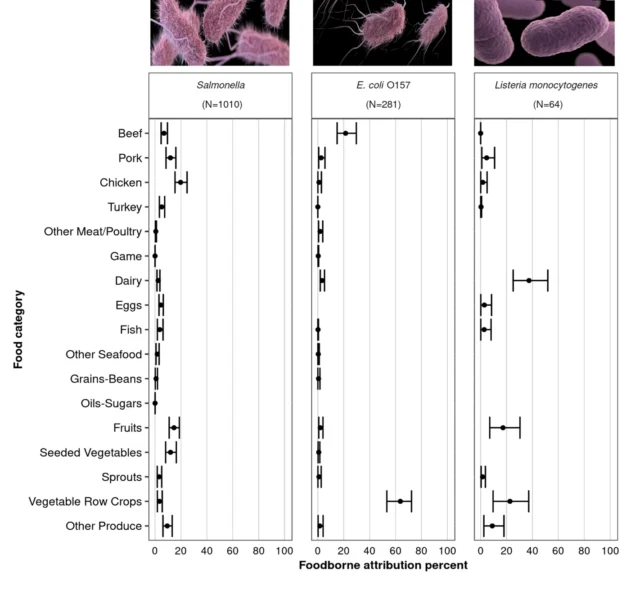
Using outbreak surveillance data from 1998 through 2022, this report presents annual estimates of the percentages of foodborne illness attributed to 17 food categories for Salmonella, Escherichia coli O157, and Listeria monocytogenes.
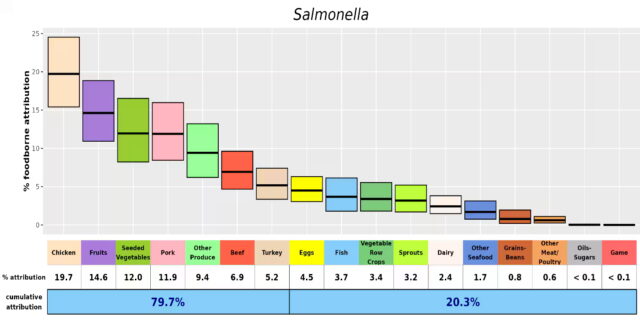
- Salmonella illnesses came from a wide variety of foods.
- More than 75% of Salmonellaillnesses were attributed to seven food categories: chicken, fruits, seeded vegetables (such as tomatoes), pork, other produce (such as nuts), beef, and turkey.
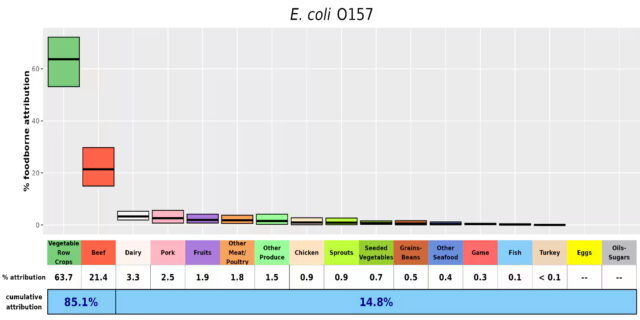
- Escherichia coli (E. coli) O157 illnesses were most often linked to two categories.
- Over 85% of Escherichia coli (E. coli) O157 illnesses were linked to vegetable row crops (such as leafy greens) and beef.
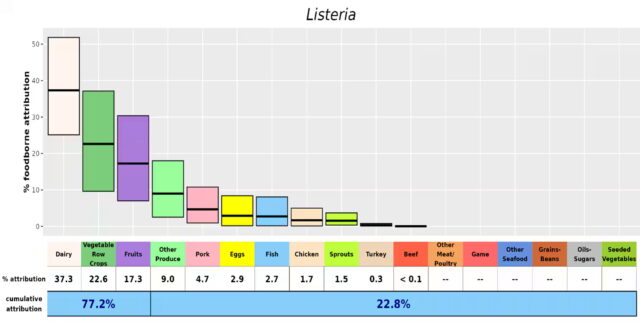
- Listeria monocytogenes (Listeria) illnesses were most often linked to dairy products, vegetable row crops, and fruits.
- More than 75% of illnesses were attributed to these three categories, but the rarity of Listeriaoutbreaks makes these estimates less reliable than those for other pathogens.
Attribution estimates for Campylobacter are not presented in this year’s report. Evidence suggests the sources of Campylobacteroutbreaks likely differ considerably from the sources of non-outbreak-associated illnesses caused by this pathogen. IFSAC is exploring alternative approaches for estimating the sources of Campylobacterillnesses.
IFSAC derived the estimates for 2022 using the same method used for previous estimates, with some modifications. The original method, dating back to the estimates from 2012, was described in a report, a peer-reviewed journal article, and at a public meeting.
The data in this year’s report came from 48,375 illnesses linked to 1,355 foodborne disease outbreaks that occurred from 1998 through 2022 and for which each confirmed or suspected implicated food was assigned to a single food category. The method relies most heavily on the last five years of outbreak data (2018–2022).