


Finance and Accounting (F&A) is often the first function business leaders turn to when evaluating performance and efficiency. Their expectations are clear – payments must be processed quickly, debtors followed up promptly, and reports delivered on time to guide decisions. Automation is key to meeting these expectations, reducing repetitive tasks, improving accuracy, and freeing teams to focus on insight over administration.

No-code automation adds more muscle to such a transformation. Take the example of Ernst & Young (EY). By building PowerMatch, a no-code canvas app on Microsoft’s Power Platform, EY’s finance team cut manual payment matching from 70% of transactions to just 5%, saving 230,000 manual hours annually while reducing errors and training time. Built in less than four months, the solution proves how no-code is transforming finance operations by giving process owners direct control over automations and strengthening areas such as reporting automation, compliance reporting, and cash management.
Cogneesol uses its proprietary ADIS framework to intelligently identify automation use cases that deliver maximum value, applying no-code tools wherever fit to achieve results faster and with minimal resources.
Automation Without Coding: Why it Matters

No-code platforms replace complex programming with visual tools, such as drag-and-drop elements, prebuilt templates, and workflow builders. It empowers citizen developers–users who deeply understand business processes but traditionally relied on IT teams–to build applications themselves. For teams handling F&A processes, this means faster automation, smarter dashboards, and streamlined operations without the need for expensive and specialized coding resources.
- Agility and Business Impact: No-code enables finance leaders to design, test, and launch solutions in days instead of months, helping organizations adapt to shifting customer expectations and market demands.
- Improved Accuracy and Efficiency: Manual processes introduce errors due to duplicate data, missed entries, and outdated spreadsheets. No-code automation embeds logic and validation rules into workflows, ensuring data accuracy while improving transparency and efficiency with intuitive dashboards for performance reporting.
- Reducing Manual Work and Increasing Compliance: By automating reconciliations, approvals, and financial reporting, F&A teams reduce manual work and enhance compliance. Leveraging regulatory reporting automation with standardized, rule-based workflows and automated audit trails helps mitigate risks, ensure timely reporting, and strengthen accountability across the finance function.
Identifying Automation Opportunities
No-code allows F&A teams to speed up implementation. However, the real challenge is deciding where to apply it for maximum impact.
There are two key factors that finance teams can consider to determine the right starting point.
- Business impact: cost savings, faster cycle times, better compliance, improved decision-making
- Automation potential: end-to-end workflows vs. automating parts of a task

With these criteria in mind, here are some areas that are well-suited for no-code automation:
- Accounts Payable (AP) and Accounts Receivable (AR): AP/AR automation helps streamline invoice tracking, payment reminders, vendor reconciliation, and risk-based customer prioritization. This reduces delays, prevents errors, strengthens vendor and client relationships, and improves cash flow.
- Expense Management: Manual receipt collection and validation often burden finance teams. Expense management automation simplifies the process by auto-capturing credit card transactions and other bills and seamlessly integrating the data with the company’s accounting software. This results in faster reconciliation and fewer audit or compliance issues.
- Tax Compliance: High-pressure tax season often leads to errors and missing data. Tax compliance automation helps detect discrepancies, ensure tax deductions are applied correctly, and streamline invoice retrieval across systems, improving accuracy and reducing manual workload tied to tax reporting.
- Purchase Management: From purchase orders to contracts, paperwork-heavy procurement workflows are prone to delays. Automating purchase order creation, approvals, and payment processes shortens the procure-to-pay cycle, cuts costs, and enhances compliance.
- Cash Visibility and Forecasting: Finance teams are central to shaping strategic decisions. By leveraging cash flow forecasting automation, organizations can access real-time forecasts, identify trends early, and make confident strategic decisions backed by consolidated financial insights.
Best Practices for F&A Automation
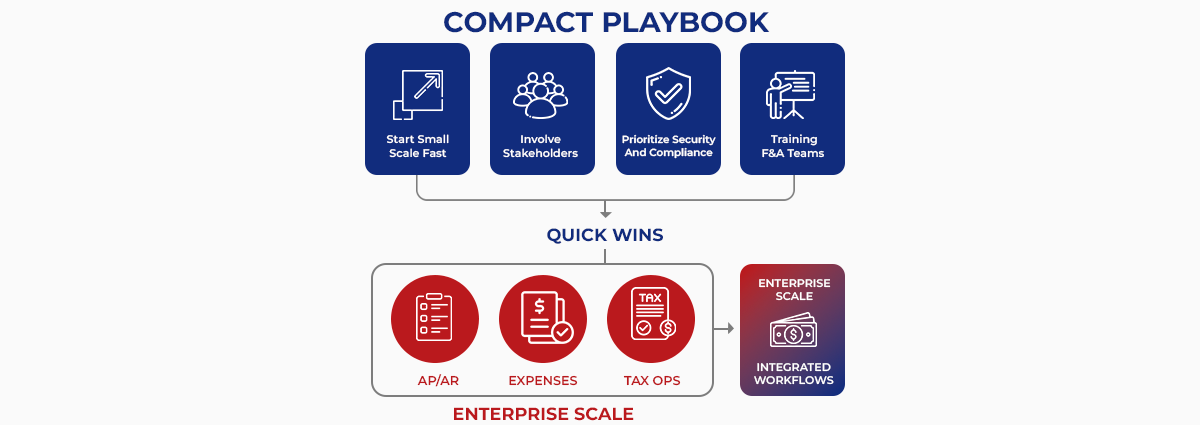
Process automation has already transformed the way finance leaders manage operations, streamlining workflows, improving outcomes, and facilitating cross-functional collaboration. No-code solutions amplify the impact, making automation faster, seamless, and cost-effective.
Here is the rule of thumb. If a task can be managed on spreadsheets, it can be automated. Yet, the potential of no-code F&A extends far beyond routine tasks. The following best practices will help organizations capture its full value while minimizing risks.
Starting Small, Scaling Fast
While implementing no-code automation, a smart approach is to analyze current processes and select tasks that are low-risk, require minimal human intervention, and take little to no creativity. Examples include email sorting, invoice segregation, payment reconciliation, invoice generation, and payment follow-ups.
These tasks provide an ideal starting point because they are rules-driven, easy to measure, and quick to automate. Focusing on such projects helps finance teams demonstrate early wins, reduce manual workload, and showcase the value of no-code without disrupting critical operations such as order to invoice, financial risk management, and revenue accounting. Once the foundation is in place, teams can scale confidently to more complex and business-critical processes, driving broader adoption across finance and accounting operations.
Involving Stakeholders
No-code automation is not always a “plug-and-play” exercise. Although it allows finance professionals to automate processes themselves, collaboration with IT and business stakeholders is essential to maximize the impact of finance process automation.
Finance teams drive the need, and other stakeholders play vital roles:
- Project owners oversee workflows, identify pain points, and define automation priorities.
- IT teams ensure automation is integrated into legacy systems, and security and scalability are in place.
- Leadership engages with the processes to provide governance, define KPIs, and allocate resources for scaling.
- By bringing together cross-functional expertise from the start, organizations prevent silos and ensure business adoption.
Prioritizing Security and Compliance
F&A processes work with sensitive data involving payments, taxation, and reporting, making security and compliance non-negotiable. Organizations must carefully evaluate the capabilities and limitations of their no-code platform, particularly in areas such as data handling, audit trails, and regulatory requirements like SOX (Sarbanes-Oxley Act), ASC 842, IFRS 16 (International Financial Reporting Standard).
As business needs and regulations evolve, approval hierarchies, exception handling, and compliance checks must be embedded directly into the framework for compliance automation in finance to ensure resilience. This practice ensures automation enhances financial risk management and compliance reporting for regulatory adherence.
Training F&A Teams
Despite the ease of use that no-code tools and platforms offer, a successful automation program will depend on enabling F&A teams to become confident “citizen developers.” Adoption requires concerted effort, such as.
- Training on problem-solving that includes breaking down complex challenges into smaller, manageable units.
- A structured framework where teams learn to define requirements, apply business logic, design workflows, test outcomes, and deploy solutions that can be integrated with existing software or databases.
- A culture of continuous improvement where F&A professionals are incentivized to look for opportunities for further enhancements and optimization, evolving from quick fixes to enterprise-wide process transformation.
True business transformation isn’t just about leveraging technology; it’s about unlocking human potential. For F&A professionals with no coding background, the ability to design a bot that once drained hours, that too without IT support, is both empowering and transformative. That sense of ownership and accomplishment is what turns no-code into a catalyst for enterprise-wide culture change.
No-Code: The Next Frontier in F&A Transformation
Manual processes and fragmented automation limit an organization’s true potential. The next frontier is agility, where teams can design and scale solutions with minimal reliance on IT teams. No-code makes this possible, transforming F&A from a process-heavy function into an adaptive and insight-driven partner to the business.
The opportunity is clear. But organizations need to move beyond experimentation and embed no-code into core finance workflows and enterprise-wide operations, balancing compliance and speed with human judgment.
Discover how Cogneesol can help make this shift. Talk to Cogneesol today to see how no-code can cut your finance cycle time and save costs.
The post How No-code Business Process Automation is Transforming Finance Operations appeared first on Cogneesol Blog.