

CFOs no longer focus only on financial reporting and compliance. Their evolving role demands an understanding of a broader set of variables, including Environmental, Social, and Corporate Governance (ESG) factors. ESG is now becoming central to financial performance and long-term business sustainability.
Poor ESG performance can increase a company’s cost of capital, drive up insurance premiums, expose the business to carbon pricing that affects EBITDA, and result in regulatory penalties and reputational damage that erode customer retention. In contrast, strong ESG management can reduce energy costs and lower the risk premium investors assign to the company.
CFOs must recognize that investor financing decisions increasingly depend on ESG performance, and ongoing regulatory enforcement of disclosure requirements will result in significant penalties for non-compliance. Sustainability commitments must hence reflect in financial results and withstand independent assurance.
According to the 2025 BDO CFO Sustainability Outlook Survey, companies that have integrated ESG into their core business strategy are more likely to achieve higher revenues and profitability. Nearly 47% of CFOs plan to increase their involvement in sustainability strategy in the coming years.
When the CFO becomes the ESG Catalyst
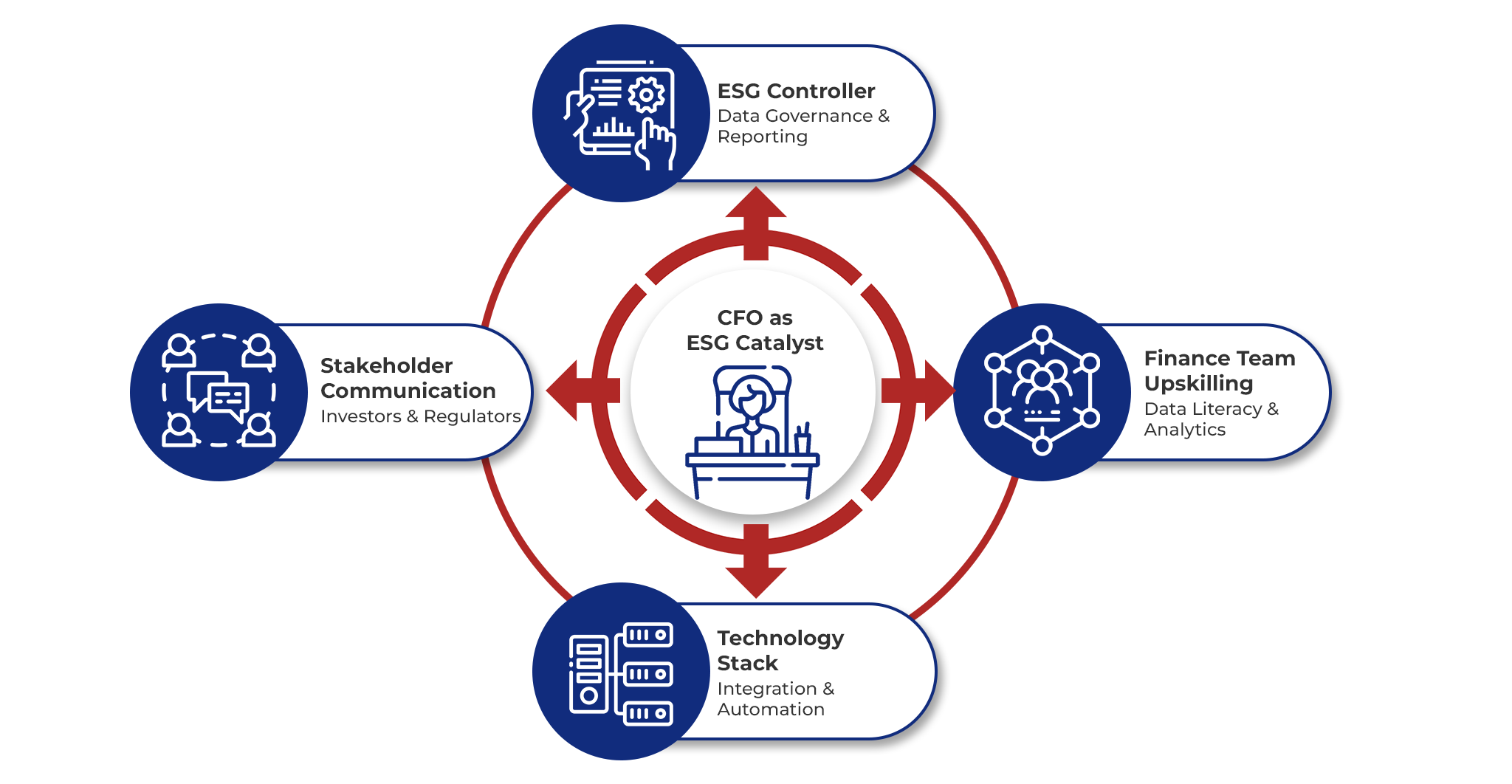
The CFO’s role in ESG is to translate sustainability data into financial terms that drive investment decisions, capital allocation, and risk management. Research from Verdantix shows that CFOs are now directly involved in collecting ESG data, conducting double materiality assessments, selecting software, and providing external assurance. This shift underscores their hands-on operational role in ensuring ESG compliance.
In practice, ESG metrics need to be integrated into FP&A workflows rather than reported separately. Energy costs, carbon liabilities, workforce turnover, and supplier risk scores should be built into rolling forecasts and capital allocation models.
For instance, if carbon prices rise and input costs increase, these impacts should be reflected in financial models before they appear in actuals. Similarly, if a supplier faces labor shortages, scenario analyses should account for potential impacts on working capital.
Workday’s approach reflects the broader shift among organizations. A recent PwC case study shows that Workday has moved from voluntary ESG disclosures to applying the same rigor to sustainability data as to financial statements. The main driver was building long-term stakeholder trust, achieved by applying financial control discipline to a new data domain.
The Rise of ESG Controllers
Many organizations are creating an ESG Controller role to operationalize the CFO’s ESG strategy. The ESG Controller implements financial controls over non-financial data, owns the processes for ESG data collection, enforces segregation of duties between data collection and approval, maintains a complete audit trail, and ensures supporting documentation meets external assurance standards.
Without this control framework, ESG disclosures face the same risks as unregulated financial reporting: reported amounts cannot be traced to source data, estimates are revised without documentation, and auditors identify gaps that require restatements. The ESG Controller’s primary objective is to close these gaps before they undermine credibility.
Making the Finance Team ESG-Ready
Finance teams will need to build new skill sets as ESG becomes integrated into financial operations. F&A professionals must develop data literacy to process unstructured ESG data from energy, human capital management, and procurement systems.
They should become familiar with the accounting standards that govern ESG reporting, such as Global Reporting Initiative (GRI), Sustainability Accounting Standards Board (SASB), and Task Force on Climate-related Financial Disclosures (TCFD), referenced in regulatory frameworks. It is also essential to understand how ESG metrics affect the income statement and balance sheet, since these are the measures boards and investors use to assess sustainability.
A Practical Roadmap for Building the Right Capability
Integrating ESG into financial operations is a long-term process and cannot be rushed. Attempting to create processes or reports before building a solid data foundation risks producing ESG disclosures that will not withstand due diligence.
1. Assessment and Strategy Definition
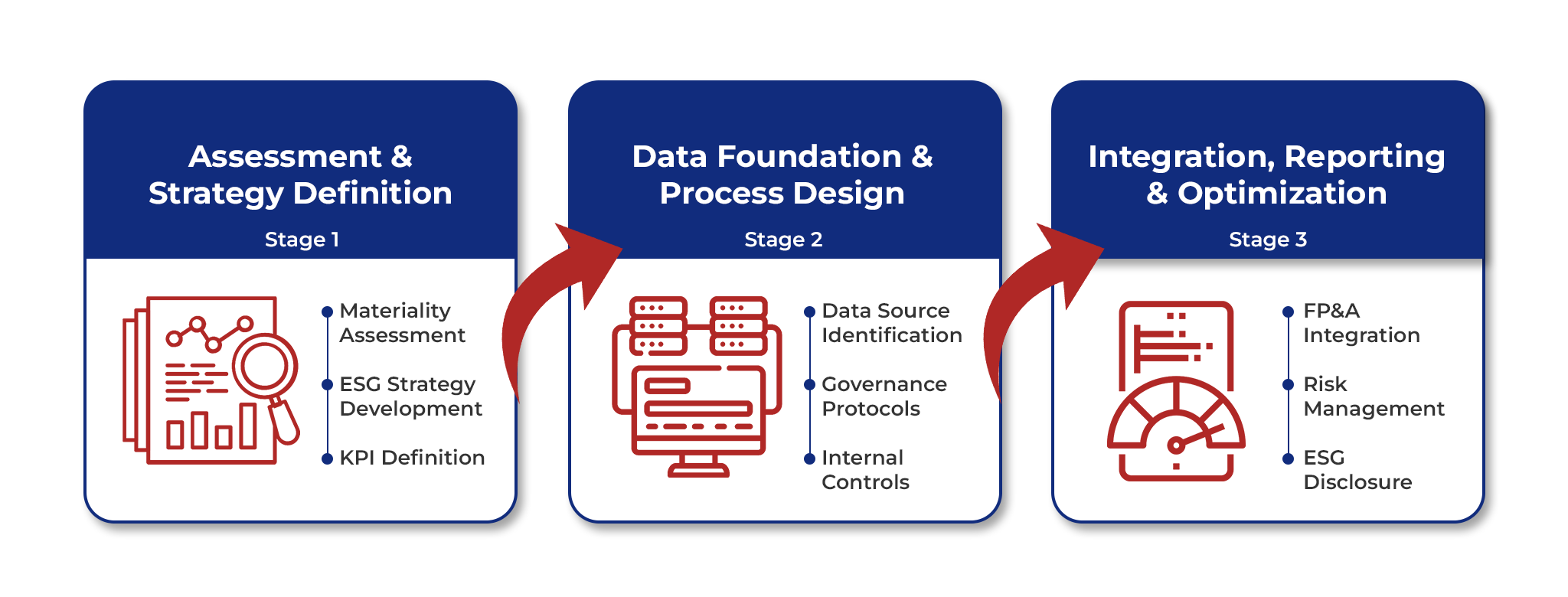
A materiality assessment determines which ESG issues, such as carbon emissions, water usage, employee diversity, and supply chain labor practices, impact financial performance or stakeholder expectations. These issues vary by sector, so organizations should set KPIs that link to financial outcomes rather than relying on broad lists of sustainability commitments.
2. Data Foundation and Process Design
Before considering technology options, organizations must design their data structures. All ESG data sources should be mapped, with ownership, collection frequency, validation rules, and controls established for each. Many organizations under-invest at this stage, but it is critical for ensuring ESG disclosures can be defended during due diligence.
3. Integration, Reporting, and Optimization
The final step in ESG integration is connecting ESG data to core financial systems. This involves integrating the ERP system so that data from energy and procurement sources are linked to all relevant ESG and financial records. Both financial and ESG datasets should be stored in a centralized data warehouse with a common structure, enabling the FP&A team to run queries across both data types.
API connections to third-party providers can supply Scope 3 emissions and supplier risk data. Automated reporting processes will replace manual data consolidation, ensuring controlled and repeatable workflows. As a result, ESG and financial information for disclosures or forecasting will come from the same data layer.
Common Pitfalls to Watch Out for
Most ESG programs that falter do so because of fragmented data, which makes it difficult to consolidate metrics from multiple sources into actionable insights. Another common cause is a lack of control over ESG data throughout its lifecycle, leading to costly corrections after publication, especially when external assurance is involved.
Excessive time and resources are spent on reporting rather than using ESG information to inform FP&A decisions. Also, unclear ownership of sustainability data creates gaps in data quality, often only discovered at year-end when accountability is needed.
Bridging the Data Gap
Manual or spreadsheet-based ESG reporting will not meet the accuracy or auditability standards required for investor-grade ESG reports. The technology needed is straightforward: ERP integration, a data warehouse, APIs to external data sources, and dashboards that combine ESG and financial KPIs in a single view.
The real challenge is in governance design. According to the PwC 2025 Global Investor Survey, 78% of investors say sustainability disclosures increase their engagement with a company. The cost to produce consistent sustainability disclosures is typically much lower than the capital risk created by poor or inconsistent reporting.
Build a Sustainable Finance Function
Financial reporting is merging with ESG reporting. Sustainability-related data that was once found in voluntary appendices is now moving into audited financial statements because of new legislation and standards. By the end of this decade, companies operating in major markets will no longer separate finance and ESG reporting.
Organizations that treat ESG integration as a separate workstream will face costly and compressed changes when new standards take effect. Companies building this capability now will be prepared.
Cogneesol partners with companies that are moving beyond early-stage ESG strategies and require operational infrastructure to support them. This includes audit-ready data governance, integrated ESG metrics in FP&A and capital allocation models, and reporting that meets investor-ready standards without the manual work many finance teams still absorb.
Our teams apply F&A, legal, and technology expertise directly to the challenges of ESG integration, focusing on current operational needs rather than future roadmap aspirations.
The post How to Integrate ESG into Core Finance Operations appeared first on Cogneesol Blog.