

Reading Time: 6 minutes
I was a newspaper carrier as a kid. That has started to inform some of my thinking about how to consume the news these days. We are seeing that information ingesting is increasingly designed to be disruptive or outright damaging. It is a mixture of many things: small, portable devices, 24-hour news cycles, data harvesting information services, dis- and mis-information, auto-generated and unverifiable content, and so on. It is not a solvable problem from the production side. It feels as though staying informed is taking far more time—including the increased likelihood of being asked to verify I’m a human before viewing any new website—that there has to be a better way. While I used to try to balance breadth and depth, I feel like this isn’t the right approach.
It’s funny to think back to what we did as paper carriers. The whole bag-over-the-shoulder thing, walking door-to-door in our little village, rain or shine. At one house, you’d put the paper inside the screen door. At another, you’d put it in the mailbox or in an alcove or whatever unique location the subscriber wanted. I wrapped them in thirds (I didn’t have to do a roll to throw) and stuffed my bag with as many as I could carry. The paper would get delivered before dinner or, on weekends, before breakfast.
It was a local and, for the most part, sole newspaper that folks received at their house. It was one of three common news sources, including radio and television news. At least at that time, most of these news sources were heavily curated, to fit within a certain number of pages or within a 30 or 60 minute TV segment. It seems quaint now but there was a certain acceptance, perhaps based on trust or tradition or mere availability, that you would learn all the news you needed.
We talk about a 24-hour news cycle now but it has always been there. It just wasn’t documented in the same way. Items that didn’t meet one day’s deadline were moved to the next day, if they weren’t bumped by other stories. But the constraint of time or physical space meant that editorial selections were being made to fill the available resources. The difference we have now is that we may have 24 hours of TV or a web server storage system with endless capacity and so, while there is still often editorial direction, the resource dynamic is different.
I am not confident that there *is* much editorial direction any longer. Humans slow down content delivery and even platforms that do not default solely to AI generated content may still not include much editorial oversight. Media platforms are no longer clear on who is a journalist following ethical standards when they publish heavy doses of opinion content
The elimination of a time or space resource constraint means that information creators can fill every moment of the day with new information. Since new information can be monetized, whether through subscriptions or advertising, it makes sense that a creator would want to create as much new content as possible. As the Wikipedia entry on the 24-hour news cycle puts it:
the 24-hour news cycle … brought about a much faster pace of news production with an increased demand for stories that could be presented as continual news with constant updating
24-hour news cycle, Wikipedia
It’s that “continual news with constant updating” part that is at the core of what I struggle with. I understand the economic imperative to follow that approach. I just do not believe it creates value for the news consumer. My news feed is filled what “what we know” stories after an event has happened, incrementally expanding on details. Often, this seems to be a way to journal about social media posts, data aggregator profiles, and other public record information about people involved in the event. Currency overwhelms relevance, sometimes even accuracy.
Here’s an example. Al Jazeera has been doing a daily “what’s happening” on the U.S.’s unlawful aggression against Iran. It’s a way to create daily content rather than focus on what is important. As you can see from one headline, one day there were actual bombings: that’s a headline on its own. Most of the rest is incrementalism. The failure to focus causes their own content to become more diffuse. This is not a particular platform problem. You can find the same thing with the weird “live blogs” that have to be summarized for posterity like on the BBC or even resources like the Guardian’s “minute by minute” page.
Who is this audience? I. Haven’t. Time!

I get the same feeling when I feel like I’m reading inside baseball. Until I moved back to Chicago in 2024, I didn’t follow legal news closely. I have since stopped because so much of it is incrementalist insider content filler. One of the places I noticed it were when whole posts would appear on Law.com or Law360 or Above The Law about disqualification motions. I’m not missing the importance of those motions; it’s whether they would be newsworthy if you were not trying to constantly refill a 24-hour fire hose of information.
For those folks who do care about these motions, is just-in-case news reporting ever going to overcome just-in-time research? Fragmented information delivery turns a topical item into a constant prairie dogging (oh, look, another, oh look, …) which arrives piecemeal and not at a time (or for the person) it can be made actionable. On the other hand, news about disqualification motions might reflect a pervasive trend but that would take time to germinate.

On the one hand, I worry a bit about the drop in people who say they follow the news. It’s also hard to distinguish the platform (like Meta or Google) or an identifiable information creator (like NPR or ABC) in some information consumption analyses. If someone is dropping in for curated news on an advertainment platform like YouTube or TikTok but the curation is by ethically, editorially guided creators, I’m not sure that’s a downside.
Speaking of which, I was a bit boggled by this interview with the former director of BBC news. The premise was that news platforms are falling behind influencers and personalities (Joe Rogan, Tucker Carson, Megyn Kelly) and should also engage in “trying to create the same direct relationship between journalists and their audiences as content creators.” I’m sorry, this is a terrible idea. We have already seen what punditry has done to news platforms. And “news influencers” are already a different and distinct thing. News media need to distinguish themselves if journalism is important to them; celebritizing journalists is an entirely contrary direction.
I do wonder if the drop in news followership is due to the lack of news. The fact that a media platform is generating around-the-clock information does not mean it’s all valuable. In fact, it’s almost definitely not all valuable. Again, a return to the newspaper days: when there was a holiday, the paper may have been printed in advance so that people could take the day off. In other words, there was no news for that period that couldn’t wait until after the holiday.
On the other, perhaps it’s just a recognition that there is less new information amid the overall flow. A newspaper was a physical container. It could be enjoyed with some randomness. A website is akin to that mode, where well-linked, structured content allows for navigation. A shift to news streams, whether with “influencers” or what are essentially linear, sequential content feeds, means that a consumer may need to see the item go by in the stream or miss it. Or access it later, on demand, which begs the question for why it needed to be in a stream in the first place.
I consume a lot of information and after awhile I am not only suspicious that I have seen a story or news event, but I am certain. I wonder if it is because I mostly use RSS feeds and so the updates with identical wording—or in the case of some platforms, the use of A/B testing on the same RSS feed, positioning the same story with 2 headlines adjacent to each other—are more visible. There is no graphical clutter or algorithm or even pagination that obscures information objects.
For more than a decade, I also used news apps like Google News and Flipboard. But I found that they frequently pushed low quality content platforms and lacked much in the way of tailoring and personalization. This was mostly fine, because it inserted a bit of serendipity into my news.
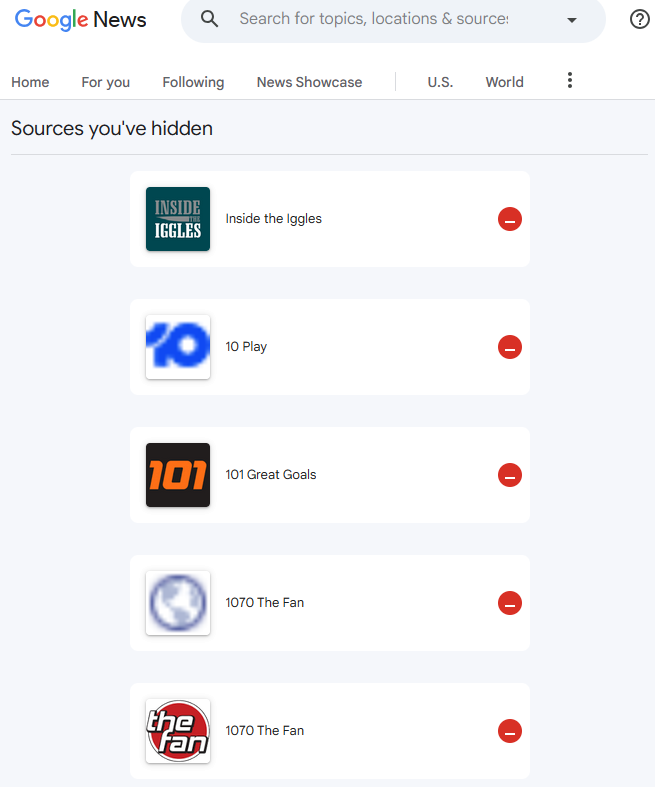
The more that I curated the feeds though, the more the app-based feeds either overlapped the RSS feeds or fell behind. I would see new postings from the day before or 5 days before or longer. The app created a feeling of freshness but the information was old. If currency was the goal, it was lost in the need to push more and more stuff. Instead, it was duplicative. Also, since I have constructed some of my own RSS feeds from media platforms, I knew that the app feeds were curated, limited slices of information.
I have uninstalled all of my news apps now. My RSS feeds power my information gathering and I am going to turn my head towards weeding that list as well. The elimination of the apps, though, has meant that I am no longer accessing algorithmically generated content feeds. There is no 24-hour flood of information except for the very specific feeds that I have chosen to receive.
The news feeds still generate a fair amount of information. There is also a good deal of noise, whether from duplicative media platform posts or items that match a search alert or other filter. But I am trying to find a balance where I look at my feeds much the way I might have read a newspaper. A lot of skimming, an occasional dip into a story. But not all day long; once, maybe twice, and with a sense that whatever I see is enough.
I will miss stories for sure. Will I miss news entirely? I don’t think so. People ask me if I’ve seen a story. Sometimes a person will share something interesting on Mastodon. But I do not have a sense of missing news. The reality is that you could literally read or listen to news 24 hours a day and still miss lots of information and news and interesting things. If you experience FOMO, it may be hard to know when enough is enough.
But I’m feeling good about my choices so far. It feels like I’ve gone back in time a bit, to before the news algorithm, or news app, or even the 24 hour cycle. I am happy to wait for the news story that reflects a pause to think. Instead of making me read every incremental update, give me the experienced, nuanced view of someone who works that beat, has prioritized what is important, and knows what an information consumer might think is worthwhile.
If that means that I have to wait for a day or two or more, I would feel better about that outcome. Also, it doesn’t require me to give up agency; if I really want to know more, I have the ability to ask questions or to search for more information. If someone asks me how the water coming from the fire hose tastes, I might just be able to manage “it’s wet”. If I can get it down to a trickle, I might sense saltiness or a hint of Zebra mussels or whatever.
The 24-hour news cycle is a production problem. It does not have to be a consumer problem. One can be a well-informed citizen with a slow news day. It all depends on the news.