
Skip to content

Menu

LexBlog, Inc. logo
NetworkSub-MenuBrowse by SubjectBrowse by PublisherJoin the NetworkGet StartedSubscribeSupport
Contact Us
Search
Close

CISA Releases Binding Operational Directive on Prioritizing Security Updates Based on Risk

By Caleb Skeath, Ashden Fein, Micaela McMurrough, Ryan Burnette & Bryan Ramirez on June 17, 2026
Email this postTweet this postLike this postShare this post on LinkedIn

On June 10, the Cybersecurity & Infrastructure Security Agency (CISA) released Binding Operational Directive (BOD) 26-04 on Prioritizing Security Updates Based on Risk and the accompanying Implementation Guidance. In releasing the BOD and Implementation Guidance, CISA noted that the documents are “part of CISA’s response to the current threat landscape” and the impact of AI on the volume of identified security vulnerabilities and compressed timelines for remediation as threat actors move quickly to exploit them. While the BOD and Implementation Guidance apply to agencies, CISA Acting Director Nick Anderson noted in the release of the documents that “CISA strongly encourages all partners to adopt similar actions in their vulnerability management policy.”

The BOD and Implementation Guidance apply to federal agency assets in a federal information system—a system used or operated by an agency or by another entity on behalf of an agency—that collects, processes, stores, transmits, disseminates, or otherwise maintains agency information. Although the BOD is directed to federal agencies, contractors that operate federal information systems should monitor agency implementation. The BOD states that it does not apply directly to contractors unless required by the governing contract, but also directs agencies to review contracts to determine what modifications may be necessary to comply with the directive. Contractors and cloud service providers therefore may see these requirements reflected in contract terms or in FedRAMP requirements in the future. The BOD requires agencies to, for example:

  • Review and update agency vulnerability management policies to include certain specified information, such as establishing a process for ongoing remediation of vulnerabilities that CISA identifies through the Known Exploited Vulnerabilities (KEV) Catalog, clear roles and responsibilities, validation and enforcement procedures, and internal tracking and reporting requirements.
  • Continue Cyber Hygiene scanning and update the agency’s exposed IPs and domain names quarterly.
  • Remediate vulnerabilities as quickly as possible, and no later than the timelines in the directive, which range from 3 to 60 days, depending on the vulnerability.
  • Implement asset management measures, including continuous identification and tagging of all agency-owned assets that can be reached from outside the agency network and using a routable IP address.

The BOD also includes proposed remediation timelines to “effectively prioritiz[e] high-risk vulnerabilities for timely action, while deferring action against low-risk vulnerabilities.”  Remediation urgency is based on the following four factors:

  • Asset Exposure: Is the vulnerable asset publicly exposed?
  • KEV Status: Is the vulnerability, as identified by a common vulnerabilities and exposures identifier (CVE ID), on CISA’s Known Exploited Vulnerabilities Catalog?
  • Exploit Automation: Is an adversary able to automate all the steps necessary to exploit the vulnerability?
  • Technical Impact: Does an adversary gain partial control or total control of the vulnerable asset after exploitation of the vulnerability?

Depending on the response to these four questions, the proposed remediation timelines are set forth in the table below from the BOD:
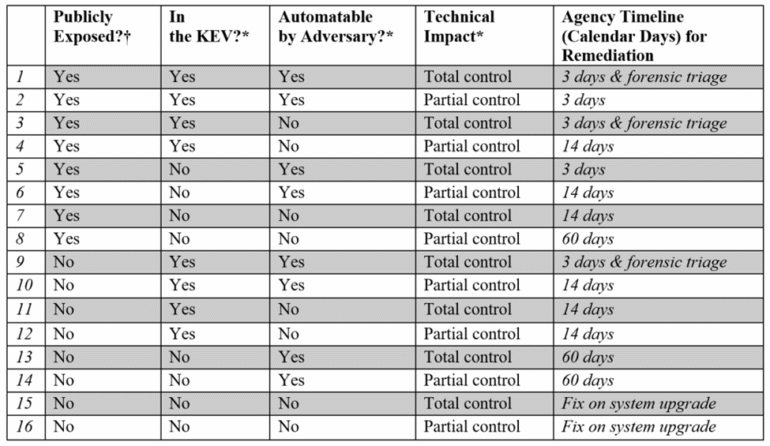
Table 1: Remediation Timelines

The BOD emphasizes that these timelines are dynamic as facts change, and remediation measures (such as removing a system from the internet) can shift the required timeline. Notably, the BOD states that the references to “forensic triage” indicate that the agency must also “carry out a forensic triage of the asset to assess whether the system is compromised.” On the other end of the spectrum, the “fix on system upgrade” timeline is described as remediating a vulnerability “the next time the vulnerable asset receives a scheduled major upgrade or rebuild.”

The Implementation Guidance provides additional recommended best practices for executing prompt vulnerability response, including:

  • Scoping: Within 2 hours of CISA adding a CVE to the KEV catalog, identify whether the vulnerability meets the remediation threshold in fewer than three days and requires forensic triage to assess whether the system or network infrastructure has been impacted or compromised. If so, activate the appropriate response team, scope the bounds of the potential incident, and establish out-of-band communications that do not rely on potentially compromised infrastructure.
  • Preserve and Collect Evidence: Within 2-24 hours of KEV addition, prioritize preserving and collecting volatile data, which includes any data stored in memory or existing in transit that will be lost when the computer is powered off.
  • Critical Patching and Stabilization: Within 2-24 hours of KEV addition, collect all required evidence and then apply critical available patches.
  • Contain and Control: Within 6-24 hours of KEV addition, begin containment of in-scope systems and network infrastructure, ensuring coordination with evidence containment to avoid destroying vital evidence prematurely or alerting the threat actor while documenting actions taken.
  • Triage Analysis: Within 24-48 hours of KEV addition, begin evidence analysis to identify unauthorized access to systems, accounts, or data; threat actor access or presence; lateral movement from the initial access vector; persistence mechanisms; and data staging and/or exfiltration.
  • Escalation Decision: Within 48-72 hours of KEV addition, produce a forensic triage report covering information gathered and actions taken, including an incident timeline; timeline of actions taken in response to a vulnerability notification and triage actions; technical findings; containment and mitigation efforts; and recommended next steps.
Tags: AI
Photo of Caleb Skeath Caleb Skeath

Caleb Skeath helps companies manage their most complex and high‑stakes cybersecurity and data security challenges, combining deep regulatory insight, technical fluency, and practical judgment informed by leading incident response matters.

Caleb Skeath advises in‑house legal and security teams on the full lifecycle of…

Caleb Skeath helps companies manage their most complex and high‑stakes cybersecurity and data security challenges, combining deep regulatory insight, technical fluency, and practical judgment informed by leading incident response matters.

Caleb Skeath advises in‑house legal and security teams on the full lifecycle of cybersecurity and privacy risk—from governance and preparedness through incident response, regulatory engagement, and follow‑on litigation. A Certified Information Systems Security Professional (CISSP), he is trusted by clients across highly regulated and technology‑driven sectors to provide clear, practical guidance at moments when legal judgment, technical understanding, and business realities must be aligned.

Caleb has deep experience leading and overseeing responses to complex cybersecurity incidents, including ransomware, data theft and extortion, business email compromise, advanced persistent threats and state-sponsored threat actors, insider threats, and inadvertent data loss. He regularly helps in‑house counsel structure and manage investigations under attorney‑client privilege; coordinate with internal IT, information security, and executive stakeholders; and engage with forensic firms, crisis communications providers, insurers, and law enforcement. A central focus of his practice is advising on notification obligations and strategy, including the application of U.S. federal and state data breach notification laws and requirements along with contractual notification obligations, and helping companies make defensible, risk‑informed decisions about timing, scope, and messaging.

In addition to his work responding to cybersecurity incidents, Caleb works closely with clients’ legal, technical, and compliance teams on cybersecurity governance, regulatory compliance, and pre‑incident planning. He has extensive experience drafting and reviewing cybersecurity policies, incident response plans, and vendor contract provisions; supervising cybersecurity assessments under privilege; and advising on training and tabletop exercises designed to prepare organizations for real‑world incidents. His work frequently involves translating evolving regulatory expectations into actionable guidance for in‑house counsel, including in highly-regulated sectors such as the financial sector (including compliance with NYDFS cybersecurity regulations, the Computer Security Incident Notification Rule, and GLBA guidelines and guidance) and the pharmaceutical and healthcare sector (including compliance with GxP standards, FDA medical device guidance, and HIPAA).

Caleb’s practice also addresses evolving and emerging areas of cybersecurity and data security law, including advising clients on compliance with the Department of Justice’s Data Security Program, CISA‑related security requirements for restricted transactions, and preparation for new regulatory regimes such as the CCPA cybersecurity audit requirements and federal incident reporting obligations. He regularly counsels clients on how artificial intelligence and connected devices intersect with cybersecurity, privacy, and consumer protection risk, and how to support innovation while managing regulatory exposure.

Caleb also has extensive experience helping clients navigate high-stakes cybersecurity-related inquiries from the Federal Trade Commission, state Attorneys General, and other sector-specific regulators, including incident-specific inquiries as well as broader inquiries related to an entity’s cybersecurity practices and the security of product or service offerings. For companies that have entered into cybersecurity-related settlement agreements with regulators, Caleb has helped guide them through compliance with settlement agreement obligations, including navigating required third-party assessments and strategically responding to cybersecurity incidents that can arise while a company is subject to a settlement agreement. Caleb also routinely works hand-in-hand with colleagues in Covington’s class action litigation, commercial litigation, and insurance recovery practices to prepare for and successfully navigate incident-related disputes that can devolve into litigation.

Read more about Caleb SkeathEmail
Show more Show less
Photo of Ashden Fein Ashden Fein

Ashden Fein is co-chair of Covington’s Data Privacy and Cybersecurity Practice. He advises clients on cybersecurity and national security matters, including crisis management and incident response, risk management and governance, government and internal investigations, and regulatory compliance. Ashden also serves as lead counsel…

Ashden Fein is co-chair of Covington’s Data Privacy and Cybersecurity Practice. He advises clients on cybersecurity and national security matters, including crisis management and incident response, risk management and governance, government and internal investigations, and regulatory compliance. Ashden also serves as lead counsel in criminal, civil, and internal investigations involving cybersecurity, insider risk, and U.S. national security issues.

Ashden regularly counsels clients on preparing for and responding to cyber-based attacks, assessing security controls and practices for the protection of data and systems, developing and implementing cybersecurity risk management and governance programs, and complying with federal and state regulatory requirements. Ashden frequently supports clients as the lead investigator and crisis manager for global cyber and data security incidents, including data breaches involving personal data, advanced persistent threats targeting intellectual property across industries, state-sponsored theft of sensitive U.S. government information, extortion and ransomware, and destructive attacks.

Ashden also assists clients from across industries with leading internal investigations and responding to government inquiries related to U.S. national security and insider risks. He frequently represents government contractors in False Claims Act matters involving cybersecurity and national security. Additionally, he advises aerospace, defense, and intelligence contractors on security compliance under U.S. national security laws and regulations including, among others, the National Industrial Security Program (NISPOM), U.S. government cybersecurity regulations, FedRAMP, and requirements related to supply chain security.

Before joining Covington, Ashden served on active duty in the U.S. Army as a Military Intelligence officer and prosecutor specializing in cybercrime and national security investigations and prosecutions — to include serving as the lead trial lawyer in the prosecution of Private Chelsea (Bradley) Manning for the unlawful disclosure of classified information to Wikileaks. Ashden is a retired U.S. Army officer.

Read more about Ashden FeinEmail
Show more Show less
Photo of Micaela McMurrough Micaela McMurrough

Micaela McMurrough serves as co-chair of Covington’s global and multi-disciplinary Technology Group, as co-chair of the Artificial Intelligence and Internet of Things (IoT) initiative. In her practice, she has represented clients in high-stakes antitrust, patent, trade secrets, contract, and securities litigation, and other…

Micaela McMurrough serves as co-chair of Covington’s global and multi-disciplinary Technology Group, as co-chair of the Artificial Intelligence and Internet of Things (IoT) initiative. In her practice, she has represented clients in high-stakes antitrust, patent, trade secrets, contract, and securities litigation, and other complex commercial litigation matters, and she regularly represents and advises domestic and international clients on cybersecurity and data privacy issues, including cybersecurity investigations and cyber incident response. Micaela has advised clients on data breaches and other network intrusions, conducted cybersecurity investigations, and advised clients regarding evolving cybersecurity regulations and cybersecurity norms in the context of international law.

In 2016, Micaela was selected as one of thirteen Madison Policy Forum Military-Business Cybersecurity Fellows. She regularly engages with government, military, and business leaders in the cybersecurity industry in an effort to develop national strategies for complex cyber issues and policy challenges. Micaela previously served as a United States Presidential Leadership Scholar, principally responsible for launching a program to familiarize federal judges with various aspects of the U.S. national security structure and national intelligence community.

Prior to her legal career, Micaela served in the Military Intelligence Branch of the United States Army. She served as Intelligence Officer of a 1,200-member maneuver unit conducting combat operations in Afghanistan and was awarded the Bronze Star.

Read more about Micaela McMurroughEmail
Show more Show less
Photo of Ryan Burnette Ryan Burnette

Ryan Burnette is a government contracts and technology-focused lawyer that advises on federal contracting compliance requirements and on government and internal investigations that stem from these obligations. Ryan has particular experience with defense and intelligence contracting, as well as with cybersecurity, supply chain…

Ryan Burnette is a government contracts and technology-focused lawyer that advises on federal contracting compliance requirements and on government and internal investigations that stem from these obligations. Ryan has particular experience with defense and intelligence contracting, as well as with cybersecurity, supply chain, artificial intelligence, and software development requirements.

Ryan also advises on Federal Acquisition Regulation (FAR) and Defense Federal Acquisition Regulation Supplement (DFARS) compliance, public policy matters, agency disputes, and government cost accounting, drawing on his prior experience in providing overall direction for the federal contracting system to offer insight on the practical implications of regulations. He has assisted industry clients with the resolution of complex civil and criminal investigations by the Department of Justice, and he regularly speaks and writes on government contracts, cybersecurity, national security, and emerging technology topics.

Ryan is especially experienced with:

Government cybersecurity standards, including the Federal Risk and Authorization Management Program (FedRAMP); DFARS 252.204-7012, DFARS 252.204-7020, and other agency cybersecurity requirements; National Institute of Standards and Technology (NIST) publications, such as NIST SP 800-171; and the Cybersecurity Maturity Model Certification (CMMC) program.
Software and artificial intelligence (AI) requirements, including federal secure software development frameworks and software security attestations; software bill of materials requirements; and current and forthcoming AI data disclosure, validation, and configuration requirements, including unique requirements that are applicable to the use of large language models (LLMs) and dual use foundation models.
Supply chain requirements, including Section 889 of the FY19 National Defense Authorization Act; restrictions on covered semiconductors and printed circuit boards; Information and Communications Technology and Services (ICTS) restrictions; and federal exclusionary authorities, such as matters relating to the Federal Acquisition Security Council (FASC).
Information handling, marking, and dissemination requirements, including those relating to Covered Defense Information (CDI) and Controlled Unclassified Information (CUI).
Federal Cost Accounting Standards and FAR Part 31 allocation and reimbursement requirements.

Prior to joining Covington, Ryan served in the Office of Federal Procurement Policy in the Executive Office of the President, where he focused on the development and implementation of government-wide contracting regulations and administrative actions affecting more than $400 billion dollars’ worth of goods and services each year.  While in government, Ryan helped develop several contracting-related Executive Orders, and worked with White House and agency officials on regulatory and policy matters affecting contractor disclosure and agency responsibility determinations, labor and employment issues, IT contracting, commercial item acquisitions, performance contracting, schedule contracting and interagency acquisitions, competition requirements, and suspension and debarment, among others.  Additionally, Ryan was selected to serve on a core team that led reform of security processes affecting federal background investigations for cleared federal employees and contractors in the wake of significant issues affecting the program.  These efforts resulted in the establishment of a semi-autonomous U.S. Government agency to conduct and manage background investigations.

Read more about Ryan BurnetteEmail
Show more Show less
Photo of Bryan Ramirez Bryan Ramirez

Bryan Ramirez is an associate in the firm’s San Francisco office and is a member of the Data Privacy and Cybersecurity Practice Group. He advises clients on a range of regulatory and compliance issues, including compliance with state privacy laws. Bryan also maintains…

Bryan Ramirez is an associate in the firm’s San Francisco office and is a member of the Data Privacy and Cybersecurity Practice Group. He advises clients on a range of regulatory and compliance issues, including compliance with state privacy laws. Bryan also maintains an active pro bono practice.

Read more about Bryan RamirezEmail
Show more Show less
  • Posted in:
    Administrative and Regulatory, Technology and AI
  • Blog:
    Inside Privacy
  • Organization:
    Covington & Burling LLP
  • Article: View Original Source

Call us at 1-800-913-0988 or email sales@lexblog.com.

Facebook LinkedIn Twitter RSS
  • About LexBlog
  • The Field We Built
  • Our Beliefs
  • Our Team
  • Contact LexBlog
  • Disclaimer
  • Editorial Policy
  • Terms of Service
  • Get Started
  • Publishing Solutions
  • Compass
  • Submit a Request
  • Support Center
  • System Status
Copyright © 2026, LexBlog, Inc. All Rights Reserved.
Law blog design & platform by LexBlog LexBlog Logo