

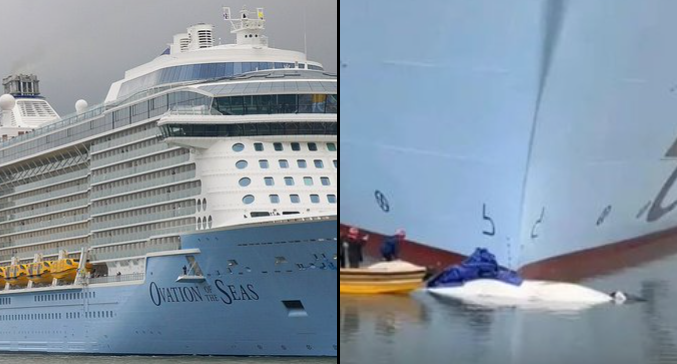
A dead pregnant fin whale was found draped across the bow of Royal Caribbean’s Ovation of the Seas when the ship arrived in Seward, Alaska, on June 19.
The whale was a 61-foot female fin whale, one of the world’s largest animals and a species protected under federal law. The Independent reported that officials do not expect the whale’s official cause of death to be confirmed until additional testing is complete, a process that could take months.
Even so, the preliminary findings were stark. The Center for Biological Diversity reported federal officials found blunt force trauma to the whale’s spine, ribs and jaw, injuries consistent with a ship strike. The group also said the whale was pregnant, turning the death into a loss of both mother and calf for an already vulnerable species.
The initial examination revealed that the whale was pregnant, “freshly dead, and in good nutritional condition,” with plenty of blubber and muscle.
In a letter to Royal Caribbean, the Center for Biological Diversity urged the cruise line to adopt a policy requiring its ships to travel at 10 knots or less in areas known to be home to whales. The group says slower ships give crews and whales more time to avoid deadly collisions.
Vessel strikes are a leading cause of death for large whales, and conservationists say many more go undetected because struck whales often sink and are never found. People noted that NOAA considers fin whales “probably the most vulnerable species” to ship strikes after North Atlantic right whales.
Royal Caribbean said in a statement that the incident was immediately reported to the proper authorities and that it is fully cooperating with NOAA although it remains silent regarding reducing the speed of its cruise ships sailing in waters where whales are to be expected.
Reactions online have focused on the same concerns being raised by conservation groups: how fast large ships are traveling through whale habitat, and whether stricter speed limits should already be in place after years of similar warnings.
In 2019, we wrote about Holland America’s Eurodam ignoring calls to reduce speed while approaching whales, another case that raised questions about whether large cruise ships are moving too fast in areas where whales are known to feed and surface.

There have been a number of cruise ships that have struck whales and arrived at port with whales impaled on the bulbous bow of the ship. You can read about another example of a Royal Caribbean-owned ship arriving in port with a dead whale on its bow here. The Grand Princess also struck a humpback whale in Alaska years ago.
Holland America’s Zaandam struck an endangered fin whale in 2016 and carried the dead whale into port in Seward on its bulbous bow.
In one of the most graphic photographs of a cruise ship-whale strike (above right), in 2009, the Princess Cruises’ Sapphire Princess arrived in port in Vancouver, allegedly unaware that the cruise ship had impaled a fin whale on the ship’s bow while in Alaskan waters. The whale was a female fin whale (Balaenoptera physalus). Princess claimed that the whale was already dead when the cruise ship hit her, a common excuse when a cruise ships kill a marine mammal.
The June 19 strike remains under federal investigation. But the pressure on the cruise industry is growing, with conservationists again demanding the same basic change they have pushed for years — slower ships in whale habitat.
“Ship strikes are already a leading cause of whale mortality in U.S. waters and the threat is growing,” Rick Steiner, a marine ecologist and Chair of PEER’s Board of Directors said. “Simply put, many of our busiest coastal shipping routes are death traps for whales.”
KTUU reported: “the cruise ships, they’re here to show people whales and scenery and it’s doubly ironic, or negligent of them, not to take every measure possible to protect the whales that are their bread and butter of their industry,” Steiner said. “But due to their hubris and corporate recalcitrant state, they just have not been willing to adopt a voluntary vessel speed reduction in these critical whale areas.”
Have a comment or question? Please leave one below or join the conversation on our Facebook page.
Photo credit Ovation of the Seas – kees torn – SMIT ELBE , SD SALVOR CC BY-SA 2.0 commons / wikimedia; dead whale on bow – Ship Board Cruiser; whale strike by Sapphire Princess – AP /The Canadian Press, Darryl Dyck via Telegraph.
July 1, 2026 Update:
Center for Biological Diversity Whale-Hitting Cruise Ship Was Likely Traveling Above Safe Speeds, Analysis Finds