


On July 22, 2026, the Federal Circuit handed down a nonprecedential yet strategically important decision in Shenzhen Jisu Technology Co., Ltd. v. The Entities and Individuals Identified in Annex A, affirming a district court’s reversal of a preliminary injunction in a design patent “Schedule A” case involving foldable fans sold on Amazon and Temu. The case is a useful guide into how later-issued design patents can complicate and undermine a design patent holder’s claim for preliminary injunctive relief.
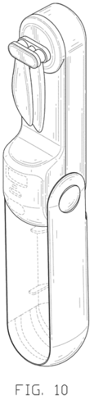
Shenzhen Jisu Technology owns U.S. Design Patent No. D886,982 (shown at right), covering the ornamental design of a foldable fan. In April 2024, Shenzhen filed what’s become a common strategy in e-commerce IP enforcement: a “Schedule A” case naming dozens of anonymous online storefronts as defendants, seeking an immediate ex parte temporary restraining order (TRO) to freeze the defendants’ ability to sell allegedly infringing products. The district court granted the TRO, and Shenzhen moved to convert it into a preliminary injunction (PI). Unlike most Schedule A cases where the majority of defendants either default or disappear, several defendants, including appellee Zhouty, responded to Shenzhen’s complaint. Zhouty argued that there were “readily-apparent and substantial differences” between its product and the patented `982 design, and thus Shenzhen couldn’t show the likelihood of success on the merits required for a PI. The district court initially disagreed, finding the “overall ornamental visual impression” of Zhouty’s product “quite similar” to the patented `982 design, and granted the PI.
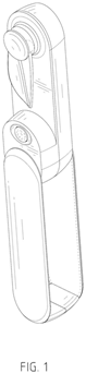
After the PI briefing was completed, the U.S. Patent and Trademark Office issued design patent D1,046,104 (shown at right) to a third party, also covering a foldable fan design, and expressly cited Shenzhen’s earlier `982 patent as considered prior art. Zhouty seized on this, arguing that if the `104 patent survived examination despite the examiner’s awareness of the `982 patent, the examiner must have concluded the two designs were not the same; otherwise, the `104 patent would have been rejected as anticipated. Zhouty argued that since the legal tests for anticipation and design patent infringement are identical, Shenzhen’s own infringement claim was now less likely to succeed. The district court initially denied reconsideration on this basis, but a month later, after Shenzhen added the owner of the `104 patent to the suit, new facts emerged suggesting Zhouty was authorized to sell products covered by the `104 patent’s design. In light of this new information, the district court reversed course by denying injunctive relief against Zhouty, and dissolved the existing PI against Zhouty. Shenzhen appealed to the Federal Circuit.
Writing for the majority, Judge Hughes rejected both of Shenzhen’s arguments. Shenzhen first argued that collateral estoppel barred the district court from revisiting its earlier rejection of the `104 patent argument. The court explained that collateral estoppel, which generally prevents relitigating issues already finally decided in a separate proceeding, has no role within a single, ongoing case. Quoting Seventh Circuit precedent, the court noted that collateral estoppel “has no role within a unitary, ongoing proceeding,” and a district court was free to reconsider its own non-final rulings as a case develops. In re Hovis, 356 F.3d 820, 822 (7th Cir. 2004).
Shenzhen then argued that the district court had improperly conflated the standards for patent validity with patent infringement. The Federal Circuit agreed with Shenzhen that at least for obviousness and infringement, the tests are examined from different perspectives (a “designer of ordinary skill” versus an “ordinary observer,” respectively). However, the district court did not base its opinion on obviousness; instead, the Federal Circuit found that the district court had properly relied on a well-established principle: for design patents, the tests for anticipation and infringement are the same test. Int’l Seaway Trading Corp. v. Walgreens Corp., 589 F.3d 1233, 1239 (Fed. Cir. 2009). Thus, if the `104 patent issued over the `982 patent, the `104 patent’s statutory presumption of validity implies that the patent office found the two designs weren’t substantially similar in the eyes of an ordinary observer, undercutting the likelihood that products practicing the `104 design infringe the `982 patent. The court characterized this as a permissible “aid in estimating” the likelihood of success at the preliminary injunction stage, rather than a rigid or improper legal rule requiring Shenzhen to prove invalidity of the `104 patent. Since the accused products were represented to practice the `104 patent’s design, the Federal Circuit found no abuse of discretion in the district court after weighing that fact against Shenzhen’s likelihood of success, while noting that Shenzhen still remains free to ultimately prove infringement on the merits at trial.
Judge Stoll dissented from this portion of the opinion, arguing that the majority let the district court skip the analytical framework that the Federal Circuit has required since Egyptian Goddess v. Swisa, and reaffirmed in ABC Corp. I v. Partnership & Unincorporated Associations Identified on Schedule “A”: a three-way comparison of the accused product, the patented design, and the relevant prior art, applying the ordinary observer test on a product-by-product basis. ABC Corp. I, 52 F.4th 934, 942 (Fed. Cir. 2022). In her view, the district court instead took a shortcut by inferring non-infringement from the mere fact that a later patent issued over the earlier one, rather than actually comparing the designs and the prior art. Judge Stoll acknowledged the shortcut might sometimes reach the right answer but insisted that “judicial efficiency” cannot substitute for the required legal framework.
Because the opinion is nonprecedential, it won’t bind future panels, but its reasoning and Judge Stoll’s pointed disagreement around Egyptian Goddess will likely be cited by litigants on both sides of the growing wave of design patent Schedule A e-commerce enforcement actions. Most notably, this opinion shows how a later-issued design patent can be a powerful defense: if a defendant can show its product practices a subsequently issued design patent that cites the plaintiff’s patent as prior art, that fact alone may weaken a plaintiff’s PI case. Moreover, Judge Stoll’s dissent signals that shortcuts around the Egyptian Goddess three-way test remain contested ground, even at the preliminary injunction stage, and a future court may need to resolve this more definitively.