


Here’s the latest in a case we’ve been closely following (because we represent the property owners!).
In this Memorandum and Order, the U.S. District Court for the District of Rhode Island invalidated the Town of Johnston’s ham-fisted attempt to take the property of a local family in order to move the current Town Hall from its present location in the center of town to the very outer border of the municipality, and build a new government complex.
What is really going on is that this scheme only came about after the Town learned of the family’s plans to build affordable housing on their own land. State law ties the Town’s hands when it comes to using the usual zoning and land-use death-by-a-thousand days process to thwart development, so Town officials latched onto what they thought was a “silver bullet” — taking the property by eminent domain would stop any development plans by the owners.
Putting aside for the moment any public use or constitutional pretext objections (the primary motivation for the taking was not to build a new municipal campus, but to thwart the owners’ affordable housing plans), there were ways under Rhode Island law to try and take the property in accordance with the multiple statutes in which the legislature has delegated to municipalities limited power to use eminent domain.
But the Town didn’t choose any of those available paths. Instead, it simply made up its own procedures after asserting that it possesses a general power of eminent domain by which it could take property for virtually any use that qualifies as public. Before you could say “boo,” the Town adopted a series of resolutions implementing this plan, seized the Santoro land ex parte, registered itself as the owner of record, and told the family that they would be trespassed if they didn’t get off of their own land.
Federal court complaint followed, after which the district court entered a temporary restraining order freezing everything in place. The court soon thereafter transformed the TRO into a preliminary injunction which required the Town to unwind its actions.
Recently, the court considered cross motions for summary judgment, which resulted in the Order holding the Town lacks the authority to do what it is doing. In law terms, the Town’s actions are ultra vires. Void ab initio. As the court wrote:
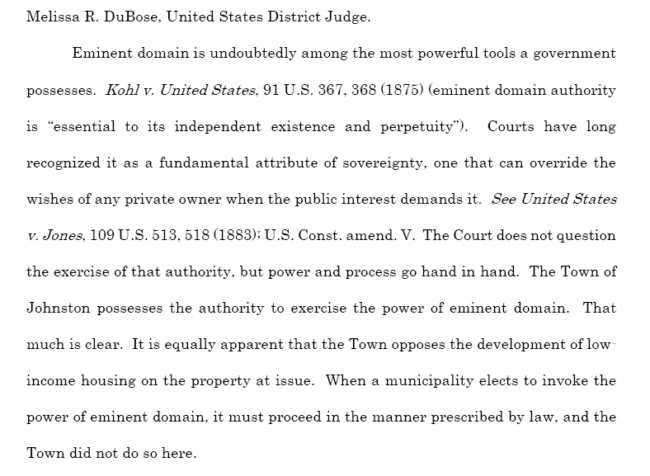
Slip op. at 1.
The issue turned on whether the state had delegated virtually unlimited eminent domain powers when it ratified the Town Charter more than 60 years ago. As the court described this claim:
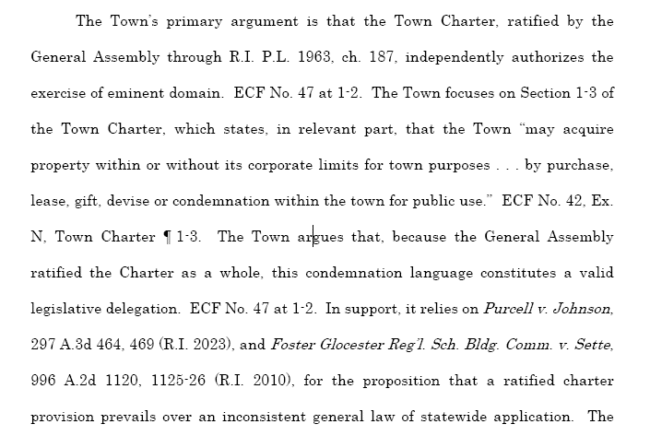
Slip op. at 14.
No, the in-bulk ratification of a Charter provision that merely mentions that the Town may acquire property is not enough to be deemed a delegation of the state’s sovereign powers:
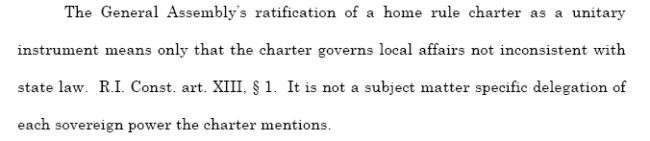
Slip op. at 17.
But even if there were a state-law basis for the Town’s claim to possess unbound eminent domain power, any such process is unconstitutional, because it “facially fails a constitutional adequacy test that the Rhode Island Supreme Court set out long ago.” Id. (citing
That standard requires that any delegation of eminent domain power be accompanied by an express pledge of public faith and credit to provide compensation, a source for that compensation, and a procedure by which an owner whose property is condemned may compel payment of compensation.
[A] a statute which delegates to a municipality the exercise of the power of eminent domain must contain a pledge of the public faith and credit and must afford to those whose property is to be taken an adequate and definite remedy for enforcing the claim.
Remington Realty Co. v. City of Providence, 151 A.2d 376, 379 (R.I. 1959) (quoting 3 Julius L. Sackman, et al., Nichols’ The Law of Eminent Domain § 8.71 (3d ed. 1964)). Note: the U.S. Supreme Court employs this same constitutional standard to test the adequacy of a delegation of eminent domain power.)
The court concluded with this summary:

More on the decision here: Nolan Page, Christopher Shea, “Federal judge voids Johnston’s land seizure under eminent domain,” Yahoo News (July 28, 2026).
Stay tuned. This one isn’t done yet.