

Happy Hens, the Ramona poultry farm San Diego County named as the source of the eggs in the SalmonellaEnteritidis outbreak that has sickened twenty-three people and hospitalized seven, announced on its own Instagram account on Sunday, August 31, 2026, that FDA testing has returned two samples positive for SE, that all product from the affected sites is being held from sale, that four thousand eggs will be tested over the next two weeks, and that if more positives are confirmed, approximately ten thousand hens may need to be depopulated. As I write this, not one of the agencies that has those results — not FDA, not San Diego County, not the California Department of Food and Agriculture, not the California Department of Public Health — has published a word about them.
The regulated party announced the regulator’s test results.
The announcement came twice on Sunday: a video from the farm, and a written post on the @trulyhappyhens account headlined “FDA TESTING RESULTS ARE IN.” Screenshots of both, captured August 31, are below. The written post says the farm pulled its own samples before the outbreak was public and those were negative; that FDA has since conducted additional testing and two samples tested positive for SE; that product from the affected sites is held from sale pending more testing; and that a positive follow-up could mean depopulating roughly ten thousand hens. FDA’s CORE investigations table, last updated August 26, has no entry for this outbreak. The County’s newsroom still shows only its July 28 bulletin and its August 17 update. The only place the public can learn that federal testing at this farm came back positive is the farm’s own social media feed, with the farm’s own spin attached.
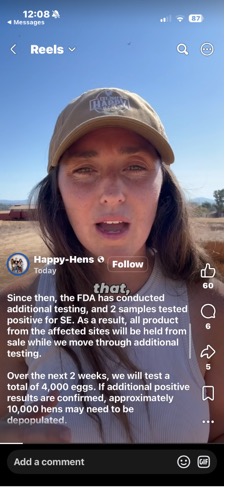
Figure 1: The Happy Hens Instagram video, August 31, 2026 — two FDA samples positive for SE, product held from sale, 4,000 eggs to be tested, roughly 10,000 hens possibly depopulated.
The numbers in the farm’s announcement are the federal egg rule running exactly as written.
Happy Hens did not invent the four-thousand-egg figure. Under FDA’s shell egg rule, 21 C.F.R. Part 118, a covered producer whose environment tests positive for Salmonella Enteritidis must begin egg testing — four samplings of one thousand eggs each — and must divert eggs away from the table market to pasteurization until the flock tests clean. “Affected sites,” “affected barns,” a hold on sale, and a 4,000-egg testing plan is that machinery, described almost verbatim. The plain reading is that FDA’s two positives were environmental samples, taken house by house, and that the farm now knows which houses. Depopulation is the farm’s own word, not the rule’s — the rule requires diversion — but ten thousand hens out of a flock its owner has put at roughly fourteen thousand tells you the positives are not confined to one corner of the operation. And FDA’s own guidance on the rule says the agency considers eggs containing SE adulterated and expects most positive egg tests to end in a recall.
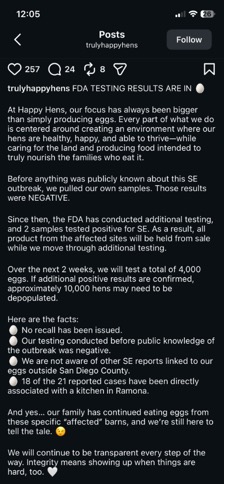
Figure 2: The written post — “No recall has been issued” offered as reassurance, and the family “still here to tell the tale” after eating eggs from the affected barns.
This is the same account that spent two weeks calling the link impossible.
Happy Hens denied the connection on Instagram when the County named it on August 17. A co-owner told Fox 5 the family had shrugged off the investigation expecting “all negative reports,” and said the farm had just pulled its own swabs. She told another station she was confident enough in the eggs to drink them raw. A video followed saying the farm followed Salmonella prevention protocols. Sunday’s post now says the farm’s samples were pulled before anything was publicly known — which is not the sequence the owner described on camera. Both accounts cannot describe the same testing, and the difference matters, because “our tests were negative” is the entire public defense. It is also less than it sounds. SE is shed intermittently and contaminates the egg from inside the hen, so a clean swab in August says nothing about the eggs laid in June that made people sick. That is precisely why the rule treats a single positive the way it does.
The farm’s “facts” list does not match the County’s own numbers.
The post says eighteen of twenty-one reported cases are “directly associated with a kitchen in Ramona.” The County’s current accounting, reported August 21, is twenty-three cases split two ways: eighteen tied to the raw-egg mayonnaise at Ramona Family Naturals Market, and five in people sickened by Happy Hens eggs directly, with no connection to the deli. The farm kept the stale total and dropped exactly the five cases that implicate the farm rather than the kitchen. “No recall has been issued” is likewise offered as reassurance. The accurate sentence is that eggs from barns where FDA has now found Salmonella kept moving into commerce in three counties until this hold.
A wink emoji, and seven people in the hospitalization count.
The post closes with the family still eating eggs from the “affected” barns “and we’re still here to tell the tale,” followed by a wink. Seven people in this outbreak were not here to tell it from home — they told it from hospital beds, one of them still admitted in mid-August. My firm filed suit on August 18 for one of them, a thirty-six-year-old Ramona mother of three who ate a deli sandwich she did not know contained raw eggs.
The post’s last line is that integrity means showing up when things are hard. On the disclosure record, the farm has a point — just not the one it intended. In the December 2025 Vega Farms egg outbreak, CDPH issued its own press release, sampled the farm, matched a sample to the patient strain by whole genome sequencing, and the eggs were recalled. In the August 2025 Country Eggs outbreak, the health agencies announced the link themselves and a nationwide recall followed. In this outbreak, the pattern I wrote about two weeks ago has not changed: two County releases, no serotype details, no customer list, no sampling results — and now federal test results reaching the public through the defendant’s Instagram. What should happen this week is not complicated. FDA or the County should publish what was sampled, which houses were positive, and whether the isolates are being sequenced against the outbreak strain, and the County should release the list of stores that received these eggs. If the egg testing comes back positive, FDA’s own guidance calls those eggs adulterated and expects a recall. The farm says it will be transparent every step of the way. The government should not be less transparent than the defendant.