

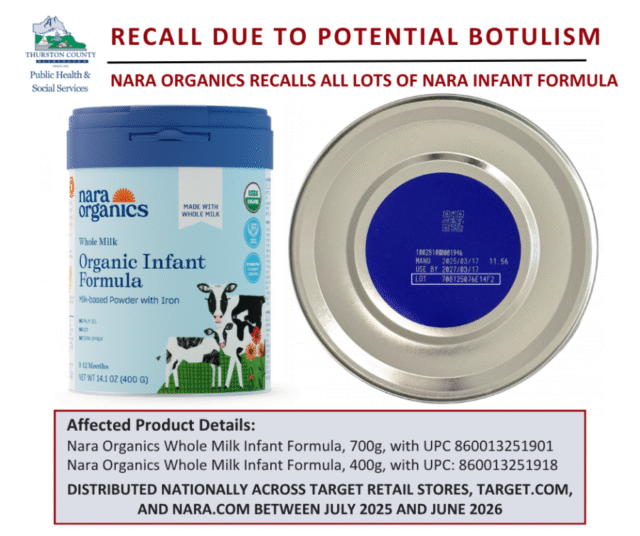
On August 27, the same day FDA and CDC declared the Nara Organics infant botulism outbreak over, the company posted an update announcing that it plans to bring its formula back to U.S. shelves with European dairy and what it calls rigorous C. botulinum testing. Newsweek picked it up as a comeback story. I read it as a company working very hard to describe an outbreak without admitting it caused one.
The single most important fact in this story is one Nara never states plainly: the link between the Nara outbreak and the ByHeart outbreak is Dairy Farmers of America and Organic West Milk. Same milk, same spray dryer, two brands, fifty-two hospitalized babies. Here is what the record actually says, and where the company’s version bends away from it.
What FDA found
FDA’s outbreak page is short and unambiguous. Four infants in California, Pennsylvania and Washington developed confirmed botulism after consuming Nara Organics Whole Milk Organic Powdered Infant Formula, with onsets between April and May 2026. All four were hospitalized. Infant botulism is rare enough that four cases sharing one product in two months is, by itself, an outbreak signal.
Then the genetics. Whole genome sequencing of one Nara infant’s Clostridium botulinum matched a clinical sample from the 2025 ByHeart outbreak, a ByHeart base powder sample, and four unopened cans of ByHeart formula. Traceback showed the Nara lots tied to these illnesses were made with milk supplied by Organic West Milk and spray dried by Dairy Farmers of America, the same two suppliers behind the ByHeart outbreak. FDA’s conclusion: the WGS match and the shared supply chain indicate a common source of contamination between the two outbreaks. The only open question is whether the milk was contaminated before drying or during it.
ByHeart, for those who missed it, was 48 infants in 17 states, every one hospitalized. I wrote last week about ByHeart’s own “no further questions” announcement, which landed the day after FDA said the two outbreaks share a common source and did not mention it. Nara’s statement is the same move from the other direction.
How Nara describes the same finding
Nara’s version is that the outbreak “may be linked to one of our former dairy suppliers.” May be. Former. One of. Three qualifiers in a sentence about a finding FDA states without any.
The company then spends most of its update on what the sequencing did not show: that the matching infant’s strain did not match the open can from that family’s home; that the other two infants’ strains match nothing in the NCBI database and do not match each other; that the open can matches nothing either; and that sealed cans tested negative for botulinum toxin types A and B. The unstated argument is that nobody can prove the spores were in a Nara can. Read the company’s own list again: it concedes C. botulinum was recovered from an open can of Nara formula in a patient’s home. The company just prefers to talk about which strain it was.
That argument does not survive contact with how infant botulism works. Infants get sick from swallowing spores, not preformed toxin. A toxin assay on a sealed can is the wrong test for the thing that hurt these babies, and a negative result tells you nothing about spores. Spores in dried milk powder are not evenly distributed; FDA’s ByHeart investigation identified seventeen distinct strains across patient, product and ingredient samples. An open can sampled from a home weeks after the fact carrying a different strain than the one that colonized an infant’s gut is exactly what you would expect. And a clinical strain absent from NCBI means the public database is thin on environmental C. botulinum, not that the case is unexplained. Meanwhile the one match FDA did find runs from a Nara baby straight to unopened ByHeart cans made from the same milk. Nara left that sentence out.
The date that gives it away
Nara says it stopped sourcing from U.S. dairy suppliers in April 2025 and that its newer EU-dairy batches were not yet on sale when the recall hit in June. Read that carefully. Nara launched in July 2025 and reached Target in January 2026. By the company’s own account, every can it ever sold in this country was made with the Organic West and DFA milk that FDA has now implicated in two outbreaks. The switch to Europe was not a response to the outbreak. It was a supply decision that happened to leave the implicated product on shelves for another fourteen months.
The timeline gets worse. ByHeart recalled in November 2025. By late January 2026, the Associated Press had publicly named Organic West and DFA’s Fallon, Nevada plant as the source of the botulism-positive milk powder. Nara formula made with milk from that same supply chain stayed on sale through the spring. The four Nara babies got sick in April and May. Nara’s June 23 supplier page does not explain what the company knew about its own supplier in January, or why lots made with that milk were not pulled then.
FDA’s page adds one more fact Nara did not repeat. During the 2025 ByHeart investigation, FDA asked Organic West which other formula makers it had supplied. The customer list Organic West provided did not include Nara. The company corrected that only during the 2026 investigation. That failure belongs to Organic West, but it does not help Nara: a supplier’s omission kept FDA from calling, not Nara from knowing who made its milk.
About that testing
Nara’s recall page says the company already tests every batch beyond FDA and EU requirements, screening for sulphite-reducing clostridia as a proxy for C. botulinum. That program was in place when the outbreak lots were made and released. It did not stop them. A promise of rigorous testing on relaunch means nothing unless the company says what changed: which method, which sample size per lot, which spore-detection protocol rather than a toxin assay, and whether results will be published lot by lot.
I would add that DFA told the AP in January that the milk powder met all required tests. Both companies in this chain have now pointed at the tests as proof of safety. The tests were the problem.
What a real relaunch would look like
I am not against Nara selling formula again. I am against Nara selling it on the strength of a statement that reads like it was written to survive a deposition. Before this product comes back, the company should name its EU dairy supplier and spray dryer. It should publish its spore-testing protocol and commit to lot-by-lot results. It should wait for FDA to finish the root-cause investigation, since a company that does not yet know where the spores came from cannot credibly say it has designed them out. And Esther Hallam should sit down with the four families whose babies were hospitalized, in person, before the marketing starts.
I represent two of the four Nara families. Erica and Micky Goldfin of Yardley, Pennsylvania sued Nara and Target in the Eastern District of Pennsylvania on June 22. Their son spent two nights in intensive care at Children’s Hospital of Philadelphia on BabyBIG and is still in weekly physical therapy. Jin Nam and Jisun Leeof Lacey, Washington sued in the Western District of Washington on July 25; laboratory testing of the opened can of Nara formula fed to their son found C. botulinum, and weeks later he could not hold his head up or feed normally. I also represent families from the ByHeart outbreak. None of these parents care whose name was on the can. They care that two formula companies bought the same milk from the same two suppliers, that the second kept selling it after the first had recalled, and that fifty-two babies ended up in hospitals.
“We’re grateful to learn that the outbreak is over” is how Nara closed its statement. Grateful is not the word.
Sources: FDA Nara outbreak page; CDC food safety alert; FDA ByHeart outbreak page; Nara Organics August 27 update.