

Does a company’s sanitary record figure into its possible criminal conduct when involved in an outbreak of foodborne illness?
That question is being disputed during the pre-trial stage of the United States v. Paul Kruse. Pre-trial motions are scheduled for July 22 in the Texas Western District court in Austin.
Kruse, 67, is the retired president of Blue Bell ice cream, the iconic Texas brand that in 2015 was at the center of a deadline listeriosis outbreak. As they approach the Aug.1 trial date for the start of the federal criminal trial that will decide his guilt or innocence, Kruse’s defense attorneys have moved to exclude sanitary issues from jury review.
The defense team, Chris Flood of House and John Cline of Seattle, have moved to strike sanitation issues from the indictment, thereby preventing that information from ever going to the jury.
The four government prosecutors assigned to the case oppose the defense motion. “Because the allegations regarding sanitation issues are material and relevant to the defendant’s scheme to defraud Blue Bell Creameries, L.P. (Blue Bell) customers, the motion should be denied,” government attorneys say.
Tara M. Shinnick, Matthew Lash, Patrick H. Hearn, and Kathryn A. Schmidt are the four attorneys assigned to represent the government. All four are from the U.S. Department of Justice Consumer Protection Branch.
Kruse was indicted in 2020 for one count of conspiracy and six counts of wire fraud. He pleaded not guilty to the charges.
The indictment claims there was a conspiracy to obtain money from Blue Bell customers by “false and fraudulent” pretenses.
The government attorneys say Kruse “knew for years that appropriate practices to ensure sanitary conditions were not being followed and achieved at Blue Bell manufacturing facilities, a practice which resulted in a deadline outbreak of disease.”
They say the origins of the 2015 listeriosis outbreak at two Blue Bell plants occurred “long before. “The evidence at trial will show that as early as 2010, the defendant was aware of roof leaks, condensation, and other unsanitary conditions at Blue Bell plants and yet allowed them to persist, prosecutors tell the court. “Under his leadership, Blue Bell shipped products with levels of coliforms that he knew exceeded the state standard.
“.Coliform testing is commonly used in the food industry to indicate the sanitary quality of products and the sanitary conditions of manufacturing facilities,” they add. “It is understood in the food industry that high levels of coliforms indicate unsanitary conditions in the facility, which can lead to bacteria and contamination issues, including the presence of L. mono (Listeria monocytogenes).”
In keeping the sanitation issues before the yet-to-be picked jury, the government says that because of high coliform levels at Blue Bell facilities, the company’s Quality Assurance team started testing finished products for Listeria in 2011.
They say the Quality Assurance Manager will testify at trial that Kruse ordered it be shut down. “After this instruction from the defendant, two samples that had already been sent for testing came back presumptively positive for Listeria.
According to the government, the defendant again ordered the program to be shut down when told about the presumptive positive tests. “The evidence at trial will show that Blue Bell shipped those presumptive positive products out to customers without regard to their safety.”
The defense argued that a discussion of sanitary issues is “surplusage” to the indictment. The prosecution cites judicial sources to say that such a motion must be “exacting and strict” and is rarely granted.
The prosecutors say a “court should not grant a defendant’s motion to strike surplusage as prejudicial unless it is clear that the information is not relevant and is prejudicial.”
“If the evidence of the allegation is admissible and relevant to the charge, then despite prejudice, the language will not be stricken,” they add.
Kruse is a resident of Brenham, TX, the headquarters of Blue Bell, and its long association with his family.
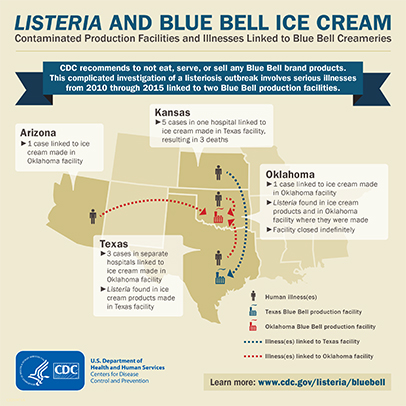
He issued, in 2015, the first recall in the company’s century-long history and suspended all production for several weeks. In the four-state outbreak, there were three deaths among 10 illnesses. All 10 patients were hospitalized.
A federal Grand Jury indicted Kruse in 2020 after a five-year investigation.
The Austin-based federal Western District Court for Texas has state that it “finds the United States v. Kruse a complex criminal case.”
As a corporate entity, Blue Bell pleaded guilty in a related case in 2020 to two counts of distributing adulterated food products in violation of the Federal Food, Drug, and Cosmetic Act.
The company agreed to pay criminal penalties totaling $17.5 million and $2.1 million to resolve False Claims Act allegations regarding ice cream products manufactured under unsanitary conditions and sold to federal facilities, including the military. The total $19.35 million in fines, forfeiture, and civil settlement payments was the second-largest amount ever to resolve a food safety matter.
Kruse is the only individual facing criminal charges because of the 2015 outbreak.
Blue Bell Creameries, founded in 1907 in Brenham, TX, today produces Blue Bell ice cream for national distribution.
(To sign up for a free subscription to Food Safety News, click here.