

A pathogen-by-pathogen look at the seasonality of food poisoning in the United States
Link to The short answer The short answer
Partly fact, partly fiction — and which one depends entirely on how you count. If you measure food poisoning by the raw number of illnesses, the single largest cause is norovirus, a virus that peaks in winter, so the popular image of summer as “food-poisoning season” does not hold up against total case volume. But if you focus on the classic bacterial and parasitic infections — the ones most associated with cookouts, raw produce, and seafood — the summer pattern is real and well documented. The honest answer is that summer is genuinely the peak season for most bacterial and parasitic foodborne pathogens, while the most common pathogen overall runs in the opposite direction.
Link to The evidence on both sides The evidence on both sides
Link to The case that summer has more food poisoning The case that summer has more food poisoning
For bacterial and parasitic pathogens, the summer peak is well established. An analysis of CDC surveillance data found that roughly a third of reported foodborne-illness cases occur between June and August, with the year’s highest share in late summer. The mechanism is straightforward: the FDA notes that bacteria multiply fastest between 40°F and 140°F, and warm weather brings more outdoor cooking, more time in the temperature “danger zone,” and greater consumption of fresh, uncooked produce. A peer-reviewed study in Scientific Reports analyzing two decades of FoodNet data confirmed summer increases for Campylobacter, STEC, Listeria, and Salmonella.
Link to The case against it The case against it
The major counterweight is norovirus. According to the CDC it causes about 58% of foodborne illnesses acquired in the United States, making it the single largest contributor by a wide margin — and it peaks in winter. Surveillance consistently shows norovirus activity beginning in November and peaking around December and January, and CDC’s NoroSTAT system places the height of the season between December and March. Because norovirus dominates total case counts, any “all-cause” tally is pulled toward winter, not summer.
Link to The five most common pathogens The five most common pathogens
Using CDC’s foundational burden estimates, the five most common foodborne pathogens by number of U.S. illnesses account for roughly 91% of illness from known pathogens. Their seasonality splits in a revealing way:
- Norovirus (58%) — winter. The decisive category, and it runs counter to the summer idea, peaking from December to March.
- Salmonella (11%) — summer. Part of the documented summer-peaking bacterial group.
- Clostridium perfringens (10%) — roughly year-round. CDC outbreak data are spread fairly evenly across seasons (fall 28%, spring 26%, winter 24%, summer 22%), with a lean toward the holidays when large batches of meat, poultry, and gravy are prepared ahead and held warm.
- Campylobacter (9%) — summer. Same summer pattern as Salmonella.
- Staphylococcus aureus (3%) — weakly seasonal. Driven by food-handler contamination and temperature abuse rather than a clear season; often linked colloquially to warm-weather picnics but lacking a strong surveillance signal.
Link to The rarer but more severe pathogens The rarer but more severe pathogens
The less common pathogens — though far fewer in absolute numbers — are the ones that most strongly favor the summer hypothesis, and several are disproportionately likely to cause hospitalization or death:
- Listeria — summer, grouped with the documented summer-peaking bacteria.
- E. coli (STEC) — summer, following the same warm-season pattern.
- Vibrio — strongly summer. Tied to warm water and raw shellfish; one analysis found about 47% of cases occur in July and August, and a 2000–2022 study of V. vulnificus described case patterns as highly seasonal, peaking in summer.
- Cyclospora — sharp summer spike. The most narrowly seasonal of all, with nearly half of recorded cases reported in July alone.
- Shigella — late summer into autumn, slightly later than the others, though its outbreak counts swing widely year to year.
For scale, 2024 reported rates per 100,000 were roughly Shigella 6.0, STEC 4.7, Cyclospora 1.1, Vibrio 1.0, and Listeria 0.2 — small numbers, but Listeria and Vibrio infections are often severe, especially for older adults, pregnant people, and the immunocompromised.
Link to Seasonality at a glance Seasonality at a glance
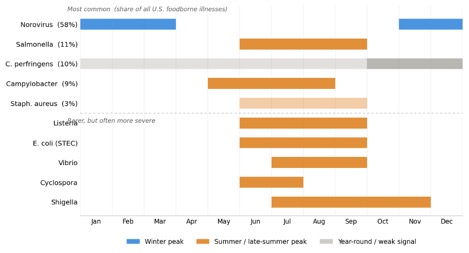
| Pathogen | Burden | Seasonal peak |
| Norovirus | 58% of illnesses | Winter (Nov–Mar; peak Dec–Jan) |
| Salmonella (nontyphoidal) | 11% of illnesses | Summer |
| Clostridium perfringens | 10% of illnesses | Year-round; slight fall/holiday lean |
| Campylobacter | 9% of illnesses | Summer |
| Staphylococcus aureus | 3% of illnesses | Weak; mild warm-weather lean |
| Listeria monocytogenes | ~0.2 / 100k (severe) | Summer |
| E. coli (STEC) | ~4.7 / 100k | Summer |
| Vibrio | ~1.0 / 100k (severe) | Summer (strong; Jul–Aug) |
| Cyclospora | ~1.1 / 100k | Sharp summer (≈½ of cases in July) |
| Shigella | ~6.0 / 100k | Late summer into autumn |
Link to Reconciling the evidence Reconciling the evidence
The full picture is a tale of two groups. Among the most common pathogens, the seasonal signal is mixed and actually tilts toward winter once you weight by case volume, because norovirus dwarfs everything else. Among the rarer, more severe pathogens — Listeria, STEC, Vibrio, Cyclospora, and Shigella — the summer pattern is strong and consistent. So “more food poisoning in summer” is most defensible if you mean the classic bacterial and parasitic infections, and least defensible if you mean total illness burden including viruses. Whether the claim is “fact” or “fiction” genuinely depends on whether you are counting raw case numbers or counting the infections most likely to send someone to the hospital.
Link to A note on the data A note on the data
These figures come from surveillance systems (NNDSS and FoodNet) that capture reported and laboratory-confirmed cases, so seasonal shares are estimates rather than exact incidence, and reporting completeness varies by pathogen and season. The pathogen rankings reflect CDC’s foundational estimates; CDC’s most recent update (2019 data, published 2025) reorders the bacteria slightly — placing Campylobacter ahead of Salmonella — and did not re-estimate Staphylococcus aureus, but this does not change the overall seasonal split.
Link to References References
- CDC — Burden of Foodborne Illness: Findings (2011 estimates; top-five pathogen tables). https://archive.cdc.gov/www_cdc_gov/foodborneburden/2011-foodborne-estimates.html
- CDC — Foodborne Illness Acquired in the United States: Major Pathogens, 2019 (Emerging Infectious Diseases, 2025). https://wwwnc.cdc.gov/eid/article/31/4/24-0913_article
- Food Safety Magazine — Six Pathogens Caused 9.9 Million Foodborne Illnesses in U.S. in 2019 (2025). https://www.food-safety.com/articles/10242
- CIDRAP, University of Minnesota — CDC foodborne illness snapshot highlights heavy burden, successes (2025). https://www.cidrap.umn.edu/foodborne-disease/cdc-foodborne-illness-snapshot-highlights-heavy-burden-successes
- Seasonal synchronization of foodborne outbreaks in the United States, 1996–2017. Scientific Reports / Nature (2020). https://www.nature.com/articles/s41598-020-74435-9
- Hall et al. — Norovirus Disease in the United States. Emerging Infectious Diseases. https://www.ncbi.nlm.nih.gov/pmc/articles/PMC3739528/
- Mattison et al. — Seasonality of medically attended norovirus gastroenteritis, 2016–2019. PLOS ONE (2025). https://www.ncbi.nlm.nih.gov/pmc/articles/PMC12063862/
- CDC — NoroSTAT surveillance data. https://www.cdc.gov/norovirus/php/reporting/norostat-data.html
- CDC — Norovirus Facts and Stats. https://www.cdc.gov/norovirus/data-research/index.html
- Trace One — States With the Highest Rates of Foodborne Illnesses (analysis of CDC NNDSS 2024 data). https://www.traceone.com/resources/plm-compliance-blog/states-with-highest-rates-of-foodborne-illnesses
- Grass et al. / CDC, presented at ICEID 2012 — Clostridium perfringens foodborne outbreaks (reported via Medscape). https://www.medscape.com/viewarticle/760531
- Bennett, Walsh & Gould — Foodborne Disease Outbreaks Caused by Bacillus cereus, Clostridium perfringens, and Staphylococcus aureus, United States, 1998–2008. Clinical Infectious Diseases (2013). https://academic.oup.com/cid/article/57/3/425/460877
- The Pew Charitable Trusts — Vibrio Infections in the U.S. Increased Significantly in Recent Years. https://www.pew.org/en/research-and-analysis/fact-sheets/2013/05/28/vibrio-infections-in-the-us-increased-significantly-in-recent-years
- Hast et al. — Vibrio vulnificus epidemiology and risk factors for mortality in the United States, 2000–2022 (2026). https://pmc.ncbi.nlm.nih.gov/articles/PMC12505355/
- Foodborne outbreaks of shigellosis in the USA, 1998–2008. Epidemiology & Infection. https://pmc.ncbi.nlm.nih.gov/articles/PMC4610123/
- CDC — FoodNet 2024 Preliminary Data. https://www.cdc.gov/foodnet/reports/preliminary-data.html