

On the one hand, the petitioner claims that she is unable to maintain herself and she cannot afford to purchase even the basic necessities for survival and on the other hand, she is multiplying non-compulsive litigation against her husband. The
Latest from Law Web - Page 3
Unlocking the Silent Witness: A Master Guide to Forensic Jurisprudence, Post-Mortem Science, and Medical Evidence in Criminal Trials
1. Introduction: The Strategic Convergence of Science and LawIn the contemporary Indian legal landscape, the transition from colonial-era statutes—the Indian Penal Code (IPC) and the Code of Criminal Procedure (CrPC)—to the modern framework of the Bharatiya Nyaya Sanhita
Supreme Court: Ordinarily an investigation cannot be started without recording the FIR
The police must have received some information. Why the other information was suppressed by the prosecution has not been explained. In a situation of this nature particularly if an FIR was lodged after recording the statements of the witnesses, another
Supreme Court: How to ascertain time of death by passing of rigor mortis?
Moreover, the doctor who conducted autopsy on the dead body on 06.10.1979 at 4.30 p.m., in the report has mentioned that rigor mortis had passed through upper extremities and was present in lower extremities. It is mentioned at page 125
Class Evidence, Not Proof of Identity: Medical Jurisprudence Perspectives on Bloodstain Serology
Why this still mattersBefore DNA profiling became the principal tool for source attribution, forensic laboratories used ABO and other inherited blood-group markers to characterise dried bloodstains. The absorption–elution technique, developed into a practical method for stains in the
What is basic concept of artifact in medical jurisprudence and the Forensic Art of Spotting False Evidence?
IntroductionIn the world of forensic medicine, not everything that looks like violence is violence, and not everything that resembles injury actually is one. Courts, investigators, and even seasoned lawyers can be misled by the body’s own postmortem behavior
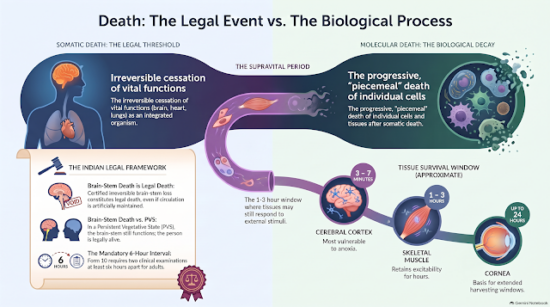
When the Person Dies Before the Cells: Somatic and Molecular Death in Medical Jurisprudence

Supreme Court: How to appreciate evidence if there is motive for committing murder of deceased?
There is also enough evidence adduced by the Prosecution to hold that the Appellants had the clear motive to eliminate the Deceased. An illicit/incestuous relationship between Accused No. -1 i.e., Ms. Uma and Accused No. -2 i.e., Mr. Ravi had
Supreme Court: How much weightage is to be given to evidence of doctor conducting post-mortem than to statements made in the textbooks?
We are disposed to think so when we weigh the medical testimony vis-a-vis the ocular testimony. There is no dispute that the value of medical evidence is only corroborative. It proves that the injuries could have been caused in the
Supreme Court: How to appreciate evidence of prosecution if weapon of offence is not shown to doctor to obtain his opinion?
A very relevant piece of evidence which has been noticed by the High Court, but not given due consideration, is that apart from the blood-stained knife (Ex. P-3) and certain other items mentioned in the letter of Investigating Officer, one