

January 1, 2026 was the effective date for a number of state law provisions relating to intentionally added PFAS in certain categories of products. July 1, 2026 will be the effective date for several more. As we have discussed in

January 1, 2026 was the effective date for a number of state law provisions relating to intentionally added PFAS in certain categories of products. July 1, 2026 will be the effective date for several more. As we have discussed in
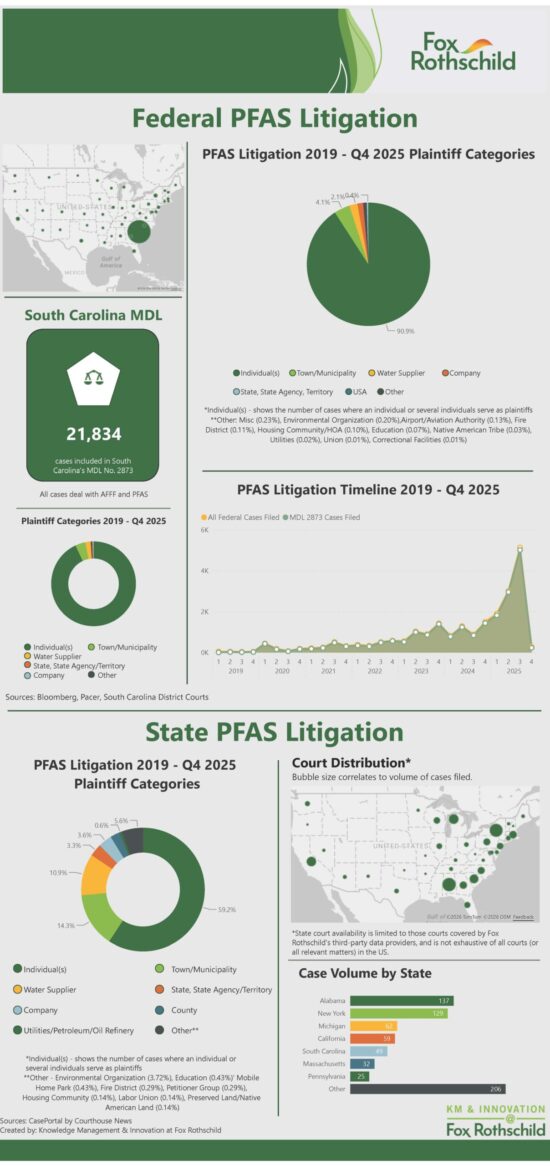
PFAS-related litigation continues to climb and to diversify as to claims and parties. See the attached graphics, updated through the fourth quarter of 2025. We will continue to update these graphics on a quarterly basis
Following the completion of briefing in the challenge to EPA’s rule designating PFOA and PFOS as hazardous substances under the Comprehensive Environmental Response, Compensation, and Liability Act (CERCLA), oral argument has been scheduled for Tuesday, January 20, 2026.
On January
As previously reported, in the context of litigation by utilities challenging Maximum Contaminant Levels (“MCLs”) for PFAS in drinking water, the United States Environmental Protection Agency (“EPA”) filed a Motion to Vacate the MCLs for PFHxS, PFNA, HFPO‑DA, and
Both Connecticut and New Mexico are moving forward with regulations to implement statutory labeling requirements for products in certain categories that contain intentionally added PFAS. Connecticut’s labeling requirement will be effective July 1, 2026, and New Mexico’s, when approved and
As foreshadowed in EPA’s most recent Unified Agenda, EPA has proposed to add four significant categories of exemptions to the TSCA PFAS Reporting Rule (Rule), citing burdensomeness of the existing Rule. Under the Proposed Rule, these new exemptions would include:
On November 21, 2025, the New Jersey Department of Environment Protection (NJDEP) filed notice with the U.S. District Court for the District of New Jersey that on January 7, 2026, it will move for entry of the Judicial Consent Orders
As previously reported, the U.S. Chamber of Commerce and two other trade groups have challenged EPA’s designation of PFOA and PFOS as hazardous substances under CERCLA. On November 14, 2025, petitioners filed their Joint Reply Brief in the U.S.
Updating our earlier post from March 2025, Maine has completed a regulatory process and has adopted updates to its PFAS in products rules to identify two approved Currently Unavoidable Use (CUU) exemptions from the state’s phased ban on in-state
On October 3, 2025, the U.S. Court of Appeals for the D.C. Circuit granted EPA’s unopposed motion to hold the PFAS drinking water standards litigation in abeyance due to the lapse in appropriations as a result of the government shutdown.