

 (in other words, do as Steve Miller says)
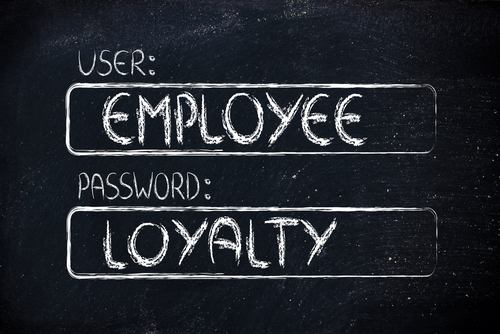
I think most would agree that loyalty is right up there among the most desirable employee traits (and if you disagree, please don’t stop reading . . . I spent a precious weekend writing this blog).
Assessing employee loyalty can be difficult. Don’t expect an employee to walk into your office and say, “hey, I really don’t care about this company, but it’s a paying job, so I guess I’ll hang around for a while.”
Look around your office. Who do you consider among your most loyal employees? Is it the guy who has been around since the company opened its doors? Is it the woman who always steps-up to accept additional work while others pretend not to have heard the initial request for help? Is it the one (and there’s probably only one) who looks forward to attending every company sponsored event? How loyal are you?
Perhaps one way to gauge employee loyalty is to offer employees money to quit. That’s right — flash cold, hard cash in front of your employees’ eyes and tell them they can pocket the money if they quit. Sound strange? That was my gut reaction, too, but this is precisely what Amazon has done. Amazon reportedly got the idea from Amazon-owned Zappos.
In a letter to shareholders, Amazon CEO, Jeff Bezos, explained as follows:
“Pay to Quit” is pretty simple. Once a year, we offer to pay our associates to quit. The first year the offer is made, it’s for $2,000. Then it goes up to one thousand dollars a year until it reaches $5,000 . . . The goal is to encourage folks to take a moment and think about what they really want. In the long-run, an employee staying somewhere they don’t want to be isn’t healthy for the employee or the company.
Amazon communicates its monetary offer under a headline, “Please Don’t Take This Offer.”
Amazon reportedly rolled-out the program to 40,000 warehouse workers earlier this year. By the end of the first quarter of 2014, fewer than 10% of the employees presented with the offer reportedly accepted the offer and left Amazon. The upshot? Amazon weeded-out employees who were not committed to the company, likely were unhappy at the company, and placed little value (or less than a $5,000 value) on their job. Overall, probably a positive development for the company and the departing employees.
From a human resources perspective, think of the added benefits of a Pay to Quit policy. Some of those who take the money and run likely would have been the “frequent flyers” of your progressive discipline policy. Others may have been the subject of countless conversations with your outside employment counsel (maybe even me). In short, weeding out the disloyal, disinterested, and unengaged could result in lower turnover and across-the-board savings.
Don’t get me wrong, I’m not advocating for, or against, adoption of a Pay to Quit policy. What works for Amazon and Zappos may not work for you. But, I do applaud companies like Amazon and Zappos for thinking out-of-the-box about ways to improve the quality of their most valuable asset, their employees.
Andrew Rodman looks forward to seeing you at Stearns Weaver Miller’s 24th Annual Labor & Employment Seminar this Thursday, May 1, at the Trump National Doral Miami. Please click here for further details.