

 Ver la versión en español aquí
If yes, they need to stop today. Why? Effective October 1, 2019, Florida drivers can use wireless communication devices (e.g., cell phones) only in a hands-free manner when driving in a designated school crossing, school zone, or work zone where construction personnel are present or operating equipment on the road or immediately adjacent to the work zone area. If they are stopped by law enforcement under these conditions, they will be issued a warning. On January 1, 2020, however, they will be issued a ticket, which will be punishable as a moving violation with a base $60 fine and 3 points assessed against their driver’s license.
Why should you care? Employers have an obligation under the Occupational Safety and Health Act (OSHA) to create a safe and healthful workplace. Therefore, employers should consider adopting policies banning their employees from texting while driving on company business or in a company-owned car (if they haven’t already). Moreover, they should not create any incentives for employees that encourage or condone texting. When conducting employee training, they also should consider including a discussion of their policy as well as the dangers of distracted driving.
If you are still wondering about the so-called “rules of the road” that can get you and your employees into trouble, here’s a little cheat sheet:
1. When did these changes occur in the law?
On May 17, 2019, Governor Ron DeSantis signed a bill that makes it a primary offense to text while driving, meaning violators can be pulled over and cited. Texting was already a secondary offense under the Florida Ban on Texting While Driving Law, but drivers could be cited only if they were pulled over for another violation. Effective July 1, 2019, Section 316.305, Florida Statutes, allows police officers to stop motorists simply for texting while driving. Starting January 1, 2020, police officers can begin writing citations that carry fines of about $30 plus court costs and fees as well as three points on your driving record for a first offense.
Section 316.306, effective today, is more stringent and allows a motorist to be pulled over and issued a warning for using wireless communication devices in a handheld manner in school and work zones. Hands-free uses in these zones are still lawful.
2. Can I text and drive if I’m not in a school crossing, school zone, or active work zone?
No. You cannot text, e-mail, instant message, etc., while driving. The law prohibits “manually typing or entering multiple letters, numbers, symbols, or other characters into a wireless communications device or while sending or reading data on a wireless communications device for the purpose of ‘nonvoice’ interpersonal communication . . . .”
3. But what if I’m stopped at a traffic light, can I send a text?
Yes. According to the amendment, a motor vehicle that is stationary is not subject to the texting prohibition. Consequently, if you are stopped at a red light, you can still send a text (although not recommended).
4. What if I’m lost and I need to use MapQuest or Google Maps. Is that okay?
Yes. The law recognizes certain exceptions and permits drivers to use a device or system for navigation purposes (i.e., drivers can still use GPS programs such as Google Maps).
5. Are there any other exceptions?
Yes. The prohibition on texting while driving doesn’t apply to a motorist who is:
- Performing official duties as an operator of emergency vehicle
- Reporting an emergency or criminal or suspicious activity to law enforcement authorities.
- Receiving messages related to the operation or navigation of the vehicle or vehicle safety; including emergency traffic, or weather alerts, receiving data used primarily by the motor vehicle or listening to radio broadcasts.
- Operating an autonomous vehicle.
6. Can a police officer ask to see my cell phone if I am stopped?
If you are pulled over and the officer asks to see your cell phone, you can decline. The officer also must inform you of your right to decline a search of your wireless device and cannot access your device without a warrant.
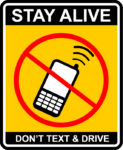
Best advice: Don’t Text and Drive, Stay Alive!