

Skip to content

Menu

LexBlog, Inc. logo
NetworkSub-MenuBrowse by SubjectBrowse by PublisherJoin the NetworkGet StartedSubscribeSupportContact
Search
Close

Update: President Trump Signs Emergency Leave Law: What this Means for Your Business

By Gabriel Jiran, Jarad M. Lucan, Daniel Schwartz & Sarah A. Westby on March 19, 2020
Email this postTweet this postLike this postShare this post on LinkedIn
GettyImages-501477454

On March 18, 2020, President Trump signed House Bill 6201, the Families First Coronavirus Response Act (“FFCRA”) into law. The law takes effect on April 2, 2020, and remains in effect until December 31, 2020. The FFCRA amends portions of the FMLA while also providing for paid sick leave in limited cases.

Because of the speed of passage as well as implementation, even the basics of the law can seem confusing to some. We have fielded calls asking: Does this law apply to my business? What has changed from the original FMLA requirements?

Employers need to understand that there are two sets of provisions in the law and each has their own restrictions and applications.

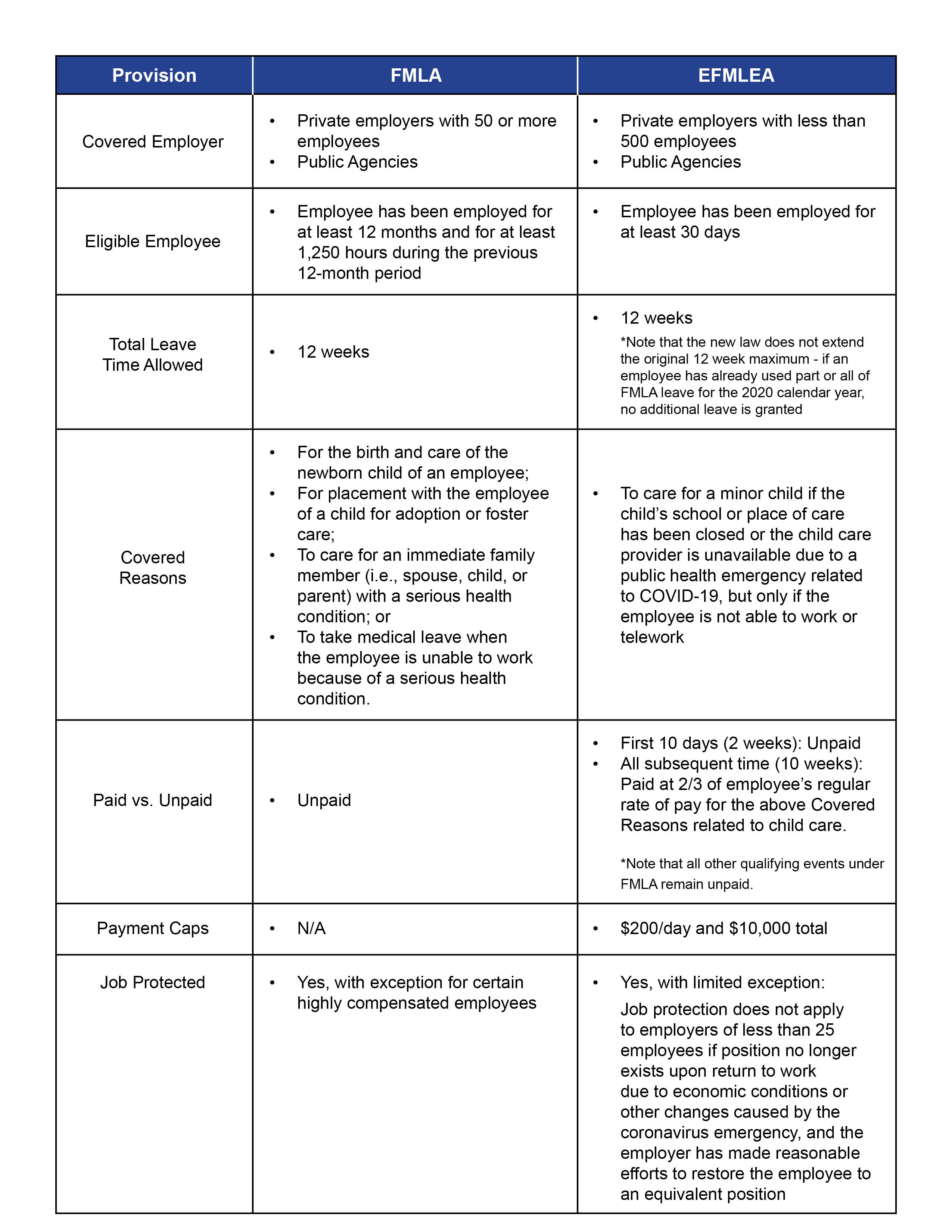
Here is a breakdown of how the provisions of the Emergency Family and Medical Leave Expansion Act (“EFMLEA”) — which applies only for leave taken to care for a minor child whose school or place of care is closed due to COVID-19 — compares to the original FMLA:

We have previously discussed the paid leave portion of the bill, known as the Emergency Paid Sick Leave Act, in a prior post here.

The key provisions of that Act provide 80 hours of paid sick leave for full-time employees (or pro-rata for part-time employees) for coronavirus-related reasons but limits the conditions in which leave can be taken and caps the daily and total amount of compensation. As noted in our prior post, under Division E of the revised bill, employers must provide paid sick leave if the employee is unable to work, or telework, if the employee:
  • Is subject to federal, state or local quarantine or isolation order;
  • Has been advised by a healthcare provider to self-quarantine;
  • Is experiencing symptoms of COVID-19;
  • Is caring for a quarantined individual;
  • Is caring for a minor child whose school or place of care has been closed due to COVID-19; or
  • Is experiencing any other substantially similar condition related to COVID-19.

Note that unlike the EFMLEA, there is no minimum 30-day requirement to be eligible for the paid leave.

For more information on the Emergency Family and Medical Leave Expansion Act and the Emergency Paid Sick Leave Act, visit our Coronavirus Resource Page.

Photo of Gabriel Jiran Gabriel Jiran

Gabriel Jiran is a partner in Shipman’s Employment and Labor Practice Group. Gabriel practices labor and employment law on behalf of corporations and public employers. He assists employers in addressing the full spectrum of issues associated with the employment relationship. He negotiates collective…

Gabriel Jiran is a partner in Shipman’s Employment and Labor Practice Group. Gabriel practices labor and employment law on behalf of corporations and public employers. He assists employers in addressing the full spectrum of issues associated with the employment relationship. He negotiates collective bargaining agreements, and frequently represents employers before administrative agencies and courts in labor disputes. Gabriel also litigates employment disputes on behalf of employers.

Read more about Gabriel JiranEmail
Show more Show less
Photo of Jarad M. Lucan Jarad M. Lucan

Jarad is co-chair of Shipman’s Labor, Employment and Education Department, where he practices on behalf of both public and private sector clients.  Jarad has successfully represented employers in grievance arbitration matters, prohibited practice proceedings before the State Board of Labor Relations, and unfair…

Jarad is co-chair of Shipman’s Labor, Employment and Education Department, where he practices on behalf of both public and private sector clients.  Jarad has successfully represented employers in grievance arbitration matters, prohibited practice proceedings before the State Board of Labor Relations, and unfair labor practice proceedings before the National Labor Relations Board.  He has also represented employers in cases involving claims of discrimination and retaliation before the Commission on Human Rights and Opportunities, the Equal Employment Opportunity Commission and State and Federal Courts.

Read more about Jarad M. LucanEmail
Show more Show less
Photo of Daniel Schwartz Daniel Schwartz

Dan represents employers in various employment law matters such as employment discrimination, restrictive covenants, human resources, retaliation and whistle blowing, and wage and hour issues. He has extensive trial and litigation experience in both federal and state courts in a variety of areas…

Dan represents employers in various employment law matters such as employment discrimination, restrictive covenants, human resources, retaliation and whistle blowing, and wage and hour issues. He has extensive trial and litigation experience in both federal and state courts in a variety of areas, including commercial litigation and trade secret enforcement. Dan is the author of the independent Connecticut Employment Law Blog. The blog discusses new and noteworthy events in labor and employment law on a daily basis.

Read more about Daniel SchwartzEmailDaniel's Linkedin ProfileDaniel's Twitter Profile
Show more Show less
Photo of Sarah A. Westby Sarah A. Westby

Sarah is the Chair of Shipman’s Cannabis Industry Team and a Partner in our Employment and Labor Practice Group. She advises clients on formation and management of a cannabis business, interpretation of state and federal cannabis laws and regulations, social equity qualifications and…

Sarah is the Chair of Shipman’s Cannabis Industry Team and a Partner in our Employment and Labor Practice Group. She advises clients on formation and management of a cannabis business, interpretation of state and federal cannabis laws and regulations, social equity qualifications and partnerships, business-related disputes, employment matters and contracts. Sarah also counsels clients on a wide variety of employment matters, including discrimination, medical leave, sexual harassment, compensation, termination, severance, and workplace safety.  She has significant experience litigating cases in state and federal court and before administrative agencies.  Sarah also serves as the Vice Chair of the Board of Directors for Simply Smiles, Inc., a not-for-profit organization that builds villages of foster homes for Native children in the United States and Mexico.

Read more about Sarah A. WestbyEmail
Show more Show less
  • Posted in:
    Employment & Labor
  • Blog:
    Employment Law Letter
  • Organization:
    Shipman & Goodwin LLP
  • Article: View Original Source

Call us at 1-800-913-0988 or email sales@lexblog.com.

Facebook LinkedIn Twitter RSS
The Library at LexBlog
  • About LexBlog
  • The Field We Built
  • Library at LexBlog
  • Our Beliefs
  • Our Team
  • Contact LexBlog
  • Disclaimer
  • Editorial Policy
  • Terms of Service
  • Get Started
  • Publishing Solutions
  • Compass
  • Submit a Request
  • Support Center
  • System Status
Copyright © 2026, LexBlog, Inc. All Rights Reserved.
Law blog design & platform by LexBlog LexBlog Logo